

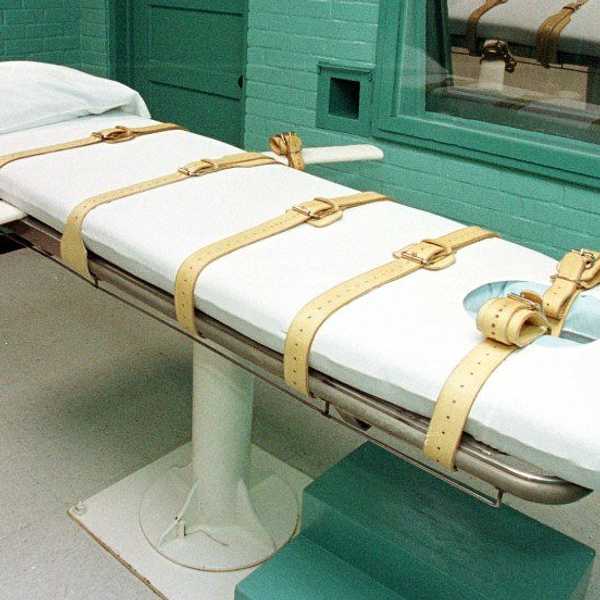

The death penalty has been a favorite topic of debate since it was brought to America in the early 17th century. It deserves this popularity; you’d be hard-pressed to find something more controversial than legal killing as punishment for illegal killing.
We’ve all heard the news stories of terrible tragedies featuring troubled teenagers who try to quell their anger and confusion by opening fire in crowded movie theaters, or psychotic men whose houses are found with bodies of countless dead children. As absolutely horrific as some of these crimes are, who is to say which exact offenses are punishable by death, if at all?
Not us.
In most debates of this topic, the biggest issue at hand is morality. The problem with using morality (or lack thereof) as an arguing point for or against capital punishment is that everyone has different morals. People believe what they believe, and that will never change. However, people cannot ignore hardcore facts.
So here are the facts.
The legality of capital punishment does not deter crime. The old-fashioned stigma of the death penalty was that its mere existence and/or utilization would prevent horrific crimes from taking place; ultimately, it was used as a scare tactic. However, in this day and age, it is no longer realistic to conclude that people will withhold from committing a crime due to the looming and unlikely possibility of punishment by death. In fact, states without the death penalty actually have lower murder rates than those who still utilize it. This difference was by 44 percent at its peak in 1996, and every year since 1990 murder rates in death penalty states have been significantly higher. The South collectively has the highest murder rate in the country and accounts for over 80 percent of national executions, while the Northeast has the lowest murder rate of the regions with less than one percent of executions. Humans do bad things. They always have and they always will, and the existence of a drastic punishment, even death, does not change that. Since there is zero evidence to support capital punishment in lowering crime rates, there is no reason to continue upholding a policy that is virtually ineffective.
The system is not fair. On the contrary, it is racially motivated and gives the wealthy a significant advantage. Historically, capital punishment was used as a tool of white supremacy. While today’s circumstances regarding racial inequality are not as severe, racism is still an issue in America and is therefore extremely relevant to this debate. In cases resulting in death sentences this past year, 75 percent of murder victims were white even though nationally only 50 percent of murder victims are white. In the state of California, defendants who kill whites are three times more likely to receive death sentences than those who kill blacks and four times more likely for Latinos. Thus, the interracial murder ratio is significantly skewed. There have only been 31 executions of a white defendant with a black victim but 294 of black defendants with white victims. Based on these statistics, the conclusion can be made that juries and judges are unable to objectively convict defendants, creating a corrupt system in which the color of one’s skin is relevant to the question of his/her life or death. In an era where social equality is an increasingly important issue at hand, this is something that should be addressed. Regarding social class, good defense lawyers are very expensive. Using this logic, the more money one has to spend, the better lawyer he/she can hire and the more likely that lawyer is to win the case and prevent that person from receiving a death sentence. A morbidly true quote in this field goes, “Those without the capital get the punishment.” It is not humane to let peoples’ ethnicities or social statuses determine whether they should live or die, regardless of the crime committed.
The system is not always accurate or dependable. Since reinstatement of the death penalty in 1976 (it was deemed unconstitutional in 1972), there have been 138 people released from death row after being found innocent. Some were exonerated just moments before execution. While that might not seem like an exceedingly large number, think about it this way. There have been a national total of 1,413 executions since 1976. So, nearly one tenth of those inmates could have been potentially innocent (138/1,413). Sorry for all the math, but I promise it makes sense. That's not a very promising proportion. Still doesn’t bother you? Here’s another way to look at it. Say someone you love somehow ends up on death row. There is virtually a 10 percent chance that he/she was wrongly convicted. Yeah, that's what I thought. Furthermore, even if someone is sentenced to death, the chance that he/she will actually be executed by the state rather than die in prison are slim to none due to the extreme inefficiency of the system. There are between 15,000 and 17,000 homicides every year, yet there is an average of only 120 people sentenced to death per year. This is less than 1 percent of the annual murderer population. Currently California has 750 death row inmates, but there have been only three executions there in past 10 years. Following that trend, the vast majority of those 750 inmates will die waiting for their execution, so what's the point of even giving them the death penalty?
It’s too damn expensive. This is probably the strongest argument against capital punishment, and the easiest to defend because the numbers are so staggering. It's as simple as this: contrary to popular belief (this blew my mind too), it is more expensive to see a death conviction through to execution than it is to keep an inmate alive in prison for the rest of his/her life. Lifelong incarceration costs are, in fact, minimal compared to the complex double trial and lawsuit required for death sentence cases. The cheaper option by far is a life sentence without parole. In Florida, seeing a death conviction through execution costs six times more than a life sentence. The national average for that same correlation is eight times more. In California since 1978, the total cost of the death penalty (including trials, appeals, and incarceration of death row patients) is over four billion dollars; in Texas a death penalty case costs three times more than imprisoning someone in a single cell at highest security for over 40 years. If nothing else can convince you of the disadvantages of capital punishment, let it be this. One thing every American can agree upon is that as a country we are struggling economically, which is why the government should stop wasting billions of dollars on this outdated feature of the judicial system.
And just as a bonus, if you want to talk about morals…it’s morally wrong. One out of every tenth person executed since 1976 has been diagnosed as mentally ill, proving there is no mercy shown for those who aren’t in the right states of mind and clearly need professional help. Furthermore, by upholding the death penalty’s legality, America is in bad company. The vast majority of Western Europe as well as most developed countries (117 nations worldwide) have abolished capital punishment. Instead of following the lead of these fellow developed countries, we continue to utilize it and therefore become associated with Iraq, Iran, China, and other countries notorious for lacking human rights. As a nation, we should not want to be able to compare ourselves to some of these countries in any respect.
And those were the facts. That, my friends, is why capital punishment in the United States should be abolished. If you agree with me, great, if not, that's okay. Everyone has their own opinions. I'm just here to share mine and maybe change a few minds if I'm lucky.

















