
During college, I’ve been fortunate enough to work with some refugee children in the United States. Through a program called America Reads, I’ve travelled around the Fargo-Moorhead area in order to provide tutoring services for elementary students. Easily, some of my best experiences have been working with English language learners (ELL). They tell me stories about their homes in Iraq, Sudan and Nepal. They all miss their old lives, but their parents seem much happier in the U.S.
The parents—that’s a topic that I’ve put less consideration into than it deserves. What happens to the people who pick up their entire lives—their children’s budding lives—and try to make a fresh start? In reality, the language barrier for adults is much more intimidating than it is for children. Children are still developing and making mistakes even through learning their native tongue. Adults, however, have had years of development already ingrained into their palates.
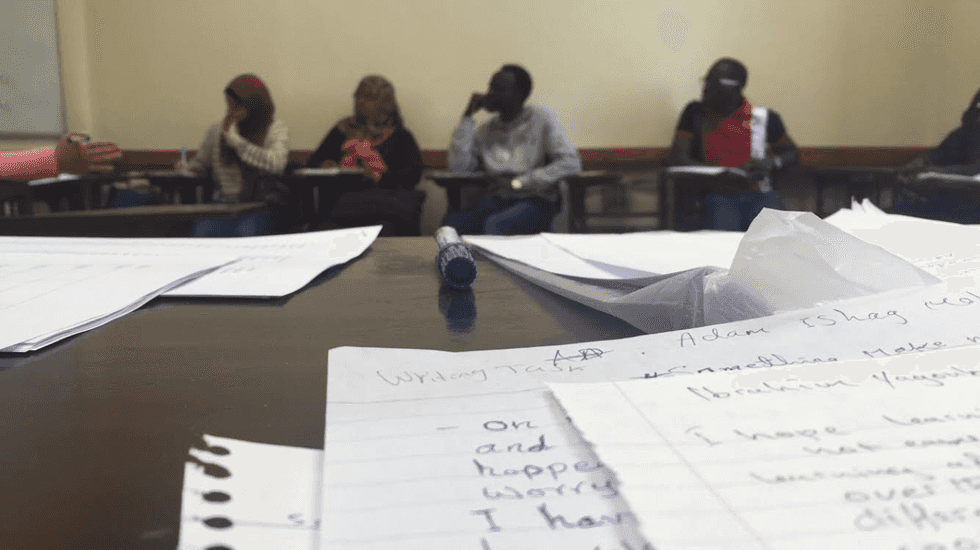
Student Action for Refugees (STAR) gives other students and me at the American University in Cairo the opportunity to work with adult refugees on a weekly basis to improve their English. I was paired with seven students from a variety of places—mostly Sudan—in order to help them reach their ending stages of STAR. One of my students has the admirable goal of teaching her son English as he grows up. Some of them tell me that they want to learn English in order to gain citizenship, and others merely have the desire to be able to more effectively communicate with an international language. Whatever their motivation, I’ve found that my students take time out of their busy lives to work to become more involved global citizens.
I once assigned them homework to write a few paragraphs about something that made them happy. The mother mentioned earlier wrote, “When I will have a lot of money to donate to poor families to help their children study in school, I will be very happy.” Even when I assigned my students homework about themselves, they all returned selfless thoughts aimed at improving the lives of other people. Each week, my students ceaselessly impress me with their compassionate attitudes permeating through their work, all while striving to improve their English skills.
During our classes, I often take a step back to examine how much they’ve all improved in the short time that I’ve known them. As many of them are older, with more life experience, and more education than I will ever have, I hope they realize how much I learn from them each time we meet. One of my college-aged student’s favorite activities is riding horses; I used this as a practice example one day. We all laughed as we realized the word “gallop” sounds almost the exact same as the Sudanese-Arabic word that describes how a horse runs. It’s these poignant instances of language similarities and real human compassion that inspire my students and me to together become more responsibly engaged in the world.