
This is probably one of the most frequent questions that I am asked, especially since I go to Carnegie Mellon, a largely technical school with a good arts program randomly tossed in there. Despite that, I am glad that I study linguistics here because what people don’t realize is that linguistics fits in nicely with computer science or even math, because linguistics is also a science.
Linguistics is the scientific study of human language. Unlike foreign language or English classes, linguistics classes usually focus on studying the general idea of language, rather than one language in particular. Like any other science class, the work for a linguistics class is primarily in the form of problem sets, tests, and lab-report-style essays, rather than in reading novels and literary essays. Actually studying languages takes up very little time in the life of a linguistics major (only two language courses are required for the major at my school). Therefore, studying linguistics does not actually guarantee that a person is fluent in multiple languages. Instead, we take dedicated linguistics courses that focus on language in a more theoretical sense. No, language is not just totally random and, yes, it does follow studiable patterns. There is a certain degree of randomness and unpredictability in language, but isn’t that also true when applying physics, chemistry, or any other science to the real world?
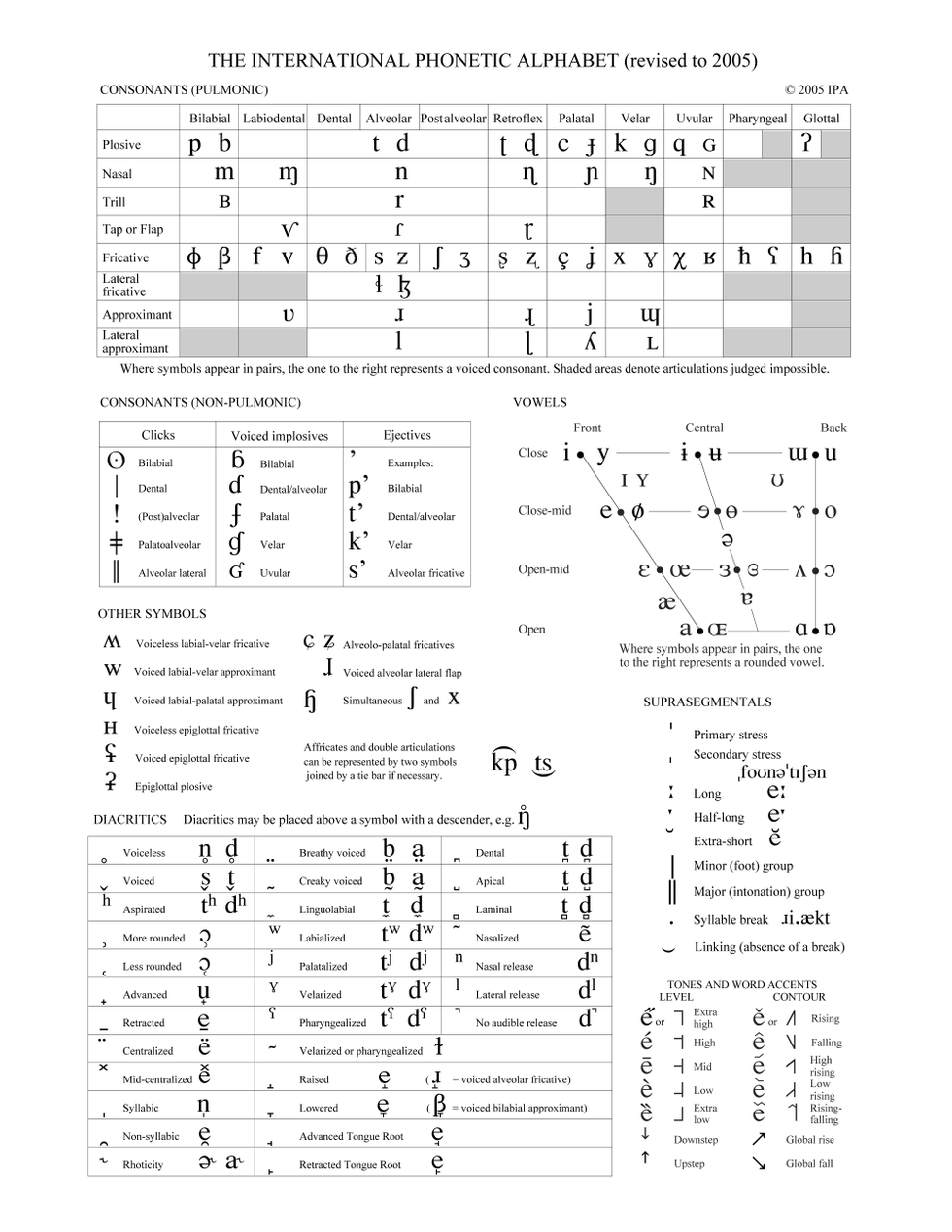
There are six main areas of study and research in linguistics: phonetics/phonology, morphology, syntax, semantics, historical linguistics, and sociolinguistics. Phonetics and phonology deal with sounds and sound systems. Linguists have developed an alphabet (called the International Phonetic Alphabet or IPA) that is based on pronunciation so that each written character has a single specific phonetic realization. To even more concretely pin down which sounds are which, the sounds are categorized based on the physical mechanics of producing the sound—for consonants: where the tongue is placed in the mouth (for instance, in making a /t/* sound, the speaker puts their tongue on the bumpy ridge on the roof of the mouth just behind the teeth), the manner in which the sound is made (compare a /t/ sound, where the air flow is completely blocked by the tongue and then suddenly released, to a /s/* sound, where the air is consistently constrained but never fully blocked), and the voicing of the sound (compare the voiceless /s/, where the vocal folds are not vibrated, to the voiced /z/*, where they are). Each language has its own system of grouping sounds such that some sounds are considered variations on other sounds and not their own separate sounds, but these groupings differ from language to language. For instance, in English, /p/ and /b/ are considered two separate sounds, since there exist words such as “bat” and “pat,” whose only phonetic difference is in the sounds /p/ and /b/, but in Arabic, /p/ is considered to be a variation of /b/. There are words such as the Arabic word for Pittsburgh, where the "p" sound in the word can be pronounced /p/ or /b/ without sounding strange either way or changing the meaning of the word.
Morphology focuses on the minimal units of sound that have meaning (called morphemes). There are two different types of morphemes: bound and free. Bound morphemes can only occur in words when attached to other morphemes, while free morphemes can occur by themselves as independent words. So, for instance, the word "irregularity" has three morphemes: ir-regular-ity, where "ir-" and "-ity" are bound morphemes and "regular" is a free morpheme. In English and other Indo-European languages, words are primarily formed by sticking (or concatenating, as is the technical term) morphemes together one at a time, but there are also many other methods that languages use to form words, such as the templatic system that Hebrew and Arabic use for verbs. In that system, there are triconsonantal roots that correspond to particular verbs. Inserting different sets of vowels between those consonants changes the tense, person, or number of the verb. One thing from morphology that I thought was super cool was how the word “undoable” has the two different meanings of “able to be undone” and “not able to be done.” The semantic ambiguity of this word is due to a structural ambiguity: since "un-" can be combined with a verb or an adjective, "un-" and "do" can be combined first (to form the first meaning, undo-able) or "do" and "-able" can be combined first (to form the second meaning, un-doable). “Undoable” having two meanings is no coincidence. It's a nice example of how language is not just completely random and does, in fact, follow some analyzable patterns.
I have not yet taken a dedicated syntax, semantics, or sociolinguistics course, but I can tell you that syntax is the study of sentence structure and it is a formal study of what is commonly known as grammar. Sentences are formed in much the same manner as concatenated words—one word is added on at a time and certain words cannot occur without certain other words (for instance, “the” cannot occur alone in a sentence without an accompanying noun). Semantics is the study of meaning and it is actually supposed to be very rigorous and mathematical. Semanticians use the same logical symbols that are used in mathematical proofs and think of the meanings of words like sets in math. Sociolinguistics looks at how linguistic patterns correspond to social patterns such as race, gender, and socioeconomic class. Sociolinguists make use of all of the other fields of study to see a bigger picture.
Similarly, historical linguistics is the study of language and dialect change. Language change seems to be one of the greatest sources of annoyance to humans everywhere. I am currently taking a historical linguistics course and it seems that with every definition of a common language change pattern that our textbook mentions, it also mentions how some generation of people was discomforted by the fact that that change was happening to their language. The ancient Romans claimed that their language was being degraded by becoming French, Spanish, and the other romance languages. Johnathan Swift mourned the fact that the youth no longer spoke like Shakespeare. Nevertheless, their languages continued to change. Language change is a natural phenomenon that should not be seen as degradation or laziness. Languages do tend to change to become simpler (for instance, the word “knife” used to actually have a /k/ sound at the beginning as in the spelling, but over time it was deleted because pronouncing two such different sounds next to each other is physically difficult), but they also tend to change to become clearer (for instance, the diphthong in “rider” was lengthened to differentiate it from the similar-sounding “writer”). Hating changes in language does nothing to prevent it. Someday, even our modern-day English will sound old fashioned and eventually die out and there is nothing that anyone can do to change that fact.
Linguists are language scientists. We observe patterns, collect data, produce theories, and perform experiments. Linguists may study human behavior, but we do so by using scientific methods. Therefore, linguistics should be respected as a science and not just lumped in with the humanities. As a math person who is trapped in a language person’s body, I am glad that I study linguistics at Carnegie Mellon because I can seamlessly combine my language studies with more technical fields.
___
*All the IPA symbols I use here are generally equivalent to their logical written English counterparts, so /t/ is the sound at the beginning of "tea," /s/ is the sound at the beginning of "sit," and /z/ is the sound at the beginning of "zip."