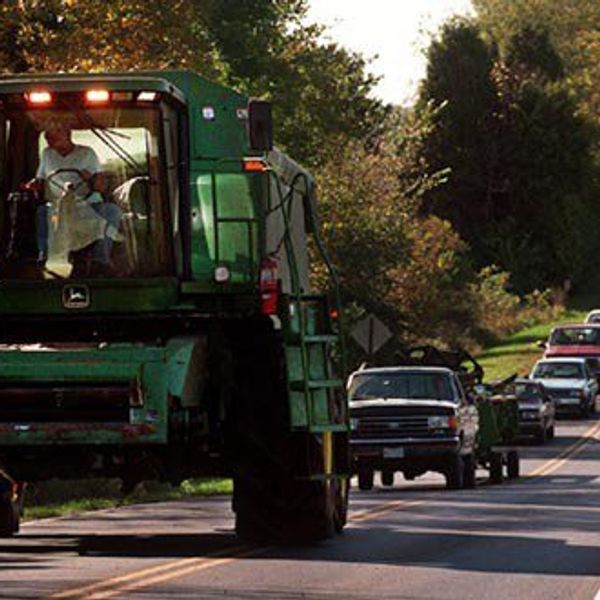

Imagine this: You're behind a big tractor on a narrow road and you can't quite pass him. If you live anywhere that has the least bit of farming, I'm sure it's happened to you before. In the tractor seat is the dirt-covered, boot wearing, t-shirt clad farmer who seems to be taking his sweet time and hogging what you probably perceive to be your road. The next time this happens to you, I want you to take a deep breath and appreciate the work that the man is doing.
Agriculture is the backbone of the America. In 2013, $835 billion dollars in gross domestic product came from agriculture. The direct output of American farms alone was 177.2 billion of that $853 billion. All of the food that you consume comes from this person and people just like him. All of the clothes that you wear are on your body because of farmers worldwide. Even things that you don't even realize are products of agriculture: tires, gas, batteries, pharmaceuticals, Windex, toothpaste, matches, and hundreds more.
Contrary to a common misconception of looming factory farms that many people imagine, 97% of farms in the U.S. are family owned. That's right, they aren't giant evil corporations with nameless board members. They are just like you and me--they're people. Sure, farms vary in size, but many are owned by families and passed down from generation to generation. Sadly, farmland is decreasing in size rapidly. Urban sprawl and development are increasing in the United States. Farmers are having to make due with less and less land while still being able to grow more and more food.
How do farmers do this? Improved technology, sustainable agriculture, and genetically modified organisms. That's right, GMO's are a part of the solution to solving the growing population conundrum. To feed the exponentially growing population, farmers cannot stick to the old ways. Agriculture, just like every other industry, will adapt and evolve. GMO's are the logical next step in agriculture, and its time that the public stop making outlandish claims and do hard research.
There has never been a case of an illness or injury due to a GMO. People claim that messing with the gene's of an animal or crop is gross or unnatural. Actually, the strawberry that we know today was never found naturally in nature. It was a direct result of human genetic modification. There really is nothing to fear. Genetically modified plants oftentimes require less water, fewer pesticides, and reduce soil erosion. They also have elevated levels of vitamins and better shelf lives.
But we still sit down at a table three times a day and expect to have food in front of us. When the world population reaches never-before-seen numbers in 2050, everyone is still going to have to eat. If you appreciate having three square meals a day packed with proteins and nutrients, you should be thankful for genetically modified organisms, and moreover, farmers. Because these families dedicate their lives to this pursuit, we're able to live with food security and peace of mind.
The next time you're behind a tractor, instead of impatiently honking your horn, thank a farmer.