

Many Greek organizations are founded under the principals of leadership, scholarship, intellectual growth, and lifelong friendship. An individual in the Greek community is held to the standards of their specific organization, and expected to uphold themselves to those values. Given the stereotype that sororities and fraternities have often been subjected to, it's not hard to believe that people outside of the Greek community have a hard time understanding what we do as an organization, why it's important and how much Greek life actually impacts the university as a whole. Going Greek is deeply rewarding, and beneficial on individual basis. However, regardless of one's affiliation to the Greek community, it is and always will be an important part of your college campus. Here's why:
1. Community service
Philanthropy is the foundation of Greek life.
Members are encouraged to engage in positive activities throughout
the community to educate, and serve others. Philanthropic efforts
are specific to the chapter. For example, Pi Beta Phi's philanthropy
is Literacy. This means that Pi Phi women across the country work
together to create a more literate and productive society.
Philanthropy dinners are held all the time to raise money and
awareness for such initiatives. The sisters of Delta Delta Delta dedicate themselves to the St. Jude children's research hospital. According to www.tridelta.org,
They have raised over $38 million for the cause and have donated
thousands of hours of service. Alpha Xi Delta raises awareness for
autism, Alpha Omicron Pi rises against domestic violence and the
gentleman of Sigma Phi Epsilon have partnered with Big Brothers Big
Sisters of America, to give members the opportunity to make a
positive influence on young men everywhere. These are simply a few
of hundreds of Greek organizations that are making a positive
difference every single day, to our community and to our nation.
2. Alumni contribution
Greek life is a lifelong commitment.
Graduating an institution does not mean the end of one's
opportunities or membership. Greek alumni across the nation are
constantly recognizing and contributing to their undergraduate
chapters, and beloved alma mater. As mentioned previously, giving
back to the community is well instilled trait and the alumni don't
hesitate to uphold that commitment, even after they've graduated.
3. Encourages involvement throughout campus
I think I can speak for most people when I say the first week of
one's freshman year of college is the by far the most overwhelming,
exciting, and straight up intimidating. Walking through the student
fair, skimming through all the potential organizations is certainly
a whirlwind. If you're anything like me, you eagerly gave your email
to 97 percent of the people who approached you and went back to your dorm
with a plethora of information, while telling yourself you'd do it
all. For me, that plan failed miserably. Realistically, I couldn’t
be a part of every single club I found interesting. However, I followed through with at least ONE of the commitments I made. I
found myself rushing the perfect sorority and becoming more
involved than I ever thought I could be. My pledge sister, Ellie
Roselle, said it perfectly when I asked her how Greek life
encouraged her overall campus involvement. “I looked up to the
people who led large organizations, so I did as much as I could to
mimic their work ethic and commitment. Which, in turn, got me more
involved. It becomes addicting to have a full schedule of activities
and philanthropy events every week.” I couldn't agree more, Ellie!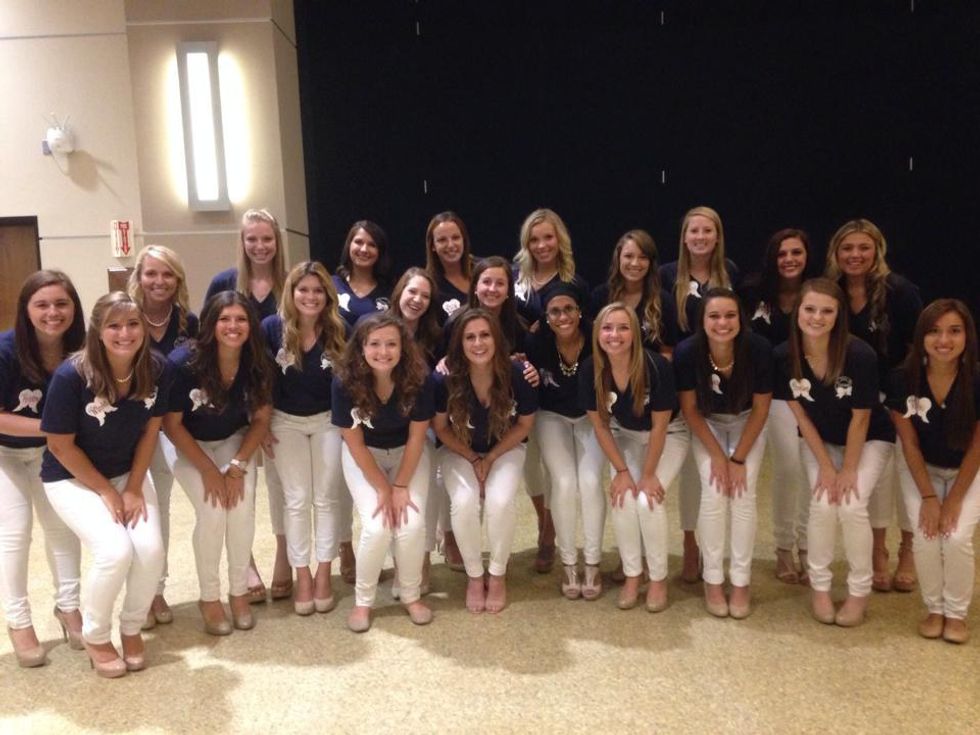
4. Traditions
Greek
life contributes to many
traditions across a college campus. Some events specific to my
university, The University of Toledo, include: Songfest,
“UT’s second oldest standing tradition, began in spring of 1937
with a group of six fraternities singing old college songs on the
lawn behind University Hall.” Since then, Songfest has continued
to expand and prosper, becoming an exciting and well-attended
production. It is an awesome event that gets students involved in
tradition, while engaging “in a little friendly competition.”
Though the most important reason behind this event is the
philanthropic mission attached to it. Another well recognized and
oldest standing tradition is homecoming. A week filled with
traditions such as pep rallies, concerts, parade, king and queen
contest and of course the game. Homecoming week unites past,
present, and future rockets, bringing Toledo together as a
community. During this exciting time, each sorority pairs up with a fraternity to build a creative and interactive float, corresponding
to the homecoming theme. These floats are then showcased at the
parade and the Greek team with the most tantalizing display, is
awarded a trophy. The Greek community also makes a significant
effort to attend and contribute to events like Rockethon and Relay
For Life, which are a few more important traditions carried out
among students and faculty at the University of Toledo.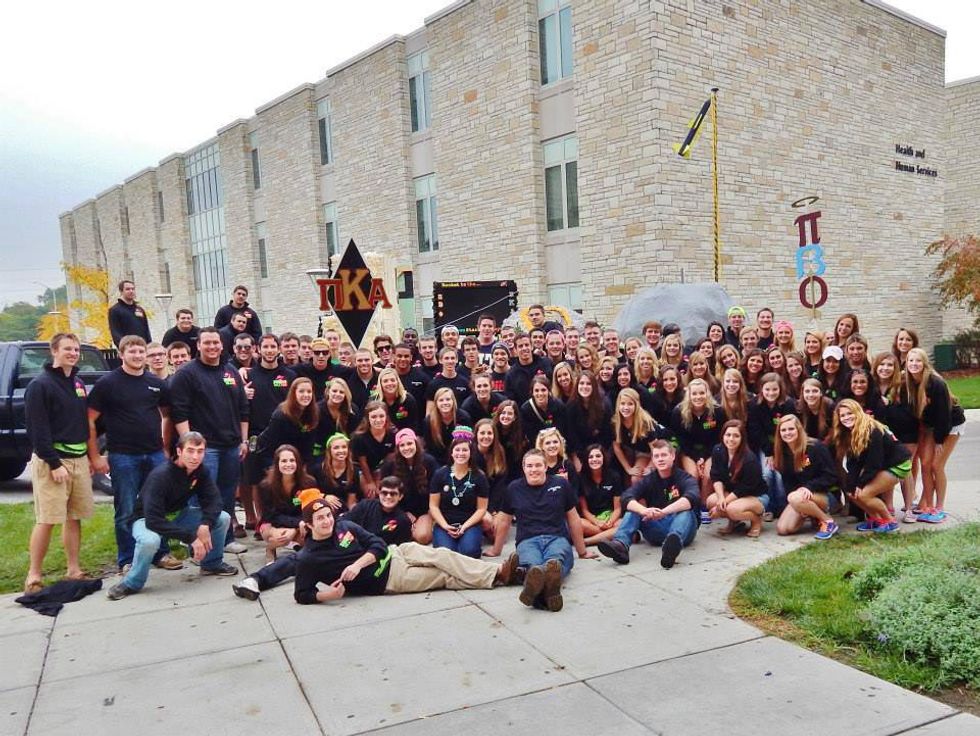
5. Academics/retention rate
Membership in a
sorority or fraternity is contingent on academic
achievement. To join and stay in your desired chapter, you are required to maintain a specific GPA. Adhering to this
responsibility may seem difficult, however, you're not the only
person who has to demonstrate high scholarship, the whole chapter
does! Surrounding yourself with people who are committed to school
work and academics makes the desire to succeed that much greater.
Success
is defined on an individual basis, so I
am not saying that non-Greek students are less likely to succeed,
because that is far from the truth. Members of the Greek community
are constantly held responsible for their academic performance,
which in turn has shown a positive reflux between success and Greek
life. In an article published by USA Today, Nicole Glass wrote
“85%
of Fortune 500 executives were part of Greek life. The first female
astronaut was Greek. So was the first female senator. And college
graduation rates are 20% higher among Greeks than non-Greeks.”
Greek life has proven to provide many positive avenues for students and the requirement to maintain good academic standing with the
university is just another factor that supports the benefits of
Greek life.
6. Loneliness/Depression
While
one individual's mental stability may not have the power to affect
your campus as a whole, it does speak to a common issue that many
incoming freshman experience during their transition into college.
College is intimidating in itself, a new environment, unfamiliar
settings and a brand new sense of independence and freedom. This
combination of things can cause a wide spectrum of emotions.
Personally, I found the transition challenging. I didn't expect to
have such a hard time adapting to my new surroundings, but
unfortunately I did. I wasn't confident in myself and often
questioned my ability to succeed. While in this weird limbo of
finding my place in college, and trying to figure out who I was, I
allowed fear and doubt to creep into my experience. This in turn,
affected my performance as a new college student, and I buckled
under the overwhelming stress that came with that. It wasn't until
about a month into my experience in Pi Beta Phi, that I began to
feel like myself again. I bonded with my sisters, and found that I
wasn't the only one who felt overwhelmed by this whole college
thing. Pi Phi gave me the opportunity to connect and engage, and
that was important to me during such a vulnerable time. I became
part of a sisterhood that accepted me, loved me, and encouraged me
to be myself. Pi Phi changed my life, and it certainly turned my
college experience around. It feels good being a part of something
bigger, having a sisterhood, a family and a purpose. Going Greek was
the best decision I would’ve made for myself.
If you're someone who enjoys giving back to the community, dedicating yourself to important causes, craves the idea of leadership, intellectual growth, and life-long friendship, then maybe Greek life is for you. Despite the stereotypes, and misconceptions that taint the reputation of Greek life, we have yet to falter in the way we uphold ourselves. We will continue to live out the values we pledged too, support the sisterhood/brotherhood that we belong to and contribute to the philanthropy in which we are dedicated. That's what being Greek means and no matter what anyone says, it IS important.