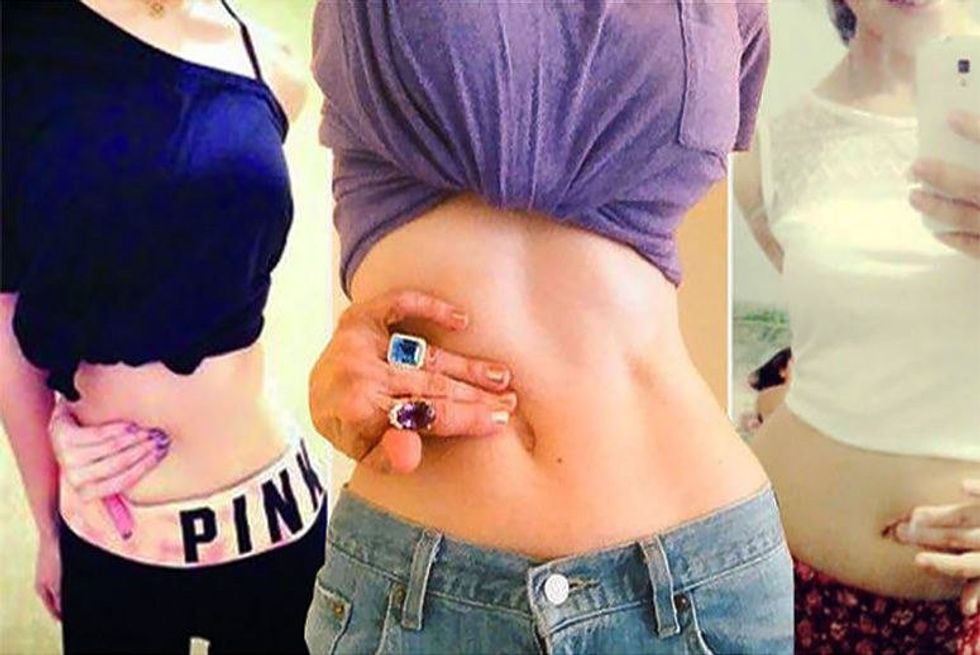
The internet trend that originated on the Chinese website "Weibo" has now made its way across the Pacific and spread like wildfire here at home. The "belly button challenge" is based on the premise that if you can't reach behind your back and touch your belly button from the other side, you're in some way unhealthy. Supposedly, failing the challenge means you're either overweight or otherwise undesirably shaped. While it may seem like another annoying but harmless fad, it is actually contributing to insane expectations and resulting body image issues that many young people today internalize from from places like social media. It sounds absurd, but people are actually believing this stuff.
Let's first squash the idea that the ability to complete the challenge reveals virtually anything about how healthy a person is. A small torso is certainly an advantage, but so are long arms and flexible shoulders. Being perfectly thin has nothing to do with your ability to contort yourself into an unnatural position. That just means you're flexible. Another problem is that America's generally accepted standard of beauty has established "skinny" as the ideal physique. Being thin enough to complete the challenge doesn't mean you're healthy, and there are plenty of people that are too "big" to complete the challenge, but are in great shape.
Apart from the obvious holes in the logic of the "belly button challenge," it perpetuates the pressure that's already put on young people to look a certain way, often in accordance with trends on social media. Claire Mysko, an expert on eating disorders, told ABC News that "Social media challenges like these can stoke comparison and body insecurity, especially for those struggling with disordered eating." These ridiculous fads are usually aimed at young women, but anyone's confidence can take a hit after failing to live up to such unrealistic standards. Some other examples are the thigh gap fixation, the "Bikini Bridge" infatuation, and, perhaps the most preposterous, the "Kylie Jenner Lip Challenge."
Possibly the most disheartening part of all this is that we bring it upon ourselves. We get sucked into the latest crazes and fall into the habit of constantly comparing ourselves to others, feeling gratified when we win and unworthy when we lose. It's hard to ignore the influence of social media, and chances are, such fads will not totally die out. But we can refuse to feed the fire by not participating and recognizing the absurdity. Whether or not you can touch your belly button from the opposite side is not worth your concern. Instead, use social media to encourage positive things like exercise and good diets, and inspire people to be healthy rather than trick them with how lanky you are.