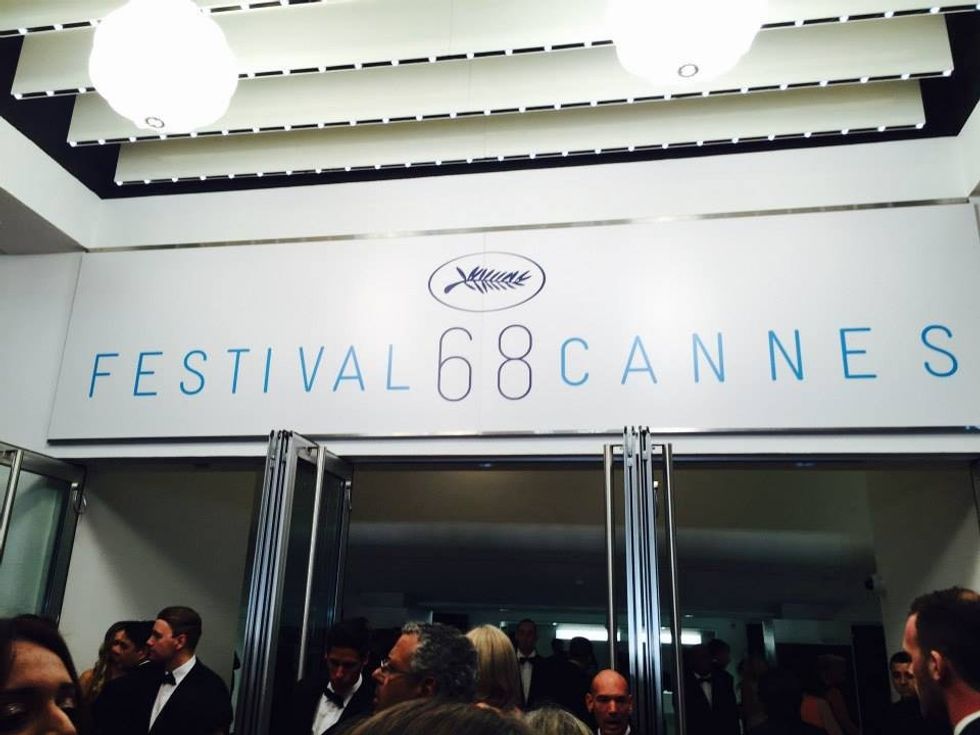
Over two weeks have passed since the Palm D’Or was awarded to French director Jacques Audiard for his film Dheepan, ample time for a still wide-eyed, first-time festivalgoer to reflect upon the films that were screened this year at the 68th Cannes Film Festival. While it’s now no secret which films were honored with which awards, how good were the films actually, in the eyes of a simple lover of film and someone who is unbiased by industry politics (read: me)? Having watched 30 films throughout the duration of the festival, here is my verdict:
**Disclaimer: I only ranked the films that I watched, and unfortunately, I did not have the opportunity to watch all of the films in the Official Competition or the Un Certain Regard Competition.**
1. "Sicario" – Director: Denis Villeneuve
Starring Hollywood big names, including Emily Blunt and Josh Brolin, Sicario is not a typical festival film, particularly not at the Cannes Film Festival. Some may argue that it’s too commercially viable; the film is already set for a September wide release here in the United States. Yet, as a lover of all action and spy films in particular, Sicario was perhaps the closest to what I would consider my preferred type of film experience. Plus, unlike similar films, Blunt plays protagonist Kate Macy, a police officer in pursuit of a Mexican drug lord, and it is especially rare to see multi-dimensional female characters in any film, let alone an action thriller.
2. "Maryland (Disorder)" – Director: Alice Winocour
A French drama/thriller, Maryland (Disorder) stars Matthias Schoenaerts as Vincent, a war-veteran-turned-security-guard, and Diane Kruger as Jessie, the wife of Vincent’s client, an owner of an expansive estate named Maryland. Essentially a stylized home-invasion film, what makes it one of my top-ranked films of the festival is its sound editing and musical selections. Pounding beats serve as the backdrop to protagonist Vincent’s paranoia, and as another festival movie-goer mentioned, this allows the film to be reminiscent of a French version of Drive (featuring Ryan Gosling).
3. "Dheepan" – Director: Jacques Audiard
Admittedly, I am a fan of Audiard, who has now become what seems to be a fixture at the Cannes Film Festival, having previously won the Grand Prix at Cannes for Un Prophète (A Prophet) in 2009. Like Un Prophète, Dheepan also focuses on the gritty, criminal world of France through the eyes of ethnic minorities, this time featuring a trio of illegal Sri Lankan immigrants in Paris who start out as a fake family but ultimately band together to face adversity. While the film mainly focuses on Dheepan, the film’s namesake and protagonist, what makes it particularly engaging is its simultaneous focus on Yalini, a woman who poses as Dheepan’s wife, and Illayaal, a young girl who poses as Dheepan’s daughter, as they face their own challenges.
4. "The Lobster" – Director: Yorgos Lanthimos
The Lobster stars Colin Farrel and Rachel Weisz in a dystopian future where single people are put into a hotel to find a partner within a set time limit, or else be turned into an animal of their choosing. Riddled with sarcasm and jabs at modern culture (i.e. online dating), Weisz’s deadpan narration is perhaps the highlight of this festival gem, which won the Jury Prize.
5. "Mad Max: Fury Road" – Director: George Miller
Cannes would not be complete without at least one big Hollywood premiere. Mad Max: Fury Road may be named for Max, the protagonist played by Tom Hardy, but the real star is perhaps Imperator Furiosa, played by Charlize Theron. In a dystopian future where a worldwide drought has caused humanity itself to crumble, Furiosa seeks to break free from the tyranny of Immortan Joe, the leader of a colony known as the Citadel, while Max tags along for the ride. Featuring dynamic editing and extensive action sequences, this film is an ideal summer blockbuster that is entertaining, while still being unconventional enough to be screened in Cannes.
6. "Youth" – Director: Paolo Sorrentino
Also starring Rachel Weisz along with Michael Caine, Harvey Keitel, Paul Dano, and Jane Fonda, Youth tells the story of a retired orchestra conductor on vacation in Switzerland along with his best friend, a film director, and his daughter. The film playfully pokes fun at the entertainment industry and reflects upon aging and memories of the past. It is a touching film whose full emotional affect is not felt until a few moments after walking out of the theater, and it is worth a watch once it comes stateside.
7. "Mon Roi" – Director: Maïwenn
Starring Cannes heavyweights Vincent Cassel and Emmanuelle Bercot, who would go on to win the Best Actress award for her role, Mon Roi follows the passionate but often dysfunctional relationship between Georgio, a restaurateur and playboy, and Tony, a lawyer. Both Cassel and Bercot are charming in their roles, and the film offers realistic depiction of the highs and lows of a relationship not often seen in modern romance films.
8. "Macbeth" – Director: Justin Kurzel
This action-packed adaptation of the Shakespeare classic stars Michael Fassbender and Marion Cotillard in the iconic roles of Macbeth and Lady Macbeth. Visually, this is a stunning film, offering impressive hues of fiery orange and red as the backdrop of many scenes.
9. "La Tête Haute (Standing Tall)" - Director: Emmanuelle Bercot
The opening film of this year’s festival, La Tête Haute, stars newcomer Rod Paradot as Malony, a troubled French teenager in a coming of age story. Riddled with stark realism, the film serves as a powerful introduction to the festival to come. My only complaint is that the ending is too neat and slightly erodes the serious emotional buildup of earlier scenes.
10. "Mia Madre (My Mother)" – Director: Nanni Moretti
Italian film Mia Madre follows female director Margherita, who struggles to care for her hospitalized mother, as she films a movie starring American actor Barry Huggins. This film also carries an introspective vibe of the entertainment industry, occasionally poking fun at itself.
11. "O Piseu (Office)" – Director: Hong Won-Chan
This South Korean horror movie, which follows the hunt for an office manager after he murders his family, is reminiscent of American Psycho for its focus around the workplace and the pressures of a competitive job environment. It has classic Asian horror elements, but is certainly an entertaining film.
12. "Inside Out" – Director: Pete Docter
The latest Pixar film, Inside Out features voice talent from Amy Poehler, Phyllis Smith, Bill Hader, Lewis Black, and Mindy Kaling. It is a thoughtful film that is sure to please kids and adults alike. (And, like always, there is a fair share of jokes thrown in for adult/parent entertainment).
13. "Irrational Man" – Director: Woody Allen
The latest Woody Allen film stars Joaquin Phoenix as a charismatic philosophy professor and Emma Stone as the college student who begins an affair with him. Yet what begins as a typical, Allen film soon weaves in some surprising, irrational elements, as well.
14. "Il Racconto Del Racconti (Tale of Tales)" – Director: Matteo Garrone
Despite carrying an Italian title, Tale of Tales is an English-language film starring Salma Hayek, Vincent Cassel, and Toby Jones. Out of context, the fantastical stories of the film are quite bizarre, but once you realize that they are adaptations of Neopolitan poet and courtier Giambattista Basile, the film begins to make much more sense.
15. "La Loi du Marché (Measure of a Man)" – Director: Stéphane Brizé
A timely film about a French man who faces unemployment while trying to support his family, Measure of a Man stars Vincent Lindon, recipient of the festival’s Best Actor award. Perhaps what is most refreshing about this film is that although protagonist Thierry Taugourdeau’s son is disabled, his disability itself is not a major focus in the narrative.
16. "Marguerite & Julien" – Director: Valérie Donzelli
Based on a screenplay written originally for infamous French director François Truffaut, Marguerite & Julien is about an incestuous relationship between siblings. While it is unclear what exactly the message of the film is regarding incest, the film is stylistically fascinating for its time period mash-up (there are helicopters and yet the film universe seems to resemble the 1800s, too).
17. "Taklub" – Director: Brillante Mendoza
Taklub is a Filipino drama documenting the survivors of the Typhoon Haiyan. The gritty realism of the film reflects the tragedy of the disaster, yet there are sprinklings of hope, too.
18. "Amy" – Director: Asif Kapadia
This documentary traces the life of the late Amy Winehouse throughout her career, weaving together videos and interviews with her friends and family. The film allows audiences to sympathize with Winehouse and brings to light how the aggressive pressures from the intrusive media contributed to her downward cycle leading up to her death.
19. "Mu-Roe-Han (The Shameless)" – Director: Oh Seung-Uk
Modern South Korean, noir film The Shameless, has all of the elements of a genre film: a loner police officer that sometimes resorts to shady tactics, a killer on the run, and the killer’s femme fatale girlfriend. While slow-moving at times, it is an engaging modern spin on the traditional film noir construct.
20. "Las Elegidas (The Chosen Ones)" – Director: David Pablos
One of the more depressing films of the Un Certain Regard competition, The Chosen Ones uses the Mexican sex trafficking trade as its backdrop as Sofia is lured into the trade by Ulises, her boyfriend, who works for a trafficking ring. Perhaps most poignantly is the portrayal of how Sofia endures her confinement; she endures with a silent strength and a face that does not show her torment to her captors.
21. "An" – Director: Naomi Kawase
In the Japanese film An, dorayaki shop owner Sentaro reluctantly hires 76-year-old Tokue after he posts a hiring ad outside the shop. However, Tokue suffered from Hansen’s disease, or leprosy, and has disfigured hands as a result. Once the neighborhood catches wind of Tokue’s condition, business stalls. The film brings attention to how those who suffer from leprosy sometimes remain shunned by society in modern Japan.
22. "The Sea of Trees" – Director: Gus Van Sant
Perhaps best known as the film that was booed, The Sea of Trees stars Matthew McConaughey and Ken Watanabe as two men who attempt to commit suicide in Japan’s “Suicide Forest” but ultimately decide to change their minds and escape. Although it is at times slow-moving and illogically jumps between the past and present, the film is decent, and potential viewers should not be deterred merely by the fact that it was booed.
23. "A Tale of Love and Darkness" – Director: Natalie Portman
Natalie Portman both stars and directs this film adaptation of the memoir of Amos Oz about his childhood growing up in mid-1940s Israel. The film largely revolves around Oz’s mother, played by Portman, and her struggle with depression. While visually appealing, the onset of Fania Oz’s depression seemed hurried compared to the pace of the rest of the film.
24. "Nahid" – Director: Ida Panahandeh
Iranian film Nahid follows its namesake protagonist, a single mother struggling to raise her teenage son while desiring a relationship with her boyfriend, widower Mas’ood. Unfortunately, Nahid’s divorce agreement with her irresponsible ex-husband, Ahmad, forbade her to remarry or else she would lose custody of her son. The film outlines several challenges that single women, particularly post-divorce, face in Iran.
25. "Kishibe No Tabi (Journey to the Shore)" – Director: Kurosawa Kiyoshi
In the Japanese film Journey to the Shore, protagonist and window Mizuki encounters her missing husband, Yusuke, three years after his disappearance. He had died at sea, but returns in his spirit form to take Mizuki on an adventure that follows how he was able to find his way back home after death. The film explores the dynamic between the past and the present as well as issues from infidelity to depression.
26. "La Glace et Le Ciel (Ice and the Sky)" – Director:
Luc Jacquet
The closing film of the festival, Ice and the Sky documents the work of Claude Lorius, a French glaciologist who found signs of global warming as early as in the 1960s. Closing the festival with a documentary was an interesting choice, perhaps even hinting at political undertones that urge for greater awareness of climate change.
27. "Chronic" – Director: Michel Franco
The recipient of the Best Screenplay award, Chronic stars Tim Roth as David, a nurse that works with terminally ill patients. However, David’s life begins to spiral downward after a lawsuit is brought against him for making sexual advances on one of his patients. The film was critically acclaimed but is paced perhaps a bit too slowly with too abrupt of an ending.
28. "Louder Than Bombs" – Director: Joachim Trier
Told out of chronological order, Louder Than Bombs, starring Gabriel Byrne, Jesse Eisenberg, and Isabelle Huppert, is sometimes difficult to follow and often seemed lacking in terms of character development.
29. "Nie Yinniang (The Assassin)" – Director: Hou Hsiao-Hsien
Director Hou Hsiao-Hsien won the Best Director award for this film, which follows Nie Yinniang, a female assassin tasked with assassinating the emperor during the Tang Dynasty in China. Shot in a retro style, the film features expansive landscapes and stunning visuals yet crawls along plot wise. Short bursts of action intervene, but to echo many critics, it is perhaps the least assassin-y assassin movie out there.
30. "Martyrs" – Directors: Kevin and Michael Goetz
The only market film I had the chance to see, Martyrs, starring Pretty Little Liars’ Troian Bellisario and True Blood actress Bailey Noble, is a remake of a 2008 French film of the same name. While not the worst horror movie out there, it is generally unmemorable due to its arsenal of horror movie clichés.