


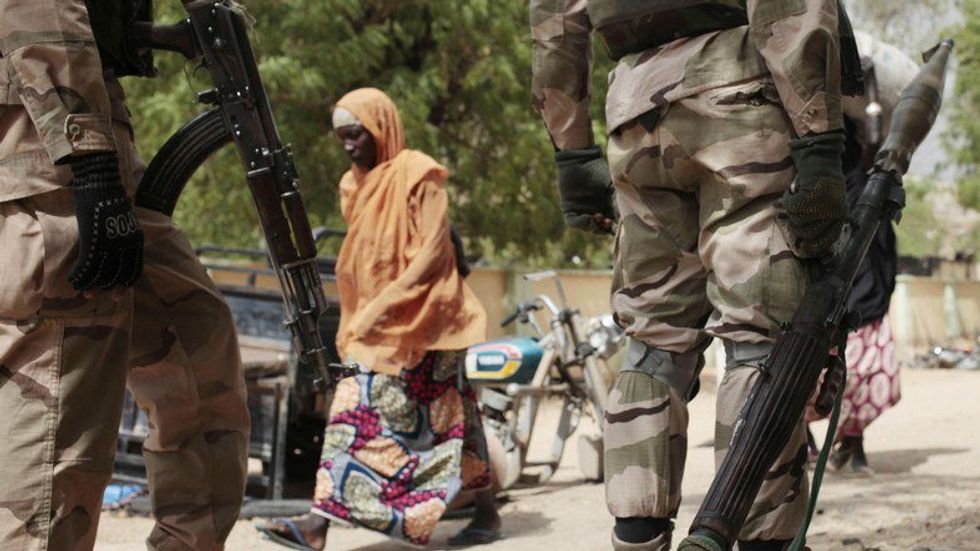
Last week, two female teenagers detonated explosives in a refugee camp in northeast Nigeria. The camp is home to tens of thousands of internally displaced people fleeing the horrors of the terrorist group Boko Haram.
One suicide bomber refused to detonate her explosive after seeing her family in the camp. She has been detained by police and has confessed that the young girls were sent by Boko Haram. Fifty-eight people died in the attacks, and more violence is rumored to come.
Boko Haram, which translates into "Western education is forbidden," is arguably the deadliest terrorist group at large right now. Their mission is to create an Islamic State in Nigeria, which is ethnically heterogeneous; the majority of the North is Muslim and the South Christian. The militant group currently controls over 30 thousand square kilometers of northeast Nigeria, where they engage in combat with government forces from Nigeria, Chad, Niger and Cameroon. Due to insufficient resources and internal corruption, government forces have been unable to overcome Boko Haram, and the terrorist group time and time again sustains its violence, even in the face of coordinated air strikes and face-to-face combat.
The group has been at large in Nigeria since the early 2000s when they carried out attacks at multiple police stations in the country. However, they first gained international notoriety when they kidnapped over 200 schoolgirls in Chibok, Nigeria in April 2014. The government has been able to find roughly 50 girls since the time of the kidnapping; the rest are believed to have been sold off in illegal slave markets or married to Boko Haram fighters. Most of the returned Chibok girls were impregnated by rape. Later stigmatized by their communities for carrying a child before marriage, many attempted abortion and died. Many of the returned girls have become pariah people in their villages: outcast, shamed and fearful.
Wars waged on civilian populations inflict massive harm on women. Sexual violence is often the left hand of domestic terrorism in places like Nigeria and Syria. Where women are not trained to defend themselves, and where cultural norms and law dictate their exclusion from the military, social mobility and personal freedom, they are victimized with a painful uniqueness.
It is often ignored that terrorist groups like Boko Haram wage an entirely independent war on women. Their plight is coalesced with the struggles of their people, and the uniqueness of the female experience gets lost in the narrative.
For more information or ways to help, check out Women for Women International and Global Fund for Children.
















