


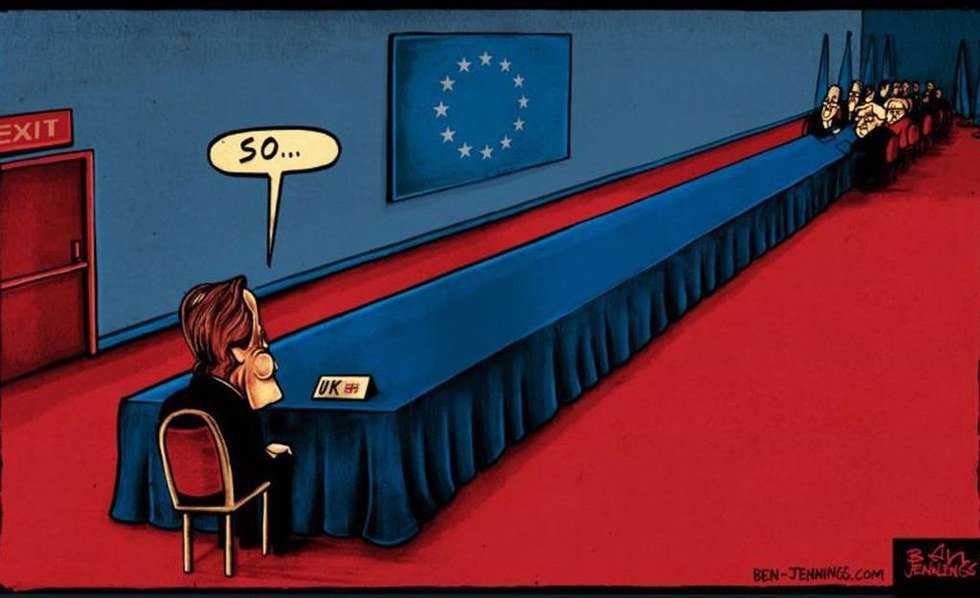
A few weeks ago, the United Kingdom voted in a historic referendum to "leave" the European Union after being a member of the supranational institution since 1973. The vote also led to the resignation of Prime Minster David Cameron, who encouraged voters to let the UK remain in the EU. There is a long history of the UK's relationship within the EU and there's many aspects to look at the UK's historic decision. In order to understand this issue and the EU in simpler terms, I'll break it down for you as best as I can.
Relationship of the United Kingdom and the European Union
Conveniently, two years ago I actually wrote a paper for one of my political science classes (since it's my major) on the UK's relationship in the EU and potentially foreshadowing events that occurred this past June. In my paper I described it as a "hesitant and/or a euro-skeptic" relationship, meaning that the UK is or was, however you wish to look at it, concerned over their national sovereignty, their trust and reliability with fellow EU Member States, their freedom as a country, and forwarding their own policy rather than someone else's. The UK had national interests in certain policy areas and sometimes locked horns with the EU policy regarding the same policy area. They exercised "opt-outs" in which the UK wouldn't be applied to EU law, since the UK preferred their own policy. An example of a policy in which the UK doesn't follow the EU would be that the UK still uses the pound sterling over the euro.
What is the European Union?
Believe it or not, "What is the European Union" was the second most searched question on Google AFTER UK citizens voted to leave it, according to the Washington Post.
https://www.washingtonpost.com/news/the-switch/wp/...
Political scientist John McCormick explained in his a book, "Understanding the European Union: A Concise Introduction", that the EU has been in existence since 1957, but as the name "European Economic Community" (5). It wasn't named the European Union until November 1993. There are 28 member states including former Soviet republics and the United Kingdom (64). Croatia was the most recent country to join in 2013 (227).
Its purpose of forming was to assure that European conflicts were to be resolved without any violence; European history has literally been written in blood with wars such as the 100 Years War, English Civil Wars, the French Revolution, World War I and World War II to name a few.
UK Voting "Leave"
The people of the United Kingdom have spoken and majority voted to leave the European Union, by a 52 percent to 48 percent margin. This would make the first EU Member State to leave the organization. The issue is that the EU has no legislation that describes the procedure of a member state leaving, so this part of the process will definitely be interesting to see how it will be addressed. This could also lead to other member states leaving if countries have second thoughts about being an EU member state.
What this means for the rest of the world
The main effects of the "Brexit", as journalists call it, towards the United States are financial/ economic. It will affect our economy because of our "special relationship" with the UK, referring to US-UK relations. It will also lead to a big political question in Europe, concerning the stability of Europe and the EU.
http://www.cnn.com/2016/06/24/politics/brexit-what...
http://www.washingtontimes.com/news/2016/jul/3/bre...
http://www.bbc.com/news/uk-politics-32810887
This article could have been much longer, but I didn't want to get into too many specifics. The EU has dealt with many problems among their member states, but the UK has been the most vocal about possibly leaving. As it turned out, they voted to do so. Now the UK will be in this negotiating period with the rest of the EU member states of how they will proceed. If you wanted to know more about what the EU is and how it was formed more specifically, John McCormick's book, "Understanding the European Union: A Concise Introduction", is a great tool to use when researching about the EU. Now that the UK has left the European Union, there is certainly a gap in European unity and integration goals; perhaps this could lead to other euro-skeptic states possibly leaving, but only time could tell that for sure.
















