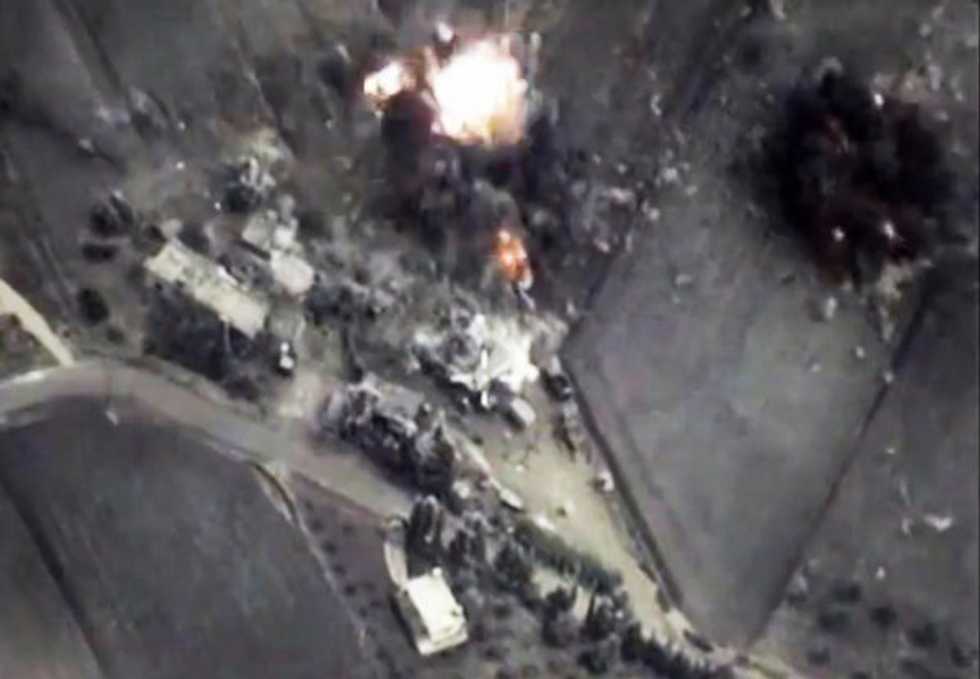
After years of sitting on the sidelines, Russia has finally intervened in the Syrian Civil War. After weeks of military buildup in the country, Russia began an air campaign in the country Wednesday morning. While nominally directed against the Islamic State and their allies, Russian strikes have instead targeted areas held by rebels against the regime of Syrian President Bashar al-Assad, a staunch Russian ally. Russia’s entrance into this conflict is a game-changer, dramatically altering the landscape of a civil war now into its fifth year.
The Syrian Civil War has become one of the most destabilizing elements in the Middle East. Now into its fifth year, the civil war is between forces loyal to the governing regime of Syrian President Bashar al-Assad and rebels, themselves split into many factions who are all at war with each other. Ranging from U.S. supported groups like the Free Syrian Army (FSA) and Kurdish YPG to the Al-Qaeda affiliate Al-Nusra Front and other Islamic extremist groups, the rebels are a fractious, disorganized entity. At war with everyone, however, is the Islamic State, or ISIS. The situation is a total quagmire, with no groups holding a distinct advantage and no possibility of peace any time soon. It has basically become a proxy war between the great powers in the region, with Saudi Arabia, Qatar, and the U.A.E. backing Sunni rebel groups, Iran backing the Assad regime and providing support from both its own troops and its Lebanese proxy Hezbollah, and the U.S. and its allies aligning firmly against both ISIS and the Assad regime. Meanwhile, Turkey has all but allied itself with ISIS by showing that it cares more about bombing Kurdish rebels fighting the Islamic State than attacking ISIS positions. Confused yet? It gets better.

Syrian President Bashar al-Assad
Beginning Wednesday morning, Russia formally entered this nightmare, beginning a bombing campaign in support of the Assad regime. A long time ally of the Syrian president, Vlamidir Putin, President of Russia, has committed weapons and vehicles to Assad since the war began, but only now has he openly committed to battlefield assistance. Over the last two weeks, Russian men and matériel have been building up at an airfield south of the city of Latakia, in Western Syria, including Marines, support personnel, artillery, and several T-90 tanks. In addition, the Russian naval base in the Syrian city of Tartus has also undergone a massive expansion, further increasing Russia’s capacity to support the Assad regime and supply its own forces in the country. On Sunday, Iraq announced that they would begin sharing intelligence on the Islamic State with Russia, Iran, and Syria, a move that caught many, including American officials, off guard.
The Russian buildup was an object of great concern during Monday’s UN General Assembly, with both Obama and Putin trading barbs over Russia’s intentions. Obama slammed Putin’s support of the Assad regime during his speech to the General Assembly, saying that “we must recognize that there cannot be, after so much bloodshed, so much carnage, a return to the pre-war status quo.” Putin, while refraining from calling out the United States by name, didn’t hold back either. Implicitly blaming the U.S. and its allies for destabilizing the region and allowing the establishment of “anarchy areas,” he called for the formation of a global coalition against terrorism, focusing on the Islamic State and its allies. Comparing his idea to “the anti-Hitler coalition” of World War II, Putin stressed the importance of backing the Assad regime, which he views as one of the only credible threats to the Islamic State in the region. “We should finally acknowledge that no one but President Assad's armed forces and Kurd militia are truly fighting the Islamic State and other terrorist organizations in Syria.” Both Obama and Putin, however, said they were willing to work together to bring about a peaceful resolution to the crisis.

Russian President Vladimir Putin at the UN on Monday
When it comes to war, though, actions speak louder than words. Wednesday morning, a mere 48 hours after his posturing at the UN, Putin received authorization from the Russian Parliament, the Duma, to carry out military operations in Syria against the Islamic State. Hours later, Russian planes began dropping bombs on targets near the city of Homs, in Western Syria. U.S. officials in Baghdad were told about the strikes only an hour before they occurred, and the Russians made no effort to coordinate strikes with coalition forces already bombing Islamic State positions in Syria. On Thursday, Russia launched a second wave of strikes, this time expanding operations into Idlib province in Northwestern Syria. There’s just one small problem: none of the areas that Russia has been bombing are controlled by ISIS. Rather, they are all controlled by groups of Syrian rebels. Syrian state media even reported that Thursday’s strikes were directed at the Army of Conquest, a collection of Islamic rebel groups that include Al-Qaeda affiliate the Al-Nusra Front but who all oppose the Islamic State. In fact, ISIS isn’t even active in Western Syria, instead controlling territory to the east.

Syrian rebels in Idlib Province putting out a truck set ablaze by Russian airstrikes on Thursday
So if Russia isn’t actually bombing ISIS, then what’s going on? First and foremost, Putin is trying to provide tactical support for the Assad regime’s forces. Government troops only control about 20% of Syria and are on the defensive, and Russia has a vested interest in making sure that they’re not pushed back any further. Second, Putin is trying to protect Russian interests in Syria. The only Russian naval base outside of the former Soviet Union is in Tartus, a city vulnerable to an assault from rebel-held Idlib province. In the long run, however, Putin is looking to Russia’s future in the Middle East, a region they have been steadily losing influence in over the past decade. Russia is preparing for a post-Assad Syria and is not going to let its only remaining ally in the region be overthrown. Rather, in the words of military analyst Sim Tack, “the most important objective for Russia is actually to force negotiations, however contradictory that might sound.” By trying to shift the balance of power in the war in favor of the beleaguered Assad regime, Russia is hoping to maintain its seat at the table and force a negotiated end to the conflict, one in which it has a say in who inevitably replaces Assad.
Russia’s intervention in Syria will change the war forever. The momentum of the conflict will surely change in favor of Assad, granting the regime a much needed break from the constant state of siege it has existed in for the last year. It is definitely an escalation of a war that has already displaced half of the country’s population and sparked a mass exodus of refugees to Europe. The U.S. now faces a choice between working with the Russians, and implicitly supporting the Assad regime, or risking a proxy war with Russia as it continues to support anti-Assad rebels. Meanwhile, Putin must proceed carefully to ensure that Russia doesn't get sucked into a prolonged conflict and repeat its experience in Afghanistan in the 1980s, a military disaster that is often considered one of the death blows to the Soviet Union. While the future of the Syrian Civil War is still up in the air, one thing is certain: the Russians are coming, and they aren’t going anywhere anytime soon.