

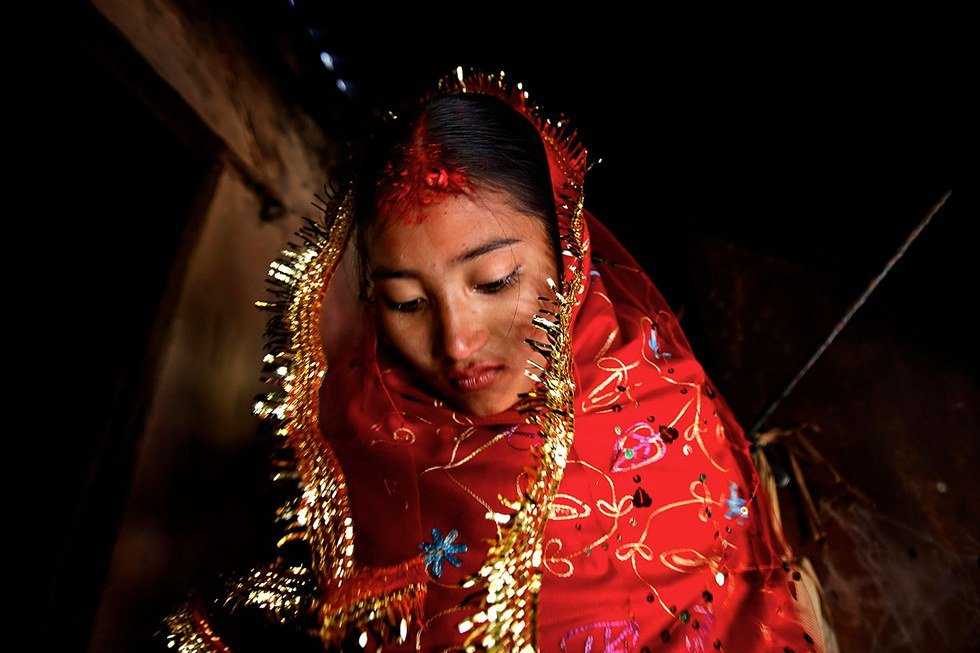
Last year, I interned at Idara-e-Taleem-o-Agahi (Center of Education and Consciousness, or ITA), a non-profit organization based in Lahore, Pakistan. As part of my internship, I attended a school that ITA has built in the slums of Lahore in order to educate children in the area. This slum hosts one of the biggest gypsy communities of Lahore. As part of my work with the wonderful NGO, I visited families of the students attending the school. Most of the kids collected garbage in the morning and attended school in the afternoon. I noticed an active and enthusiastic student called Sadia and decided to meet her family. After journeying through piles of rubber, plastic and paper, I finally entered the small tent where Sadia’s family resided. A cow was tied to a pole near their tent and I could smell dung and garbage. Three charpais crowded the tent, in addition to a rusted stove, a few broken suitcases and torn clothes. I sat on a charpai with two staff members of ITA, opposite another charpai on which a 35-40 year old woman sat with a quite elderly male, who she described as her husband. She wore a printed shalwar kameez with a dupatta over her head to cover her hair. The old man, although lying down, was fully aware of our presence.
I looked at the woman and I felt an instant connection. Her eyes glimpsed with shards of sadness, hope, and despair. I took out my notepad and decided to start my unstructured interview. Kausar Bibi, the woman I interviewed, was married at the age of 12 to a 40 year old man. Every girl in her community was married at a very young age. She frankly confessed that this community treated women as baby-producing machines, although she wasn't ashamed of this. She straightened her neck and boasted that she had eight children. I hesitated to ask at what age she had her first child but asked anyway. “14”, she said as she lowered her head. She didn’t go to a clinic. A midwife attended to her and gave her home-made medicine. She gave birth to all eight children in her tent without any sort of medical help.
As I digested this information, I heard a baby wail across the tent. A young girl of about ten or twelve held the baby in her arms, soothing the little boy. I assumed she must be Kausar Bibi’s daughter. I looked towards her and asked if her daughter takes care of her younger brother. She waved her hand in the air and answered in a monotone voice,” She’s not my daughter. She’s my son’s wife. And that’s her baby.” I felt a pang of guilt fluttering my heart. I realized how different my life is from theirs. I inquired about her family's monthly earnings. She looked up for a minute to calculate and finally said that it was about 6000rs (about $60). $60 per month for eight people (including her son’s wife and son and excluding her married daughters). 1500rs were used to pay the rent for this land and the rest of the 4500rs was spent at home. While many believe that the purpose of having several children is to increase working hands in the family, only one of her sons worked and the entire family was dependent on him. He was responsible for selling the garbage to recycling units. We spoke more and I learned that her husband was half blind, her sons weren’t interested in working, and her daughters were either married or helped in household chores, thus no one, except one of her sons, worked.
Kausar said, “We’re poor. No matter how much we work, we will always stay poor and miserable. We are surviving somehow and this setup is fine for us. “When asked about marriage, she said, “Our parents get us married to whoever they like and we don’t argue. We’ll always stay like this. Educating our girls won’t be of any use because they’ll end up getting married too.”
I spoke with her about the importance of education, the repercussions of child marriages and the consequences of giving up. She kept nodding in agreement but I knew she didn’t believe me. Why would she? Kausar had never seen anything different. I hope that one day we can show that education can be fruitful and help get families like Kausar’s out of this cyclical poverty. I hope that one day communities across Pakistan will realize that girls deserve to make free choices and choose when and whom to marry. This is why I worked with ITA and Advocates for Youth’s Girl Engagement Advisory Board to create awareness and highlight the magnitude of the abuse of girls' rights in Pakistan.
*charpai: traditional woven bed
*shalwar kameez: traditional outfit of Pakistan. The shalwar (pantaloons/drawers) and the kameez (body shirt)
*dupatta: Is a long scarf to cover the head or chest