
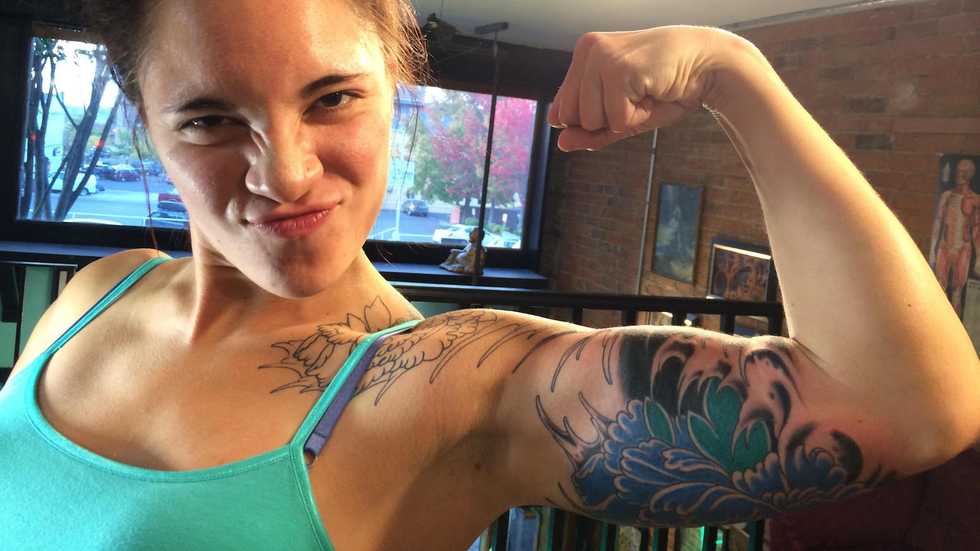
I work for a law firm in downtown Bellingham. I spend most of my days behind a desk, typing at a computer, and you might never know that I am covered in tattoos. This is on purpose.
One of the biggest pieces of work on my body is a Japanese style half-sleeve and shoulder cuff: a series of red hawthorn flowers and bright peonies with a tiger on the outside of my arm. In the Philippines, Japanese style tattooing is very popular, and in many ways, the style adapted to the Filipino culture. Geographically, the two countries are very close together.
I started getting tattooed when I was 18; my first tattoo is a very small script that wraps from one foot to another. You can’t even read it anymore, but the words still hold a dear place in my heart. The tattoos on my feet and legs are easy to hide. I just wear pants or shoes. Sometimes, the tattoos on my shoulders are hard to hide.

People often ask me why I get tattoos if go through the effort of hiding them. Certainly, I can understand why people are curious on this certain topic, but first and foremost, the reason someone gets a tattoo is no one’s business but the person on the tattooing table. On that same thought thread, the reason that someone intentionally hides or shows off their tattoos is exclusively their business. But since I’ve come to terms with it, and now have a greater understanding of my tattooed identity and covered identity, I will explain.

I work in a professional setting; I work with clients all day and make my appearances at the courthouse when needed. I make a point to cover most of my tattoos; some are easier to hide than others. Sometimes the peony on my chest will peak out from behind the neckline of my shirt, or the tiger on my arm will show a faint shape through a white, long-sleeved blouse.
Embracing my “covered” identity was a challenge in itself. Getting tattooed is something that is so incredibly freeing for me, and at first, the idea of having to cover something so personal to me was almost insulting. I eventually grew to prefer my tattoos covered at work; I don’t like when clients engage with me about what is on my skin. Strangers really love to ask me what my tattoos mean to me, and then act shocked when I don’t want to share my personal life story with them, right then – I don’t have a "Reader's Digest" for how I came to get each tattoo on my body.
Honestly, it’s a long story – the attorney will be with you in a moment.
Last year, I read the book, “Covered in Ink: Tattoos, Women and the Politics of the Body,” by tattoo collector, author and professor Beverly Yuen Thompson. When I picked her book off of the self, I remember telling myself, “treat yo self.” I knew I was going to have a special connection to this text. Thompson describes her text as “an ethnographic exploration of the social world of heavily tattooed women and women tattooist working in the industry” (page 6). She argues that “when tattoo collectors begin to modify their bodies with tattoo art, social relationships are transformed as well." As a heavily tattooed person, my social interactions drastically changed in comparison to my “bare days” – I roll my eyes at tatt-callers; I had to sit my mom down and “have a talk” with her before I showed her my half sleeve (my mermaid and other tattoos are on less “public” skin).
Thompson’s chapter “Covering” Work: Dress Code Policies, Tattoos, and the Law” especially struck a nerve with me and how I view myself in the professional arena.
Thompson walks her readers through the preparation process for a heavily tattooed job seeker previous to an interview. Looking for summer jobs, I would drop off resumes and go to interviews in sweaters and shirts buttoned all the way up – my mother’s voice ringing in my head. Thompson interviews many women in a variety of professions, but I connected most with the story of attorney Marisa Kakoulas. Based in Brooklyn, New York, Kakoulas meets with Thompson to discuss tattoos and the law. Kakoulas validated the inner conflicts I was facing in regard to my “covered self.” Thompson explains that Kakoulas works to fight against “prejudice in the workplace, [while] she also realizes the power of appearance enforcement that is given to employers through the legal system” (page 100). Kakoulas describes her two-prong approach for a tattooed person to cover up until they are established in their career; she sets this up as a way to help change discrimination surrounding tattoos in the professional sphere:
"I think we should be vocal. But at the same time, I like the backdoor approach as well. I worked very hard in very conservative offices, and they had no idea I was heavily tattooed. But when they did find out, I was making them a lot of money and I showed my value. And so it didn’t matter. … So I believe in banging on doors, and also sneaking in from the other side."
Marisa Kakoulas helped me understand my “covered identity.” I’ve written about this before, but I’m young, and I have dues to pay (and a lot to learn). It’s not going to kill me if I have to wear a long-sleeve shirt in the office anyway – the sound of the fan behind my desk drowns out the crazy in my office.
















