
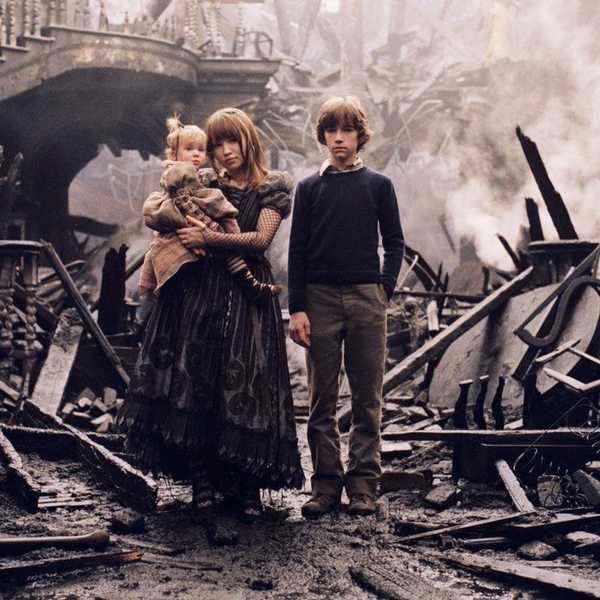
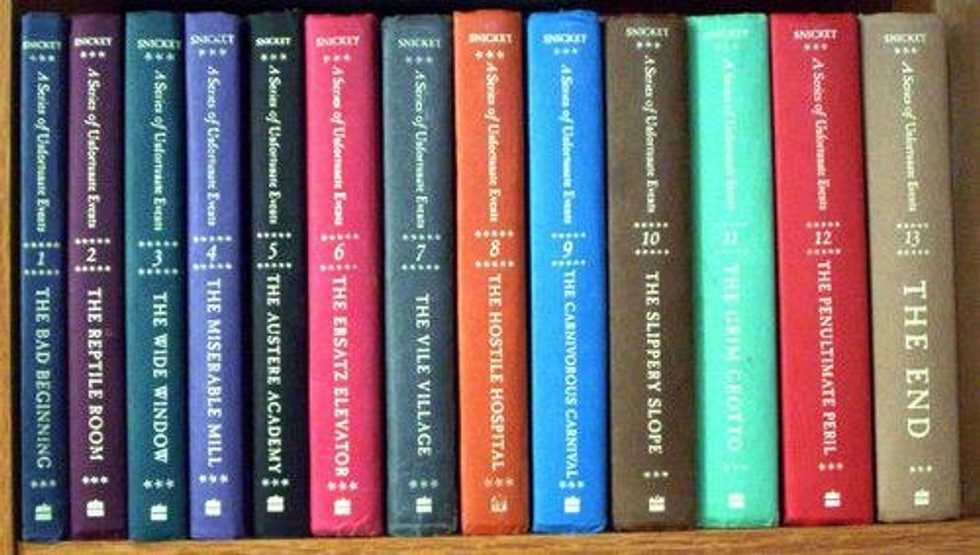
I did not read Lemony Snicket’s "A Series of Unfortunate Events" as a child. I have seen the movie, which I admit that I like, but by the end of the first novel I quickly realized the two don’t quite match up. I borrowed the entire series, 13 books, to read over winter break. While it is a “children’s series,” I find myself thoroughly enjoying it nonetheless. Also, while reading, I can’t stop thinking about Franz Kafka.
Has anyone else noticed how Kafkaesque A Series of Unfortunate Events is?
Kafkaesque, from the Merriam-Webster dictionary means: of, relating to, or suggestive of Franz Kafka or his writings; especially: having a nightmarishly complex, bizarre, or illogical quality.
I don’t think there can truly be an exact definition, but in my own words, Kafkaesque is a way to describe most of Kafka’s own work. His work is, as stated before, bizarre and illogical. His stories themselves aren’t illogical, but the things that happen to the main characters in the novels are. While Kafka’s work can be analyzed and argued in many different ways, there is a distinct gap between the individual self vs. everyone else in his stories. All of Kafka’s protagonists face what seem to be a series of unfortunate events (ha, ha) that lead to tragedy. But the tragedies usually occur because of strict rules that are rational to the rule-makers (whoever they are), which come with irrational results.
The Baudelaire orphans, after the death of their parents, are whisked from one location to the next, each with its own set of rules and irrationality; readers knew there wouldn't be a happy ending for these protagonists.
For example, let's look at the fourth book in the series, "The Miserable Mill." This is the book that sparked my realization.
The Baudelaire orphans are sent to work at a lumber mill, where the workers don’t get paid in money. They get paid in coupons; a coupon for 30 percent off of a haircut, a coupon for a half-off visit to the doctor, etc. The workers’ coupons are useless since they cannot be used without cash. The Baudelaires are quick to realize how backward this is, but no one does anything about it.
In the next book, "The Austere Academy," the orphans are sent to an awful boarding school. They are forced to live in a shack on the school grounds because the students need a parent’s signature to live in the dorms. They don’t have parents, so they’ll never get that form signed. Also, Sunny, because she is too young to go to school, is employed as an assistant to the vice principal (itself absurd) in the faculty building. Children are not allowed to enter this building, and if they do, they are punished by having their utensils removed during meal times. Sunny, because she is a child working in the no-child building, is therefore never allowed to use utensils. The vice principle doesn’t think anything of how illogical that I, because rules are rules.
What makes Kafka’s work so Kafkaesque is that while the protagonists are facing a force that they don’t even understand, or know how to combat, they know they can’t give up. And the Baudelaire orphans are in that same position.
I could pull out something Kafkaesque from every book in this series, but you can read them for yourself. They’re really quite good.
Snicket liters his books with references to authors and poets. Sappho, Poe, Orwell and Homer are just a few of very many. In fact, there is a tiny allusion to Franz Kafka in the endnote of "The Reptile Room," where Snicket mentions “Café Kafka.”
I’m not done with the series yet, but I’m hoping the orphans don’t face a similar ending to K’s in Kafka’s "The Trial. "

















