

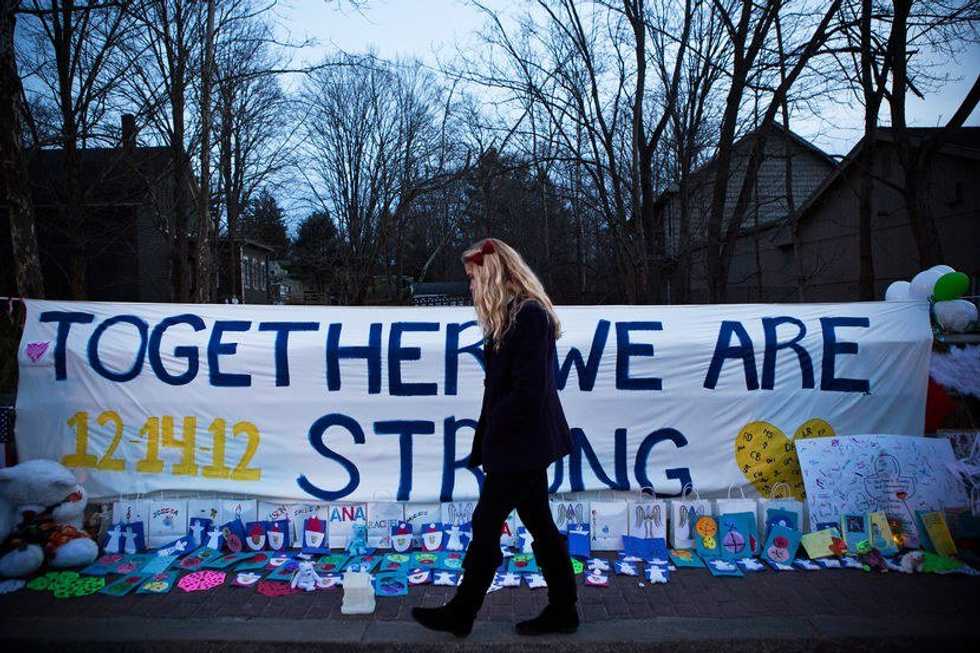
On the morning of Dec. 14, 2012, Adam Lanza walked into Sandy Hook Elementary School and killed 26 people. Twenty of the victims were children under the age of 7. The massacre shook the nation, and there was non-stop media coverage. People were shocked, outraged, and devastated at the loss of so many young lives, as well as the lives of the teachers that died trying to protect them. People tweeted thoughts and prayers, public figures spoke out against the violence, and politicians vowed change. So what, if anything, has changed?
The answer: not much. Three years later, the United States faces higher statistics of gun violence than any other developed country in the world. Since the Sandy Hook massacre, there have been 1,044 mass shootings (shootings where four or more people were shot), killing at least 1,327 people and wounding 3,784 more. There have been no advancements in gun control legislation despite an overwhelming 90 percent of Americans that were in favor of meaningful gun reforms after Sandy Hook, and a current 80 percent approval of advancements.
One of the main issues with creating change is the divide between opinions of American citizens. There are two sides to the gun control debate: pro-gun control and pro-guns. To get a wider perspective, we reached out to members of our community to find out what they believe and the reasoning behind their beliefs. For anonymity's sake, all participants are referred to by their initials.
From the perspective of anti-gun control advocates, freedom and the Constitutional right to own a gun are key arguments against reform efforts. RLH says "My parents were not gun people, therefore I am not a gun person, but the word 'control' is key here. I feel everyone should be allowed to own firearms, if they choose to do so. The gun itself is not what is killing people, it is the person holding it and firing it. I am not in favor of government involvement in my personal decision making on any topic, but that is what this is. I am not in favor with gun control—I am OK with background checks on criminals and persons who are mentally unstable, but who is qualified to determine who is or is not capable of owning a firearm? These methods won't be enough to keep guns out of those people's hands who plan to take innocent lives. There is no perfect way in my opinion to 'control' what happens no matter who has a gun in their hands. You can't control sales of guns on the streets or the black market, so if someone wants a gun badly enough—unfortunately there will always be someone willing to sell it to them if the price and supply is there. I have no problem with people owning firearms, you can only hope those folks make the right decisions when owning and using them."
Others make the argument that even if gun control laws were passed, criminals would ignore the laws. MDA points out that "thugs who ignore laws against murder, robbery, rape, and assault will, by some stretch of lunacy, obey gun control laws is the purest form of lunacy. Does anyone think that a gang planning a bank robbery will trash those plans because they would first be required to register their guns before the job went down?"
Those in favor of gun control make a different argument. The central motive behind gun control seems not to be to ban all types of guns and fire arms, but to ensure the safety of people by ensuring that all gun owners go through universal background checks, limiting purchase of weapons of mass destruction (or weapons that have no purpose other than large scale and rapid fire), and increasing efforts to stop weapons trafficking in the United States. One of the biggest components of gun reform is the ban of military weapons, such as assault weapons.
ADB explains her reasoning by saying, "Kalashnikov assault rifles are the most trafficked weapon in the world, and the United States' complacency with gun control are not helping the problem. One of the arguments that I always see in favor of gun rights is 'banning guns will never keep them out of the hands of criminals.' However, in our current system, literally anybody can buy a gun. Literally. Everybody. There's more regulation on people buying White-Out, cough syrup, alcohol, cigarettes, even fireworks. If we can live with being asked to see an ID every time we have a persistent cough, we can deal with stricter regulation on gun ownership."
She goes on to explain the type of reforms that should be implemented. "I agree that people should be able to have certain weapons, including handguns and rifles. I also believe that one of the requirements for getting a gun should be like getting a driver's license. People who want a gun should be educated on how to use them, how to lock them, and how to protect them before gaining access to them. They should have to pay for insurance on the gun to ensure that they will be careful about who they will allow to use the gun and there should be a fine for anybody who does not comply."
Eighty-five percent of Americans were in favor of gun control after Sandy Hook, and there were even strong efforts among both parties to pass gun reform laws, headed by Republican Pat Toomey, three other Republicans, and a Democrat. Unfortunately, they failed at the last minute due to four back-outs by candidates who were scared of losing electoral votes in mid-term elections.
ADB also points out that it's no secret that the National Rifle Association (NRA) has extreme power in Congress. "The National Rifle Association has such power over the legislative branch of the United States that the will of the people no longer matters. The NRA is simply an interest group, meant to represent the best interest of the people. The NRA, however, should never supersede the will of the people. Ever. Interest groups are supposed to work for the people, not against them. But politicians are frightened to go against the NRA because of the power they wield. This is not how America should be. America is a democracy, a democracy is supposed to be 'for the people, by the people,' not 'for the money, by the money.'"
We want to believe that there has been change since Sandy Hook, or that there will be soon. It's hard to cut a line where protection and privacy can coexist. As shown above, citizens are of mixed opinions; there is no one unifying idea except the desire for shootings like this to end. These were 26 people that will be missed every single day. They were family, friends, loved ones, but the important thing is that they were human beings that should still be here. There needs to progress if we're going to stop this, and to make that happen we need to unify.
















