


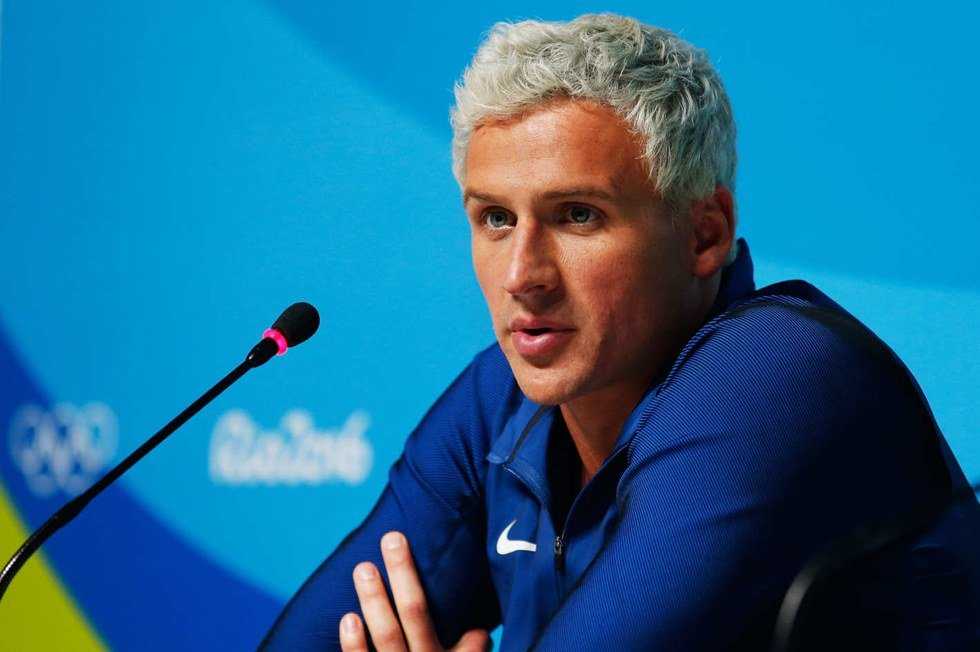
America has excelled this summer in the Rio Olympics, bringing a great deal of pride home for eager fans. From the pool to the arena, we have won gold and demonstrated outstanding athletic performances, and in the process many athletes have become celebrities. Amidst our cries of victory and flying stars and stripes, however, the inhabitants of Rio de Janeiro and the underlying struggles of poverty have been covered by colorful flags and lavish decorations. Naturally, we had our reactions: articles about tourists being mugged along with phrases such as "petty thieves," "street thugs," and "shambolic security" (to insinuate poor security on Rio's part). These articles display an American attitude of superiority and portray desperate youth as violent perpetrators, and the country's attempts toward a successful economy are overshadowed by mentions of "criminals" and "robbers". Unfortunately, this is only the tip of the iceberg in terms of media coverage and points to a larger bias.
Let us bring in an incident concerning American swimmer Ryan Lochte and three of his teammates: Gunnar Bentz, Jack Conger and Jimmy Feigen. Lochte initially claimed that the swimmers were inside a taxi when they were approached by multiple "guys" who "came out with a badge, a police badge, no lights, no nothing (sic) just a police badge and they pulled [the swimmers] over". He continued, saying, "They pulled out their guns, they told the other swimmers to get down on the ground . . . then the guy pulled out his gun, he cocked it, put it to my forehead and he said, 'Get down,' and I put my hands up, I was like 'whatever.'" The Olympic swimmer added that his money and wallet were taken, but the swimmers survived the attack. Sound terrifying? This story, along with several others about rampant thievery and criminal behavior, certainly contributed to an image of Rio de Janeiro as poverty-stricken and corrupt. From Lochte's account, the incident appeared unsettling because it was seemingly unprovoked and illustrated Lochte as the brave protagonist who remained unflinching despite threats of violence. However, that is exactly the problem: it never happened. Police reports, security footage and testimonies from witnesses all contradicted the swimmer's claims.
The real story is this: Lochte and his teammates, who happen to be adult men, were actually at a gas station the night of the alleged robbery. Anywhere from one to all four of these swimmers took part in vandalizing the gas station bathroom. Rio Civil Police Chief Fernando Veloso stated that Lochte's story was completely false, and that several of the swimmers admitted to lying. Officials added that "one of the swimmers tried and failed to open an outside bathroom door. The swimmers then pushed on and broke the door, prompting a guard to confront them. The store manager asked the swimmers to pay for the broken door, which they did, and then left. Veloso said one of the security guards pointed a firearm at the American swimmers in order to control one of them, bur didn’t use excessive force". Reports of Lochte and his teammates drinking and partying before the incident have also emerged. Sounds awfully different, doesn't it?
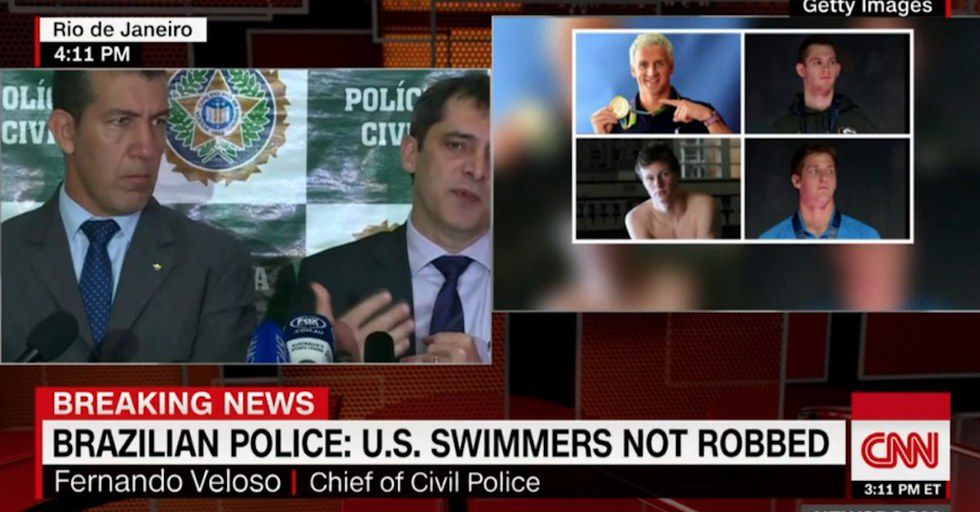
Why does this matter? The incident brings to our awareness several questions about how our media depicts other countries in relation to our own, as well as how adult males like Lochte are pardoned for their crimes. An article by the "Washington Post" covered the "robbery" after Lochte's story and described the incident as a "harrowing assault" and "the most serious breach of security against American athletes in these Olympics, and it follows a troubling pattern of robbery, gunfire and assaults that call into question the ability of Brazil's security forces to keep participants and fans safe". Words like these create stereotypes of a backward and violent Brazil, and Americans who read these articles are likely to develop assumptions from these poorly-articulated news coverages. As I scan this same article, which remains available to the public, many phrases jump out at me: "dangers of Rio de Janeiro," "spate of robberies," and "for a city on high alert for foreign-born terrorism, it has been the everyday domestic crimes that have disrupted the Olympics". Accompanying these words is an undeniable sense of American superiority and a metaphorical turning-up-of-the-nose at Brazil's economic and social disparities.
More dangerous than the initial stereotyping was the media's quick shift from fear-mongering to condoning Lochte and joking about his fabrication. In a recent interview, Lochte admitted that he "over-exaggerated that story" and blamed his "immature behavior". NBC's Matt Lauer then asked Lochte about referring to himself and the other swimmers as "victims" when they were actually considered vandals by police. Lochte's response? "It's how you want to make it look like." Ignoring the structural confusion of the sentence (I will condone Lochte's poor English but not his criminal actions), this response is quite possibly the most illuminating set of words Lochte could have spoken. He may not have known it, but Lochte himself as well as the American media have done a fantastic job of criminalizing the host country of the 2016 Olympics and deemphasizing individual accountability and maturity.
While the children of Rio de Janeiro are the stars of articles and videos titled "Thieves Targeting Tourists at Rio Olympic Games" and "Everybody Robs in this Country", Lochte is still renowned for being a "12-time Olympic medalist" and "American competitive swimmer". After admitting to being highly intoxicated and at fault for damaging property, Lochte found himself the subject of humorous memes . . . many of these comics paralleled Lochte with fictional liars and made a joke of the incident. Though humor is often used to deter from an uncomfortable situation, it is problematic to view the incident as anything but serious. At first I sighed and wanted stories of Lochte to disappear from my timeline, but I realized that it was the manner of addressing the incident that was so wrongly executed. An intoxicated adult man, one who has been invited into another country to represent the athleticism and honor of the United States, should not be let off easy for vandalizing property, lying about it, and fabricating a story that made Brazil appear violent and unpredictable.
Rio 2016 spokesman Mario Andrada responded to Lochte's vandalism in the worst way possible by saying, "Let’s give these kids a break. Sometimes you take actions that you later regret. They are magnificent athletes." By using the word "kids" to describe Lochte and his teammates (Lochte is 32, and the others are 26, 21 and 20 respectively), Andrada makes the common mistake of condoning white male crime by deferring to the fact that the men are amazing athletes. All too often, public figures and media outlets will ignore the crimes of adult white males and instead elaborate on their athletic abilities, academic success, or other favorable characteristics. How often, in the wake of a sexual assault case or a school shooting, have we seen the criminal depicted as a smiling, "normal" person, often a "kid", with notable accomplishments that are more important than the fact that they committed a crime? While Lochte vandalizing a bathroom is not as severe as assaulting or harming a person, it is the same attitude that allows us to bypass accountability and proper disciplinary action.
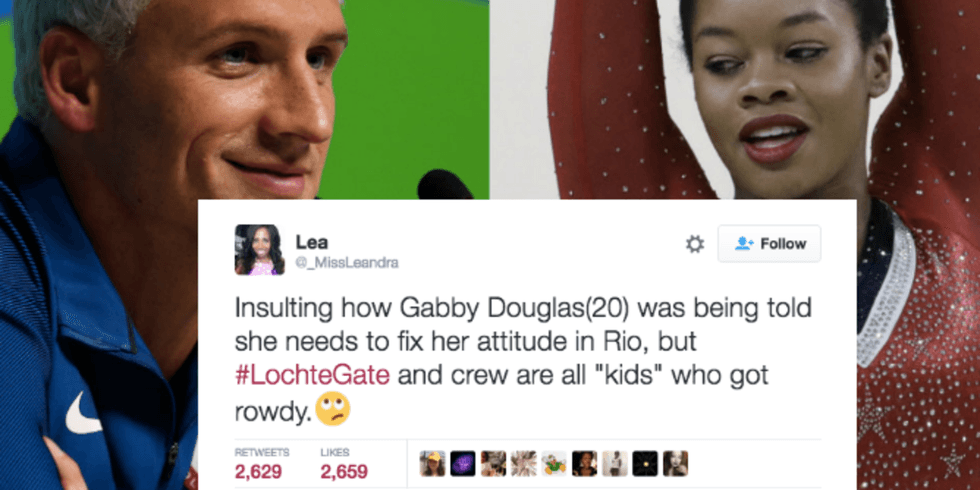
Specifying the positive portrayal of white adult males in the media is important, especially because it provides such a stark contrast to how young black males (and females) are depicted. While Gabby Douglas was criticized for not putting her hand over her heart during a medal ceremony, even being called "unpatriotic, un-American, and disrespectful", Lochte's vandalism was portrayed as joking and accidental. Trayvon Martin was just 17 years old when he was murdered, but he was immediately shown in a hoodie and called a "thug" among other racist expletives in order to justify what was done to him. As rapists like Brock Turner use alcohol as an excuse for their crimes and receive minimal punishments, teenagers like Michael Brown (murdered at age 18) are described as being "no angel" for "dabbling in drugs and alcohol". For white men, often time and time again athletic performances and substances are used as defenses against crimes . . . surely they cannot be held accountable if they were under the influence! Surely they cannot be held accountable if they are Olympic medalists, "good kids", "honor roll students", or "talented" in any way!
Lochte's immaturity and irresponsibility are mere indicators of a larger issue, one that favors the white adult male and allows him to commit a crime and maintain a polished media image. The same media will take the death or assault of a non-white individual, often a teenage male, and ignore the same athletic, personal or career accomplishments. Instead drugs and alcohol will be incorporated, as well as claims of violence and criminal behavior, and in the same way we are quick to laugh at memes of Lochte and forget his wrongdoings we are quick to accept crimes against different individuals and soon forget. If Lochte's media treatment was criticized more carefully, we could examine our social responses to such incidents and become more aware of the way we abandon accountability and find arbitrary ways to excuse certain crimes. If alcohol serves as a reason for excusing adult Lochte, then why is it also a reason for validating the murder of a teenager?
As Lochte said, "It's how you want to make it look like," which I suppose, in his own bro-like way, means we have a great distance to go if we want to eliminate media bias.

















