



“Those are the things I miss the most," Sean Maguire (played by Robin Williams) explains about his late wife to Will Hunting (played by Matt Damon). “The little idiosyncracies that only I knew about; that’s what made her my wife. Oh, and she had the goods on me, too; she had all the little peccadillos. People call these imperfections, but they’re not; that’s the good stuff.”

This quote from Good Will Hunting defies the striving for perfection in American society. In an airbrushed, American Dream world, one that focuses on efficiency and making oneself “great again,” the claim that flaws are what should be yearned for sounds doubtful. But, after a little personal digging, it makes all too much sense.
Looking back at the characters in films that are favorites of mine, they have usually been the most relatable to me. And, because I’m me, they also have to be flawed. These flaws keep the characters from seeming like just creations; I could see myself in that character’s shoes and I could be completely wrapped up in the movie.
The Night Before, directed by Jonathan Levine (50/50) takes its flawed characters very seriously. Even in the title sequence, showing Ethan (played by Joseph Gordon-Levitt) playing his guitar and looking through pictures of who we will later come to know as Diana (played by Lizzy Caplan), we know that something is wrong. Right after the opening credits, we see Ethan working as an elf, offering finger foods on a platter and being told to look “more whimsical.” Later on, Ethan reveals that he’s writing a “concept album,” an experimental album that has a common theme or concept through it (see The Dark Side of the Moon, Kid A, or Miley Cyrus & Her Dead Petz). But, when asked what the concept is, he says “I’m trying to figure out.” It’s an applicable answer, given how many other things he’s figuring out, including his relationship with Diana. Ethan and Diana had recently broken up because Ethan didn’t want to meet her parents, likely because of his own parents dying in a car crash when he was younger.

The start of this film, documenting the death of Ethan’s parents and the start of his Christmas Eve tradition with Chris (played by Anthony Mackie) and Isaac (played by Seth Rogen), is dark in comparison to most comedies. There actually is a screenwriting “rule” not to start comedies on a serious note. However, this rule has been broken before and for good measure. One of last year’s most successful films, Guardians of the Galaxy, known for its humor, starts out with the death of the mother of Star Lord (played by Chris Pratt). The film, for the most part, has a lightweight quality to it, but this beginning stood out.

This start works because it immediately allows the viewer to gain empathy for the characters, which is important because the viewer usually only gets about ten to twenty minutes to have the character be introduced before the character sets out on the his/her journey. The first act of the film is traditionally where the most jokes are made in the comedy, but taking just one or two minutes out can set a positive, relatable tone for the rest of the film.
The rest of the protagonists, too, have their own problems. Chris, a 34-year old NFL player, is seen in his first shot injecting what later is revealed as steroids to his rear end. Chris’ problems are so deep, though, that steroids aren’t his main concern. When the quarterback of his team Tommy Owens (played by Aaron Hill), requests Chris to bring him pot for a party that night, Chris almost literally bends over backwards trying to get it. After a hookup with “hipster girl” Rebecca Grinch (played by Ilana Glazer), Chris finds that his pot was stolen by Rebecca, ensuing a well-directed action sequence of Chris trying to get his pot back from the girl, revealing how truly desperate he is to fit in.
Isaac is a yet-to-be father, insecure about if he’s qualified to play that role. Though this storyline bears an obvious connection to Seth Rogen’s breakout film Knocked Up, screenwriters Jonathan Levine, Kyle Hunter, Ariel Shaffir, and Evan Goldberg make Isaac’s case one of his own. The entire night shows Isaac on drugs, whether it be cocaine, ‘shrooms or pot, leading him into more bad situations than good. After taking more than enough ‘shrooms at the group’s first party at a bar, Isaac gives himself a “note to self,” recording a video on his iPhone, telling his future self to not have the baby. The bathroom is what is to be expected of a bar bathroom, barren and worn down, showing Isaac in a vulnerable position, on drugs, alone, and in a bad place mentally and physically.

This film appears to be one of celebration, three friends going to parties on Christmas Eve, but throughout, these characters constantly deal with roadblocks that their insecurities produce. It really, really works, and it really is what comedy is all about. Mark Twain said “comedy is tragedy plus time”. It would have been better if he said “comedy is wrapped in tragedy”, given the Christmas theme, but we’ll Marky slide on this one. All of the tragedy in The Night Before, one about a tradition built upon a tragedy, lets the audience hold onto that humor that much more.
The Interview, the controversial 2014 film starring Rogen, is an example of a comedy without tragedy. Rogen, playing show producer Aaron Rappaport is sent to assasinate Kim Jong-Un along with the show’s star Dave Skylark (played by James Franco) after Aaron and David are invited to interview Un on Skylark’s show. The film, though funny at parts, was mostly empty, not giving that much, as shown through its 51% rating on Rotten Tomatoes, the worst that Rogen has had in a leading role since 2012’s The Guilt Trip. The Interview suffers mainly from the lack of flaws in Rapapport and Skylark, who seem like two buddies just stumbling around and sporadically quoting The Lord of the Rings. It was arguably Rogen’s most cocky film, someone who usually plays funny yet modest characters in earlier films like Knocked Up, Funny People, and 50/50.

50/50, which also stars Joseph Gordon-Levitt, is another example of a successive comedy with a tragic overtone. Though not too commercially successive, only grossing a bit more than $35 million dollars domestically, this 2011 films, also directed by Jonathan Levine, was critically acclaimed, scoring a near perfect rating of 94% on Rotten Tomatoes. 50/50 is about Adam (played by Levitt), a 20-something newspaper writer who is diagnosed with a rare form of back cancer, one that only gives patients a 50/50 percentage of survival. Adam’s best friend Kyle (played by Rogen) is given the difficult job of supporting Adam through his treatment. In addition to a tough story, Adam is forcedly flawed by his cancer. He also can’t drive, never taken a driving test, and his inability to drive symbolizes his inability to go where he wants in life due to the disease plaguing him.
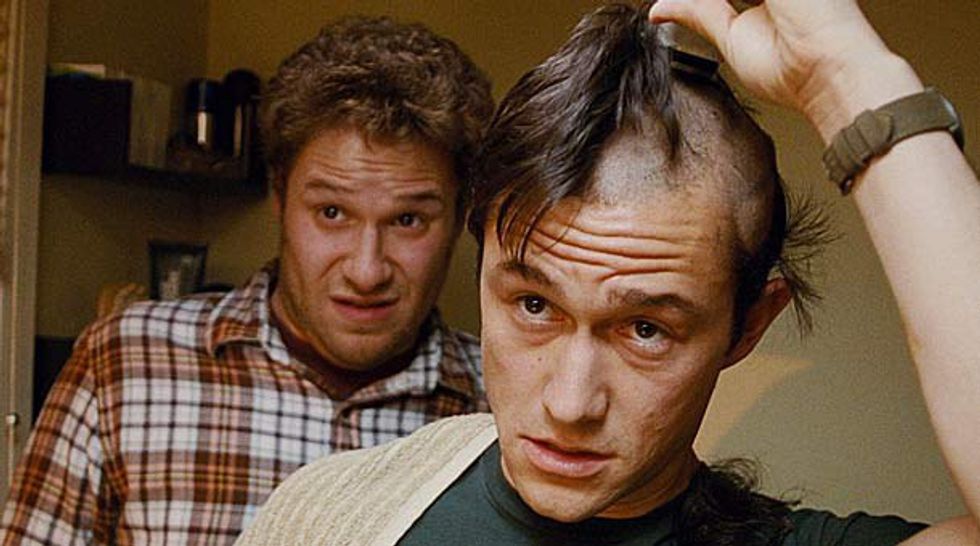
These flawed characters, having to deal with real problems in a real way, is something that Hollywood needs more of. Judging from recent critical failures like Get Hard (29%) and Hot Pursuit (7%), the Hollywood model is to put people together and let them do crazy sh*t and be awesome, but it’s been proven that the flawed character is the better option. People call those imperfections, but they’re not. That’s the good stuff.

















