
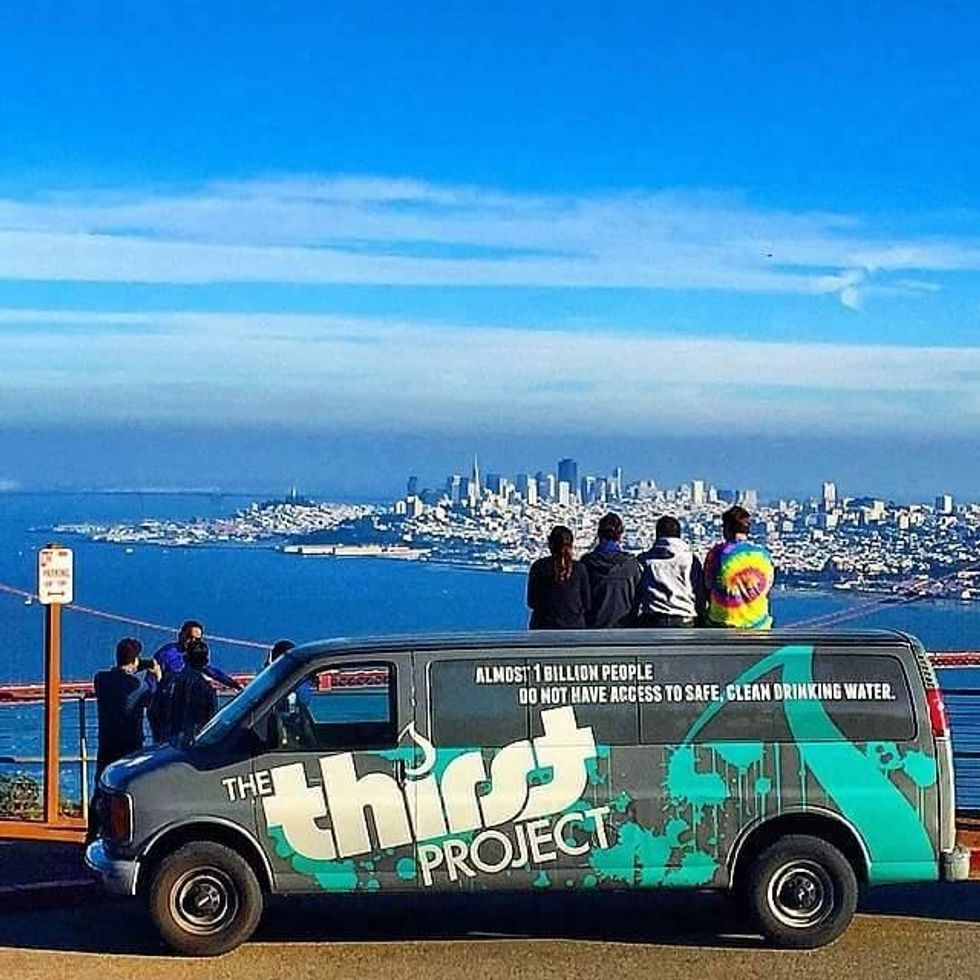
Meet Emily Yanos. She’s a senior in Industrial Design and a sister of Phi Mu. Emily was selected from many to become one of the Thirst Project’s four Road Warriors. This means she is spending this semester traveling across the United States to raise awareness for the clean water crisis.
Living in the Midwest and in close proximity to the Great Lakes, it can be easy to forget that access to clean water is a privilege that many people don’t have. According to Emily, almost one billion people on our planet do not have access to safe, clean drinking water. One. Billion. That’s 1/7th of the global population. Take a look at your classes, your pledge class, and your close friends. Now imagine that one out of every seven of them who can't get a drink of water when they need it, one of life's basic necessities. Of all the issues facing our world, this could be the most significant.
This is where the Thirst Project comes in. As a Road Warrior, Emily is traveling across North America in hopes of informing and educating other students on the clean water crisis. Their goal is to raise awareness and funds in order to combat the water crisis facing much of the world all within a 45 minute presentation. She says: “We know we've done our job when a school starts a club! Mostly, we want to empower students to make a difference in the world.”
Below are some additional facts that Emily shared:
- Thirst Project is the leading youth water activism organization in the world.
- In many developing communities, individuals have to walk an average of 3.75 miles to collect water (which is contaminated, and can expose people to bacteria, fungal infections, and parasites).
- A child dies every 21 seconds due to waterborne diseases.
- When a community has access to clean water, it suddenly means that children have time to go school and women have time to get jobs instead of spending it walking to collect water.
- Just $25 can give someone safe, clean drinking water for life.
- If we could provide the entire world with clean water, global disease rates would drop upwards of 88 percent.
- It costs $12,000 to build one well in Swaziland
Currently, the goal at Thirst Project is to provide all of Swaziland with clean water by 2022. Swaziland was picked for a multitude of reasons, one of which being that it currently has the highest density of HIV/AIDS in the entire world.
Emily says: “Over 53 percent of Swaziland's population, between the ages of 18 and 30, has AIDS. If you imagine having a conversation with someone in that age bracket, one in every two people you talk to will die from AIDS. This is a startling statistic, especially because it is our age bracket!” Remember when I asked you to visualize your friends and classmates? Now picture more than half are HIV/AIDS positive. Clean water can help act as a catalyst to improve a slew of disease reductions.
With an obtainable goal and such motivated people, Thirst Project cannot fail. In fact, Purdue’s chapter has already funded two wells! If you’re interested in learning more or want to get involved, Emily would love to hear from you at emilyy@thirstproject.org. You can also donate to their fundraising page at https://my.thirstproject.org/roadwarriors2015. She and the other three road warriors are looking to raise $12,000 (one well!) by the end of their tour in April. Of course, not all of us can donate money, but donating your time to spread awareness is just as important!