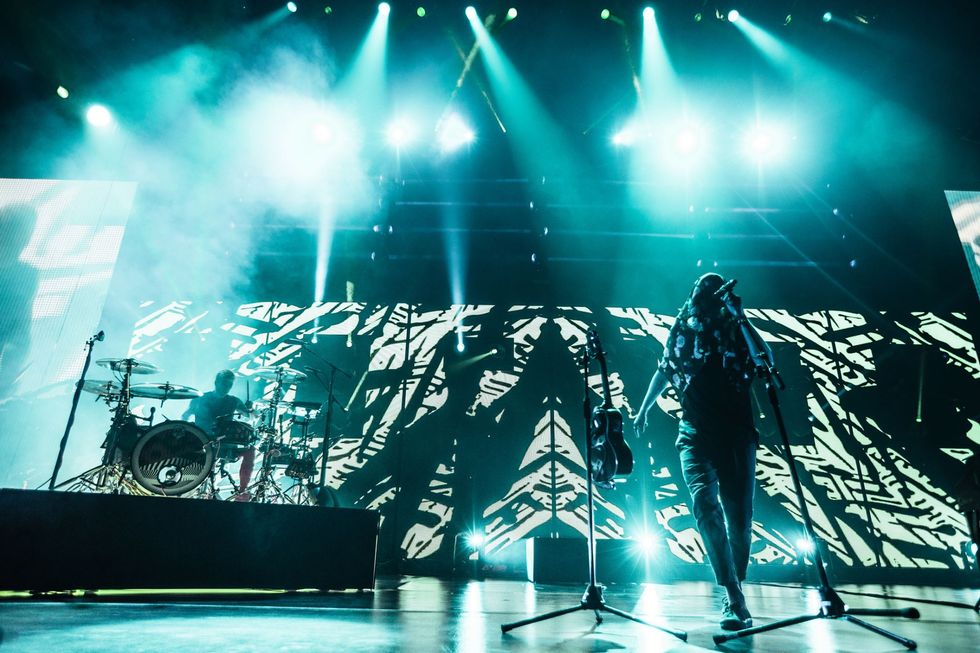
Over the last couple of years, the Ohio pop duo known as Twenty One Pilots have gained an incredible amount of attention. They earned Billboard chart success with rap rock singles such as "Stressed Out" and "Heathens," and generated positive word of mouth from their energetic live shows. Their humble, compassionate approach toward fan interactions has also shown their mature handling on this incredible attention as well. Overall, one could assume that this duo is relatively harmless.
While that assumption is correct, it is important to reflect on these two Ohio natives as they bring forth a chance to address a reoccurring, incorrect perspective on rap as a genre. Keep in mind, the idea being critiqued is not perpetuated by Twenty One Pilots themselves, but rather it is an observably shared sentiment across the band's fanbase: that Twenty One Pilots are a unique artist because they rap about quote--unquote "real issues," while other artists rap about money, drugs, and sex.
Do many rap artists produce bars about the subject matter mentioned above? Undoubtedly. But to perpetuate the idea that Twenty One Pilots are one the very few artists that rap about "real issues" is preposterous.
However, rather than put this incorrect observation on blast, I do want to commend Joseph's songwriting, as he unpacks his own life story and personal struggles in a very honest, transparent way. Whether he raps about inescapable childhood nostalgia in "Stressed Out" or the necessary carefulness toward evangelism in "Heathens," his approach to songwriting, particularly his hip-hop influenced verses, speak of real life experiences.
But this takes me back to my main point: this in no way makes Twenty One Pilots above other artists who are also heavily influenced by hip-hop. There are plenty of other artists that also use the genre to rap about "real issues" as well. To claim that the Ohio duo are distinct because they write about real life situations and emotions indirectly insinuates that their contemporaries fail to do this as well. That is just not the case.
Even removing Twenty One Pilots from the situation entirely, this problematic perspective of hip-hop is noticeable among discussion of other white rappers. Growing up and living in Washington State, the same sentiment seems to be shared among the discussion of Macklemore (or at least, the sentiment was shared when he was at the height of his popularity). The parallel is striking to me: singling out a white hip-hop artist, claiming their lyrical content is more relatable and tasteful, thereby dismissing a vast majority of other fantastic hip-hop artists.
I don't want to play the race card (I'm a white guy who grew up in a safe neighborhood and spent his childhood listening to TobyMac and Uncle Kracker; I have zero cards to play from that deck). Instead, what I want to do is to assume the best of music fans' intentions. Those who love Twenty One Pilots and believe they have a unique message are correct. But they are not the only hip-hop influenced artists that use the genre to spread personal lyrics that reflect on real, human problems. With that said, I wanted to present a short list of young, modern hip-hop artists who offer passionately produced tracks; they bring insight to the struggles of black America, an area of social discourse that hip-hop music was and consistently is birthed from.
This year saw the release of rapper Joey Bada$$'s second studio album "ALL AMERIKKKAN BADA$$." Track after track on this project is filled with sociopolitical commentary, as the Brooklyn-born artist delivers stellar bars discussing a multitude of personal topics such as police brutality, systemic racism, and religion. Credit should be given when it is earned, and Joey Bada$$ clearly has earned it with tracks such as "FOR MY PEOPLE," "BABYLON," and many others.
Rewind to the previous year, 2016, and you will find yourself emotionally engaged with Noname's debut mixtape "Telefone." On this collection of tracks, Noname delivers heartfelt, honest lyricism that speaks about a myriad of topics, from fame to redemption. She even crafts a song called "Bye Bye Baby," which touches on the subject of abortion, providing an acknowledgement of and moment of empathy toward those who have made the often sacrificial, conflicting choice.
This could not be an article that discusses modern hip-hop without mentioning Kendrick Lamar, whose entire discography reaches heights of poetic wordplay and vibrant imagery that is unmatched by his contemporaries. His recent studio album, "DAMN.," features plenty of introspective cuts that wrestle with racism, theology, and Lamar's own worldviews. From "DNA." to "DUCKWORTH.," the project sports some of Lamar's most lyrically dense tracks yet.
These artists and more (and by more, I mean decades worth of critically acclaimed and award-winning MCs) clearly put to rest the incorrect notion that only specific, white rappers are the ones writing about the "real issues." Anyone and everyone is free to enjoy Twenty One Pilots, but they are by no means an exception to the rule in terms of introspective and intelligently written hip-hop lyrics. They are simply another voice among a consistently growing list of artists who speak about a variety of topics through rap, including the "real issues."