


"But if there's one thing we can say
I know it sounds a bit cliché
There's no such thing
As just an ordinary day
And you don't have to build a roller coaster
Just find your own way to make the most of
These days of summer
And dance to the beat of a different drummer
Just grab those opportunities when you see 'em
'Cause every day's a brand new day, you gotta Carpe Diem!"
- from Season 2, Episode 39: "Rollercoaster: The Musical"
I love "Phineas and Ferb" passionately. When I'm asked what my favorite TV series is, I contemplate saying something more "mature," a la "Suits" or "The Americans" or even "Parks & Recreation," but am never able to. Always and unfailingly, I default to "Phineas and Ferb," the greatest children's TV show of all time.
Perhaps the beauty of the show comes in its clever simplicity. Almost every episode includes an A plot and a B plot, the A plot being a tale of what fabulous contraption the two stepbrothers have built that day and their elder sister Candace's eternally failing attempts to bust them; the B plot the story of Perry the Platypus, semi-aquatic, egg-laying mammal of action, secret agent for the Organization Without A Cool Acronym (O.W.C.A) and his battles with his nemesis, the evil (read: traumatized at an early age) Dr. Doofenshmirtz. Near the end of the typically 10-minute long episodes, the two plots intersect, Doofenshmirtz and Perry's antics generally causing whatever the boys created to disappear, making Candace look like a lunatic in front of their mother day after day after day.
In other words, genius 10-year-olds build crazy contraption and anger snitch sister (snitch does seem too harsh for Candace, she's really rather nice) who would get them in trouble, but the actions of their anthropomorphic platypus and his semi-villainous target manage to wreck her efforts every time.
That's the simple, basic, compelling conceit of virtually every single episode. Phineas and Ferb never permanently find out their pet's identity. Candace never successfully busts her brothers. Girl-across-the-street Isabella never has her feelings for Phineas returned. The creativity and excitement that seemingly burbles out of every second of the show doesn't result in a compromising of the structure, but rather in the elaborate sculptures that are draped over the basic skeleton.
Despite the inflexibility of that skeleton, the show works. Its plots lie rich and vibrant, never unexpected, but never predictable, either. Its structure renders it inherently prone to enthusiastic episodic nostalgia – "Do you remember the one where they _________?" "How about the one where Doofenshmirtz has a jump rope battle with Perry?" Each story, through its simplicity, allows character events to become fused to various sections of story. Doofenshmirtz's backstory brings back sad memories of Balloony, his only friend; der Kinderlumper; his mother, who never let him swim in public pools and whose love was always inexplicably linked to kickball, a game at which he stunk and the immortal line from his father: "Are you a man or a schnitzel?"
It's hard to forget young Doofenshmirtz up on the rickety high dive squealing back - "I'm a man!"
"Phineas and Ferb" is a show that heartily rewards its fans. Elaborate callbacks are created, from the bizarre floating baby head to Klimpaloon, the magical old-timey bathing suit that lives in the Himalayas, to the entirety of the first episode's rollercoaster-centric events repeated again in "Rollercoaster: The Musical" and "Quantum Boogaloo," one of the time-travelling episodes.
But perhaps most rewarding is the experience of watching all four seasons. "Phineas and Ferb" provides a unique tetrad to its dedicated viewers. First, while it eschews traditional character development, in the vein of characters changing after being exposed to events and other characters, it develops the characters by delving deep into what makes them tick, who they are and what their purpose is. Earlier I mentioned that "snitch" is too strong a word for Candace. It is, and yet, it's true. However, it seems harsh because the Candace isn't a nasty person. She has some flaws, but beneath those, there's a doting, loyal sister who realizes the exceptionalness of what her brothers do. Candace is not only a character, she's one of the few normal characters aware of the brilliance of the brothers, which makes her a companion for the audience. She, in some interpretations is the main character - the effects of all storylines ultimately lead to her. More exceptional on the character development front, though, is the character of Doofenshmirtz. One of the most fully directly realized characters ever, probably, Doofenshmirtz is the deconstruction of the evil scientist. "He's more than just that," says the show. Most of the characters in "P&F" begin their four-season, one-summer journey as an archetype – the snitch sister, the evil scientist, the bully, the nerd, the girl across the street, the... platypus... (that stereotype dies quickly), and then end the show as fully realized people, each of which is known well and loved for whoever he or she is.
Secondly, there's the incredible intellectual level the show operates at. On the surface, the show's operating vocabulary is incredibly vast, bouncing "genuflecting" off "bureaucracy" in "It's Been a Charmed Life" from "Quantum Boogaloo," or diving deep into Freudian psychology in "Monster from the Id." And then that's just superficial! The show is inherently witty. It'll set up a conceit, then pull the floor out from under it in an extraordinarily humorous moment, or it will exhibit a knowledge of science and technology that pays off in an exquisite plot point in its 10-minute run.
Thirdly, most importantly, "Phineas and Ferb" is inspiring. It's the story of two boys with an empty summer. They don't sit around. They don't play video games all day long. They go outside! They build strange, wonderful, glorious things! They have seats on the City Council. They come up with new languages! Levitate! They answer "the annual problem for our generation" by "building a rocket or finding a mummy or climbing up the Eiffel tower!" "Phineas and Ferb," for me, when I was 10, was the quintessence of lauding the power of imagination. It claimed, with every single particle of its being, that if you put your mind to something, if you poured your heart into it, you could do anything! Anything!
"You don't have to build a rollercoaster just to find your own ways to make the most of these days of summer!" Phineas and Ferb exclaim joyously. "Just grab those opportunities when you see 'em! Because every day's a brand new day, baby - Carpe Diem!"
Then Disney aired "Act Your Age," and in conjunction with the time-traveling episode from the past, "Quantum Boogaloo," "Phineas and Ferb" became, to be frank, a tragic story with a different meaning. It didn't lose its original meaning, mind, but rather created an incredibly subtle underlying one. I imagine it was done unintentionally. Nevertheless, it happened.
"Act Your Age" is the only episode of the series that takes place in the future without any acceleration of time. It's fundamentally a fanservice episode as well, as noted by Dan Povenmire and Jeff "Swampy" Marsh in a live action sequence preceding the episode. "Will we see Phineas and Ferb as teenagers?" one fan had asked. "Yes, yes we will."
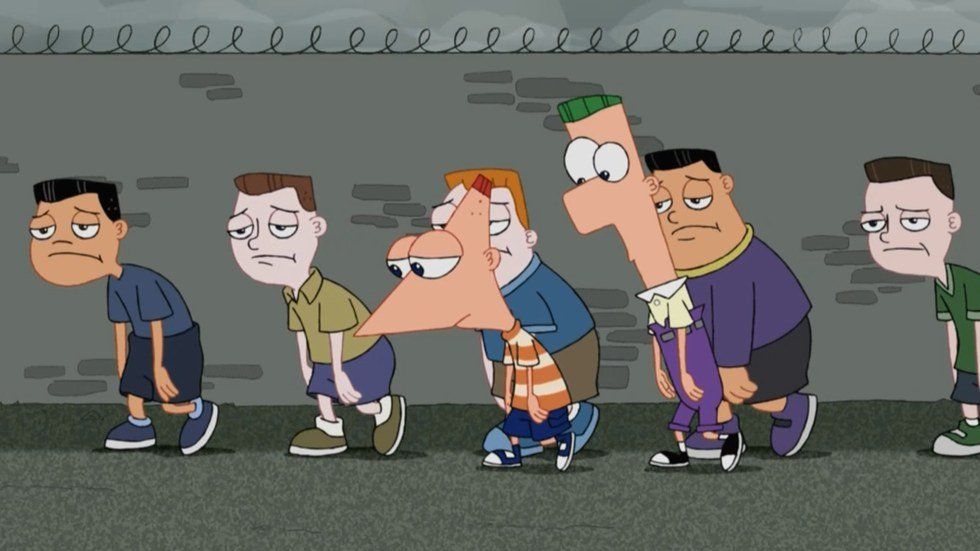
Then, we did, and the episode had no qualms at all about giving fans exactly what they wanted. The plot of the episode diverged dramatically from the traditional structure – Candace was nonexistent, Perry the Platypus did no thwarting and most notably, Phineas and Ferb did nothing.
At least in the Season 1 episode, "The Best Lazy Day Ever," though, Phineas and Ferb are doing nothing intentionally. In "Act Your Age," it's totally unintentional.
The brothers, plus Baljeet and Buford, spend an entire scene idling in the kitchen, exchanging what honestly amounts to idle, high school boy chatter. In another scene, Ferb sits on a couch, eating a sandwich, glancing sidelong at a remote. In yet another scene, the once incredibly diligent, dedicated Fireside Girl group sits at a table getting their texting badge texting and talking about their texts. They note that'll be difficult for Isabella to tell Phineas her feelings and set up a romantic occasion since she's working so hard, attempting to get enough money to feasibly pay for college.
Speaking of college, the only hint of Phineas and Ferb's inventive spirit that occurs in real time throughout the entire episode is a glorified leaf blower that hurls all Phineas' college acceptance letters into the air for random selection.
That doesn't work, and Phineas eventually decides between two state schools. I'll refrain from judging his particular decision there, but instead harshly judge him on a different front.
Why in the world is Phineas Flynn going to college?
I get why Isabella is going to college, or can plausibly see Buford going to art school. Baljeet, naturally, already has a doctorate.
But the fact that Phineas Flynn is actually going to college illustrates a devastating flaw not in the show, but rather our society. This kid, at 10, held a city council seat. This kid, at 10, figured out how to make functional nanobots that didn't turn into a grey goo and obliterate the world. This kid, at 10, developed a functional teleporter, a shrinking submarine, and "the flying car of the future, today!"
Two fifth graders in their backyard are, indisputably, the greatest engineers the world's ever encountered.
And yet, 10 years later, their brilliance has been reduced to an occasional hobby. In the highlight song from the episode, Phineas, in a flashback, sits in his backyard building a mechanical eggplant. It's quite depressing, really. Nobody needs a mechanical eggplant. Isabella's gloomy look that Phineas is building a mechanical eggplant could well be because he's building a mechanical eggplant rather than because he's building something instead of paying attention to her.
In "Quantum Boogaloo," Phineas and Ferb go forward in time 20 years in order to get a machine that can fuse wood and metal together. However, in the process of doing so, they find out why the future world has become such a marvelous place comparatively, why the technology's so extraordinary, and are advised by the adult version of Candace to "keep doing what [they're] doing."
The thing is, they can't. The way I interpret the time machine in "Quantum Boogaloo" is that it presents the past as it happens, but that it presents the future as it would occur, given no change in activity up until that future occurred. Thus, if Phineas and Ferb continued to build incredible, physics-defying inventions until they were 30, or alternatively, if Doofenshmirtz kept creating inators after the demise of Perry the Platypus, then you'd either end up closer to utopia or in a strange dystopia.
However, if time is allowed to progress normally, as it does in "Act Your Age," then you experience a multi-experiential present caused by numerous different features – namely, the tempering effect of the school system and societal quashing of whimsical imagination. College becomes more important than original innovation, "responsibility" supplants excellence in terms of conventional importance.
It's best summed up in the blatantly dangerous title of the episode, "Act Your Age." Phineas and Ferb aren't kids anymore, and thus, they shouldn't act like kids. They have to put the idealism of their childhood behind them, no matter how capable they are of actually bringing those ideals to pass. They have to "mature" and understand that "the real world" doesn't let people imagine new things, branch into new worlds, unless it's within the right contexts. In other words, if you go to college and have a physics or engineering degree.
Clamped down by the stress of getting into college, romantic altercations among teens, homework, debate team, student government, the gamut, Phineas and Ferb no longer have time to be "Phineas and Ferb". Society has trampled imagination – it's not permitted if you're a "realist."
The shows creators didn't even make that point an extrapolated one. Within the show, there's a perfect example of what happens to a person who remains imaginative and whimsical in society after their imagination was supposed to be put aside for more practical things. He's even portrayed as a bumbling evil scientist for preserving those whimsical ideas beyond childhood. His best friend is, ostensibly, a platypus. He's a member of an "evil" support group known as L.O.V.E.M.U.F.F.I.N.. His elder brother practically ignores him, treating him on almost every single occasion with utter disdain. His wife's divorced him.
Society had cast him out.
"Phineas and Ferb" is the story of what happens if you believe in yourself. It's the story of what happens if you take opportunities to their full potential, use your skills to their full extent. Anything is possible, the show joyously declares.
But, in the show's penultimate episode, that message changes. The original still remains, but a second appears. More concerns will come your way, the "real world" won't let you be who you can be. People who remain unique gradually become portrayed as weird, strange and creepy. They're societal failures. This is the way the world works, "Phineas and Ferb" notes somberly.
Grow up. Act your age.

















