


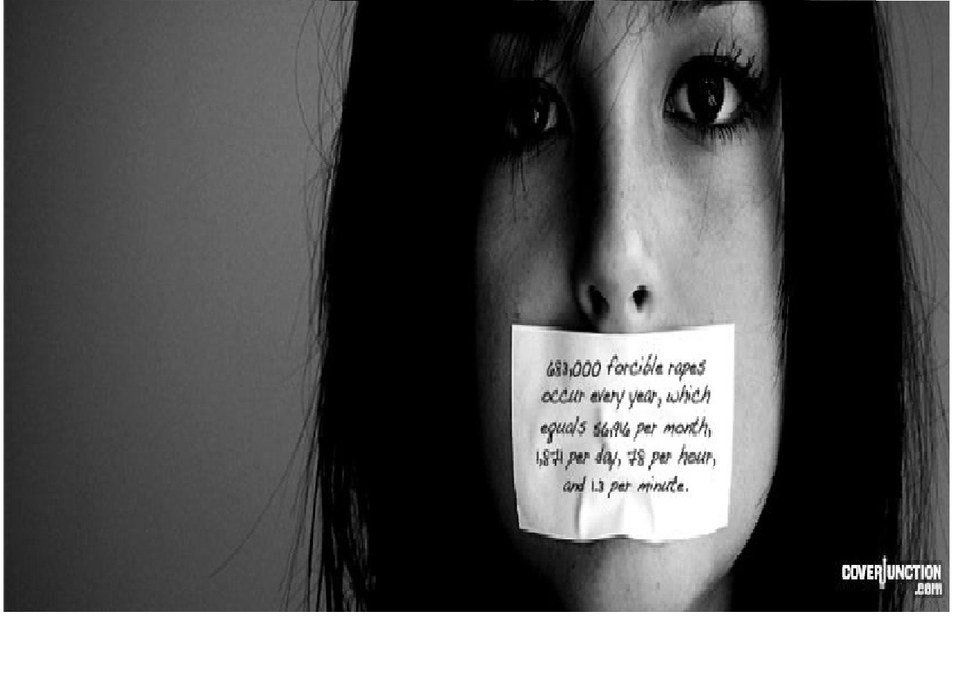
When I first came to Oklahoma State, I didn’t know what to expect as far as crime stats. I transferred here from a community college called Northeastern Oklahoma A&M, located in Miami, Okla. This was a fairly small school with generous police officers, and crime was at an all-time low. They have every single type of crime committed recorded on the schools website. This made me think that for the most part, Oklahoma schools do whatever they can to prevent people from getting hurt or jeopardized any way possible; until I came to OSU.
I worked with my best friend at OSU for one or two months in IT, and she was the one who first informed me about all the sexual assaults that occur here at this institution. When she said that the “1 is 2 many” campaign wasn’t intact until 2013, I felt an extreme despair, because that was only three years ago. The campus safety website of OSU does not put every crime ever experienced at campus on its page, and many things go on without a recorded report. Several things happen that are published in the newspapers, but not in documentation.
Why are schools not more prevalent in preventing things like this on campuses? Why do they not bring more awareness to these issues? Why do they not give out stricter punishments for this abuse of women? And WHY do we not hear more about this if it’s a big issue nationwide? Well, I’m here to explain that most of these crimes go unreported.
Of all the institutions in America, 91 percent report that they have zero incidents of sexual assaults and rapes on campus (Clery 2014). According to the National Sexual Violence Resource Center of the United States, one in five women, and one in sixteen men are sexually assaulted while in college. This means that there is an average of 293,066 victims of rape and sexual assaults each year! More than 90 percent of sexual assault victims on college campuses do not report the assault. Rape is the most unreported crime in the U.S. 63 percent of ALL sexual assaults are not reported to police. Only 12 percent of child sexual abuse is reported to authorities (“Statistics About Sexual Violence"). A 2014 report conducted by senator Claire McCaskill found that countless campus sexual assaults are never even investigated. Researchers have found that 40 percent of colleges have not conducted a single assault investigation in five years ("The Hunting Ground"). According to research by the Huffington Post, less than one-third of students found guilty of campus sexual assaults are expelled. Nationwide, more students are expelled for cheating than sexual violence ("The Hunting Ground"). At Stanford University, 259 sexual assaults were reported between 1996 and 2013, but only ONE student faced expulsion("The Hunting Ground"). Eighty-eight percent of women raped on campuses do not report the assault. According to the FBI, 26 percent of rapes reported to police lead to arrests ("The Hunting Ground"). Many students who experience sexual assaults drop out of college, lose scholarships, and become advocates for change. Reasons for not reporting rapes are the fear of denial, fear of the legal system, fear of retaliation, guilt and blame, personal matters, and victim-offender relationships (“Victimology: Theories and Applications").
It is known that 84 percent of women, who are raped, know their attacker. Fifty-seven percent of rapes happen while on dates, and 30 percent of women contemplate suicide as a result of their incidents. Eighty-two percent of victims also say that the experience permanently changed them (“Victimology: Theories and Applications"). An estimated 88,097 forcible rapes were reported to law enforcement in 2009. The truth is that control is the key ingredient of a rape. In practical terms, the assailant has two goals: physical and sexual control of the victim. The conclusions reached in a study by Burgess and Holmstrom resulted in that the victims suffered a significant degree of physical and emotional trauma during a rape. Victims describe symptoms that include flashbacks, intrusive thoughts of the rape, fear, anxiety, nightmares, daymares, development of phobias, and the rape trauma syndrome (now known as PTSD): consisting of acute and long-term processes. This syndrome includes physical, emotional, and behavioral stress reactions that result from the person being faced with a life-threatening event to one’s life or integrity (“Victimology: Theories and Applications").
This past year in 2015, Netflix released a brand new documentary giving awareness against sexual assault and rape called "The Hunting Ground." A young woman named Erica Kinsman, told her story for the very first time on camera in this new film. As a pre-med student attending Florida State University, she spoke of being sexually assaulted by the NFL draft pick Jameis Winston, who was a star quarterback for FSU. The athlete put something in her drink one night at a bar, and took her back to his room, where he raped her. Erica first saw her attacker in a class they were both enrolled in. Sometimes cases of rape even get ignored by law enforcement! Scott Angulo was the detective handling Erica’s case, and after he and Carroll, (the attorney) spoke about getting a DNA swab from Winston, Angulo refused. Carroll later said that Angulo insisted that this would make the investigation “go public.” Angulo warned Carroll that if Erica decided to press charges against him, she would be harassed and forced to leave Tallahassee ("The Hunting Ground"). A medical examination revealed bruises and semen on her body. Tallahassee police didn’t obtain a DNA sample from Winston until ordered to do so by the State Attorney’s office 10 months later. On Dec. 4, 2013, 11 months after Erica identified Winston, his DNA was finally tested and matched with the DNA found in the sperm on Erica’s rape kit. On Dec. 5, 2013, the State Attorney Willie Meggs announced that the investigation was complete, and there would be no charges filed against Winston ("The Hunting Ground").
On Jan. 22, 2013, everybody including the coaches, investigators, the school, etc. failed to report all the information to the FSU Title IX coordinator as required by Federal guidelines. For 18 months, FSU did almost nothing to investigate the alleged rape report, even though FSU, and the Department of Education’s policy was to investigate and resolve it within 60 days. It was then discovered that a second young woman had a traumatizing sexual encounter with Winston that she had reported to an FSU housing official. The housing official told FSU’s Dean of Students, who began a Title IX investigation. The Dean of Students later decided that there would still be no charges filed against Winston even after a second victim came forward. On Nov. 14, 2013, Erica decided to drop out of school, fearing for her safety because of retaliation over social media from FSU students and fans. Winston ended up being named the winner of the 2013 Heisman Trophy on December 14, 2013, and the following month on January 6, 2014, FSU’s football team won the BCS National Championship ("The Hunting Ground").
On Jan. 23, 2014, FSU finally interviewed Winston. This was more than a year after FSU became aware of Erica’s accusations of rape against him. He refused to answer any questions, and after that day, FSU sent a letter to him stating they weren’t going to investigate the case. In the Spring of 2014, FSU gave Erica’s victim advocate file to legal counsel. Finally, on Dec. 2, 2014, nearly 2 years after Erica reported her rape, FSU decided to hold a two-day hearing about the accusation. Winston refused to answer any questions asked of him in the hearing, while Kinsman answered all 156 questions asked of her. The hearing officer, Major Harding, found that Winston was not responsible for violating FSU’s student conduct code for sexual assault, despite the fact that the code requires verbal consent of sexual encounters. The two day hearing produced absolutely no evidence that Winston received the required verbal consent, but FSU still did whatever they could to make this athlete rise to fame. On Jan. 7, 2015, Winston withdrew from FSU and made himself eligible for the 2015 NFL football draft. On April 30, he became the top draft pick by the Tampa Bay Buccaneers. Justice had not been served, and is still not served to this day ("The Hunting Ground").
One quote in this movie that really struck me was by an OSU professor named John Foulbert; “College has a reputation for being a safe place… It’s not.” If colleges aren’t a safe place for students, shouldn’t we do something about this? After watching "The Hunting Ground," I now have speculation about why campuses don’t want to punish those involved against sexual assault and rape crimes. A lot of campuses do not want to show fault. Especially in cases of a student-athlete rape, the school is represented by their sports, so if they keep quiet about these crimes, then everybody will watch their teams, and they will earn much more money as if we otherwise never knew about the athletes that represent them. But this has especially backfired as with a case such as FSU’s. According to the National Coalition against Violent Athletes, a three-year study shows that while male student-athletes comprise 3.3 percent of the population, they represent 19 percent of sexual assault perpetrators, and 35 percent of domestic violence perpetrators. The Benedict/Crosset study found that one in three college sexual assaults are committed by athletes. In the three years before 1998, an average of 1,000 charges were brought against athletes each year. The general population has a conviction rate of 80 percent, but the conviction rate of an athlete is 38 percent. According to an ESPN SportsZone Poll, 84 percent of the public believes colleges should revoke the scholarship of a player convicted of a crime. Studies show that a college rapist will have raped seven times before being caught ("NCAVA"). These statistics were compiled by Jeff Benedict and Todd Crosset.
According to the Oklahoma State safety report of 2015, there were five rape offenses overall, and three fondlings. There were four dating violence offenses, and nine domestic violence offenses, (including five off campus). This may or may not tell us how many of these offenses were committed in Fraternity and Sorority houses. According to the sexual assault statistics from the Campus Safety Magazine, students living in fraternity/sorority houses are three times more likely to be raped then students that live off-campus. It’s also proven that out of all the sexual assaults committed, 50 percent are associated with alcohol use. Fraternity men have been identified as being more likely to perpetrate sexual assault or aggression than non-fraternity men ("Campus Safety").
On April 16, 2015, a youth offender in Oklahoma, was charged with rape in the first degree, and forcible oral sodomy, which was later appealed. The state proposition claimed that forcible sodomy cannot occur where a victim is so intoxicated as to be completely unconscious at the time of the sexual act. The court ordered not to prosecute the offender because of the statute meaning and language. On March 24, the Court of Criminal Appeals found that because of the way the state’s sodomy law is written, “Forcible sodomy cannot occur where a victim is so intoxicated as to be completely unconscious at the time of the sexual act of oral copulation.” On May 5, 2015, Representative Biggs introduced language into an existing bill that would amend the state’s forcible oral sodomy law to include instances in which the victim is unconscious or intoxicated. The House Bill 2398 also changed the definition of sexual consent to state that “consent cannot be given by a person who is asleep, physically incapacitated by drugs or alcohol, or is under duress, being threatened, or being forced to perform a sexual act. This is a big mistake on Oklahoma’s part in trying to prevent rapes ("Court Ruling"). If our house members stick together, we can eventually change the laws and punishments of this offense.
If you liked reading this new material from me, PLEASE don't hesitate to "like" my brand new Facebook page "Oklahoma Students Against Sexual Assault" at https://www.facebook.com/OkstateSASA/. Together, we can bring about change to our University's campus. I can be the voice to your story from the Student Government Association at Oklahoma State.
If you know somebody who has been affected by sexual assault and rape on campus, please contact your local crisis center at 1.800.656.HOPE (4673).

















