

I cannot recall the time I first heard of Aziz Ansari. I just remember fixating on him, given the rarity of encountering South Asian comedians and actors in American pop culture. Despite not remembering how I discovered him, I can still reflect upon one of my first impressions: He was funny without making any brown jokes.
For many comedians of color, catering to and joking about cultural stereotypes automatically makes up a part of the routine. While this technique can be humorous, it is hard to listen to the jokes at times without sensing an internalized shame and distaste for the culture. Even if one does not detect these sentiments, hearing a constant stream of stereotypes can feel exhausting. Perhaps worst of all, cultural humor runs the risk of reducing the perception of an entire people to jokes.
Yet I noted how Aziz Ansari did not follow this tradition and carved out his own comedic space without the Asian stereotypes. In his debut role as Tom Haverford in “Parks and Recreation,” he founded the now iconic “treat yo' self” ideology and entertained with his recurring entrepreneurial and verbal prowess.
In his standup routines, Ansari delves into relatable topics for people in their mid-20s and 30s, such as marriage and the power of the Internet.
Throughout “Parks” and his standup tours, Ansari has walked a delicate line, never exploiting the stereotypes surrounding his race for comedic gain, yet also acknowledging the reality of race and racism. These acknowledgements, however, have been subtle until now.
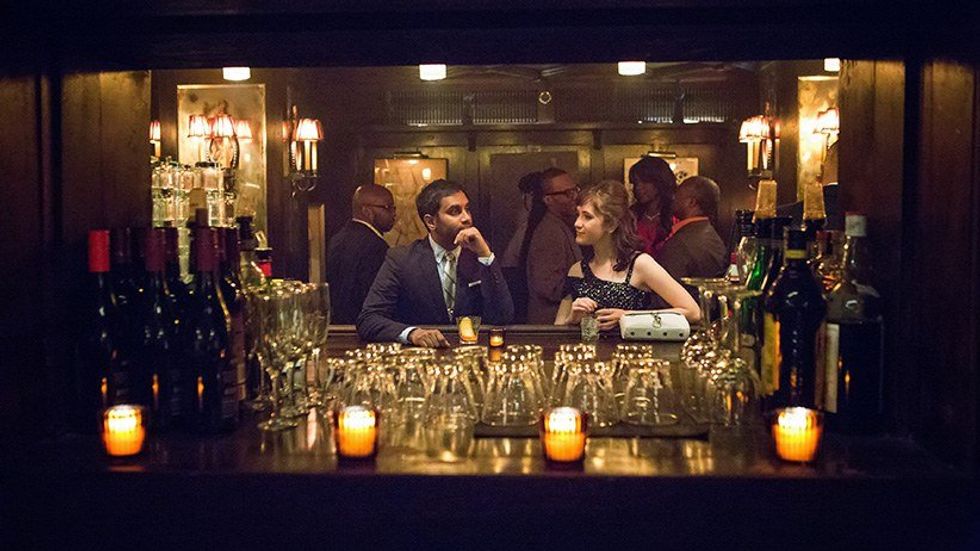
Just a little over a week ago Ansari unveiled his Netflix series, “Master of None,” which he co-wrote with Alan Yang, who was also a writer and producer for “Parks And Recreation.”
“Master of None” functions as the platform upon which Ansari, through his lead role as Dev Shah, claims agency over his identity as an Asian-American man trying to survive as an actor in New York City. With episode themes ranging from sex and dating life, immigrant parents, and racism in the acting world, “Master of None” provides a necessary insight into the lives of Asian-Americans.
The show is especially critical for the representation of Asian-American men, who often endure racist stereotypes regarding masculinity. While Ansari by no means plays a womanizing character in “Master of None,” he does involve himself with women and dating much like many men in their mid-20s and early 30s.
On the whole, a key insight “Master of None” bestows onto viewers is that Asian-Americans, much like anyone else, lead their lives three-dimensionally. They have concerns that strike many as universal, such as love, careers, and friendships, while also having to endure experiences such as racism and growing up with immigrant parents.
The choice Ansari made to avoid deep investigation into these issues until he could do so on his own terms was a smart one, for with “Master of None” he now has the freedom to tackle not only issues of Asian representation, but also representation on a grander scale. Diversity is a critical aspect of “Master of None,” with the primary group of friends consisting of a white man, two Asian men of South and East Asian descent respectively, and one gay black woman.
Upon its release, “Master of None” garnered a complimentary reception and made an impact on pop culture – a hopeful indicator of more groundbreaking Asian representation in the future.
















