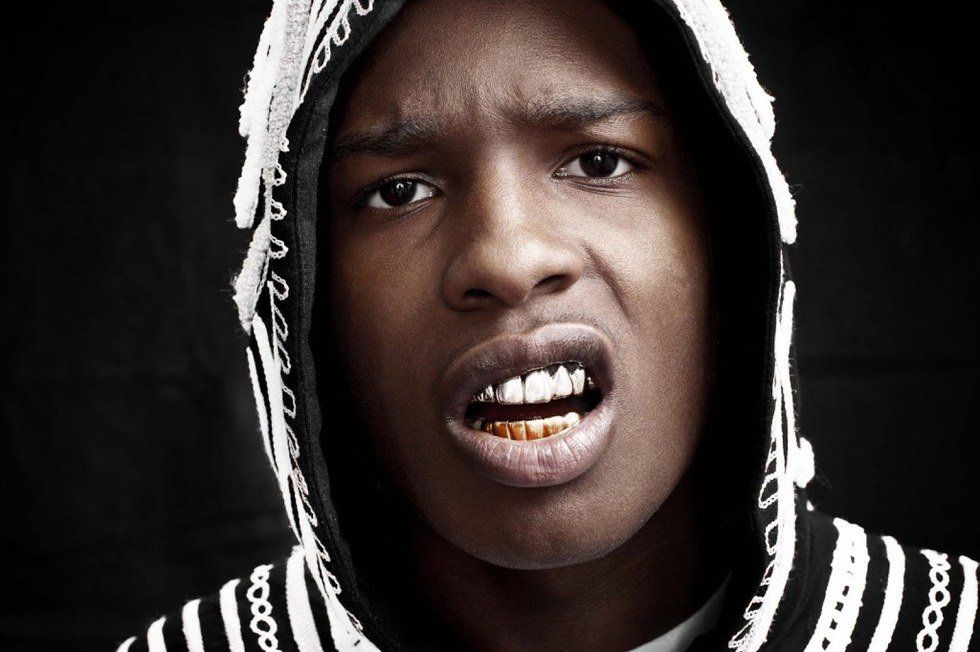
At long last, A$AP Rocky's new album, AT.LONG.LAST.A$AP, is finally here. The anticipation behind this album was heavy, for reasons bigger than the actual music itself -- the shocking death of A$AP Yams this past January caused Rocky to lose a friend, founder of the A$AP Mob, and executive producer for AT.LONG.LAST.A$AP. Losing his close friend and professional righthand man, Rocky could have easily released a disappointing album, and everyone would have, sort of, understood. Who could blame him?
The thing is, AT.LONG.LAST.A$AP is really good. I'm not saying it's an instant classic, or that it's better than Live.Love.A$AP. But it's a great album that reminds us why A$AP Rocky belongs in the top-tier of today's rappers.
Before the release of the album, what put Rocky among the best was his wide artistic versatility that continued to produce high quality music. He'll give you dope lyrics in "Peso," a radio hit in "F**kin' Problems,"an aux-cord fryer in "'Trilla" or "Multiply," or the whole package in "Goldie." He'll even give you something to rage to in his collab with Skrillex -- "Wild for the Night."
All of these songs are stylistically different, yet they're all great songs. How many artists can go out of their comfort zones, try something different, and actually produce the same high quality music?

AT.LONG.LAST.A$AP makes answering that question easy. Rocky flaunts his versatility, while also sticking close to same style of production fans fell in love with in his early work. The album as a whole has a psychedelically inspired feel to it, epitomized by "L$D," where Rocky drops rapping and sings about a mixture of love and drugs. "Fine Whine" featuring Future, M.I.A., and Joe Fox, along with "Pharsyde" featuring Joe Fox, add to the album's aura.
Juicy J, an executive producer of the album, also collaborates with Rocky on "Wavybone," which also features verses from UGK, including both Bun B and the late Pimp C. The Dirty South influence on the track sets the song apart, but it shares a platform with several incredible group projects: "Electric Body" with Schoolboy Q is appealingly groovy and "Jukebox Joints," featuring Kanye West and Joe Fox, has “Yeezy production" written all over it. "M'$" with Lil Wayne is just plain filthy (in a great way), while "Everyday" with Miguel, Rod Stewart, and Mark Ronson is melodically strong.
Still, some of the best parts of the album feature the man himself. Rocky kills both of his verses in "Excuse Me," which mixes high energy with slow, steady rhythms in a clean and fluid way. "Lord Pretty Flacko Jodye 2 (LPFJ2)" and "JD" are also embodiments of classic Rocky. I like "LPFJ2" and "JD" so much that my only complaint is that both of the songs are too short.
Rocky even shares a rare view into his emotional side, which come heavier than ever with the recent passing of A$AP Yams. The album's first song, "Holy Ghost," reflects on Rocky's thoughts on God and religion, while the album's last song, "Back Home" featuring Yasiin Bey (formerly known as Mos Def) serves as a song of nostalgia and tribute to Yams, who even speaks on the outro of the track. It only seems fit that the late leader of the A$AP Mob closes it out.
Rap has both progressed into a genre so diverse and broad that it's hard to recognize an artist's style by simply labeling an artist as a rapper. Nowadays, calling someone a rapper can mean anything from Kendrick Lamar to Young Thug, Killer Mike to 2Chainz, or Wiz Khalifa to Flo Rida. All of these different styles fitting under the single umbrella of rap show just how far the genre has progressed, and how far rap can go in implementing different genres and unfamiliar sounds.
AT.LONG.LAST.A$AP is your reminder that Flacko can successfully do it all.