Many of you reading this article right now will not like what I have to say. Some of you will. Some will be offended and try to fight me on it. Some will leave harsh comments that I will take with a grain of salt later because then I know I’m doing my job. Will I still say what I have to say? Yes. Why? Because I have the right to free speech. What I say isn't supposed to be filtered to make you comfortable.
In our society today, people are very sensitive to certain words and phrases. It seems that one really can't say anything anymore without someone getting offended. Hell, we can't even say "Christmas Break" even if one is Christian. Of course, there are certain words people shouldn't say, but there is no law stating, "these words shouldn't be spoken." Sure, we can say them, but you'll face the backlash.
Every day, at school and at home, it seems that “political correctness” is seeping its claws into our society, stripping us of “what we can say” versus “what we can’t say”. At colleges and universities across the country, where you’d expect our future leaders are educated and where you'd expect speech to be the most free, are now instilling highly-restricted politically correct speech codes that can limit the right to free speech for students.
For example, on Tuesday, September 13th, 2013 (aka Constitution Day), a student in California, and also a decorated military veteran was told he could not hand out copies of the Constitution to his fellow students. This university's ruling was not only completely infringing on free speech, but a totally unfair imposition of limiting speech. FIRE (Foundation for Individual Rights in Education) took this college to court, but the fact that they had to show how influential political correctness and limited free speech has become.
Although Miami hasn't instilled such speech-codes into our college learning experience, that doesn't mean students aren't affected by it from other students.
This past week, in my creative writing class, a friend of mine wrote a dark, heart-wrenching short story of depression, unfaithfulness, and war. Let's just say it was deep. When it came time to turn in our short stories and receive "compassionate critiques" from our fellow classmates, my friend not only received stabs of "political correctness" in her paper, but students attacked her character for writing such a twisted story. Notes among her paper included: "that's full-fledged racism" when an Afghan woman was introduced in the story; my friend had called her "a foreign woman with dark skin." She was called a "sexist" for having her female character not know how to assemble a fan, but a man did. She was accused of "slut-shaming" when the Afghan woman sleeps with the main character's ex-boyfriend and the main character flips out. Let's keep in mind this is a creative writing class that has nothing to do with the author's real-life opinions and beliefs.
As small as these situations may seem, this is just evidence of a growing sensitivity problem in the United States, and even other countries (Europe has a "sensitivity-based censorship" system that censors out anything "hateful, hurtful, or criticism of religion") that need to be reevaluated.
To me, freedom of speech is a basic human right. Intellectual comfort isn't. Don't get me wrong, I too become offended from what people say from time to time, but the fact that we can limit the freedom of speech and impose such strong political correctness, makes me wonder what our society will be like when freedom of speech turns into freedom from speech.
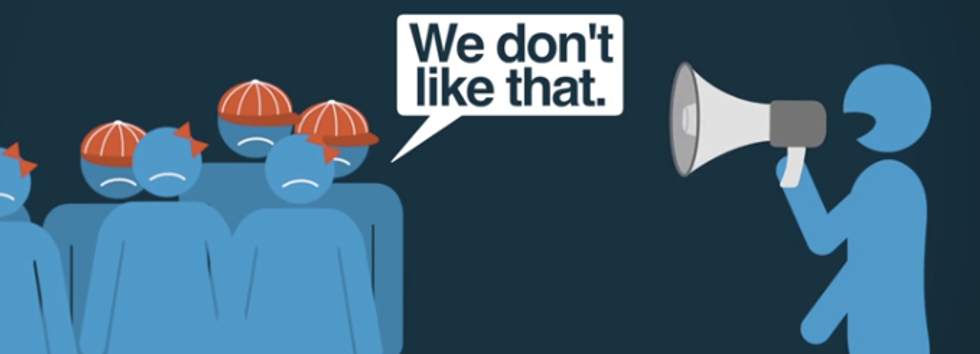
*For more information on this issue, watch this short video from Prager University.