
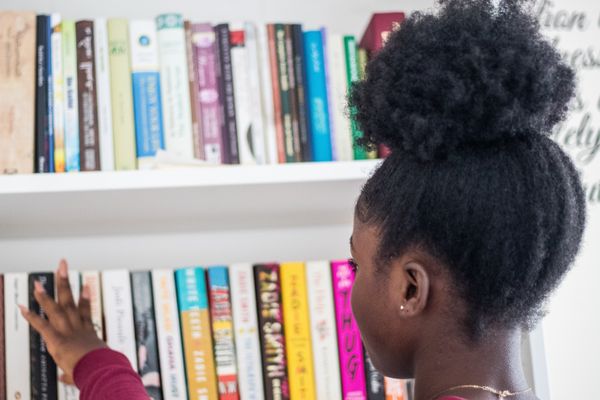

In my eyes, one of the biggest differentiators between people was what they did in their free time when they were growing up; play video games, or read books? I fell into the latter category. Of course, I enjoyed playing Spyro games on my old red Gameboy, but I loved books more than myself. I devoured novels daily, absorbing their stories and letting fiction shape my views on reality. It started off with weekends at Barnes and Noble, where I would lay in any quiet corner I could find with a stack of Junie B. Jones books in hand. Then came Jerry Spinelli’s books, of which "Stargirl" was my favorite."Maniac McGee," "The Book Thief," "Kira-Kira" (the first book to ever make me cry), "Out of the Dust," "Walk Two Moons," "The Art of Racing in the Rain" and of course the Harry Potter series sprinkled throughout, twice over.
Reading taught me patience, perspective. If I was in the middle of something exceptionally good, you couldn’t possibly move me from my room. I would be camped out for hours in there, finishing homework as fast as I could, rushing through dinner, and then settling down to read until my mom forced me to turn the lights off. I was enamored with the worlds presented to me, delighted by characters with quick tongues and unique senses of humor.
Believe me, I read trash too. "Dear Dumb Diary" captivated my entire 5th grade class, 6th grade was dedicated to "The Princess Diaries," and I spent junior high gossiping about the latest installment in the "Pretty Little Liars" books and its parallel TV series on ABC Family (way back when the show made sense). But even this helped me grow – it gave me a point of bonding with my classmates, alleviating the some of the pain of having to go through puberty and remaining alive simultaneously.
Growing up, I had never really thought that a book could ever hurt me. I thought the pure volume of novels I had conquered established me as an independent, smart, and mature teen™. I ran into "Extremely Loud & Incredibly Close" by Johnathan Safran Foer when I was 14, and in gushing its excellence to my closest friend of the time, she told me, “You have to read "Everything is Illuminated," it’s so much better”. And honestly, it was. The way it wove throughout so many different narratives so rapidly demanded my full attention, leading me to linger on every word to make sure I wasn’t missing a thing. For that, I was glad – Foer weaved words together so delicately, he made me fall in love with phrases and sentences for the first time in my life. His characters seemed real to me because I saw so much of myself in them.
He awoke each morning with the desire to do right, to be a good and meaningful person, to be, as simple as it sounded and as impossible as it actually was, happy.
It also dealt with love in a much more direct, all-encompassing way than I had ever experienced before. Brod and The Kolker’s, two of the main characters in the novel, were each other’s lives, and in the midst of so many quaint backstories and dedications to love and all its complexities, their relationship sounded quaint and complex. By the time they had been introduced as characters, I had already decided this was going to be my favorite book, so the next natural course of action was to emulate their love as what I wanted to have, what I wanted to be.
Things turned bad quick, but by that point I had let myself become blind to how truly toxic their marriage really was. Brod accepted The Kolker’s abuses because love meant sacrifice and acceptance in the face of evils. She never ran from his fists, but took them, went to them, certain that her bruises were not marks of violence, but violent love. And it wasn’t The Kolker’s fault that he beat her, he didn’t want to and he was still a good man in spite of it. I’m sorry this has been your life. Thank you for pretending with me. Somehow, I finished that book believing that if love hurt, it was worth holding on to.
A quick flash forward to my senior year of high school, where I wrote possibly the worst senior thesis on "Everything is Illuminated" in existence due to the complete breakdown in the middle of the novel I experienced because finally everything just clicked. It felt like the cause of the pain of my entire dating history was finally exposed, and it was all due to a simple misunderstanding of 276 pages I had read years ago. An attempt at an explanation to my English teacher just lead to awkward sobbing across a table, while I spilled that I was basically the result of any author’s worst nightmare. Embarrassment ensued, and then acceptance (as is the natural route for most events in my life).
Where do I go from here? With the identification of exactly why I had let myself be beaten down for so long for guys who were hardly worth a second of my time, I’ve been able to forgive myself for the harm I inflicted on myself and those closest to me during my darkest moments. Now, I constantly ask myself whether the relationships I’ve formed with others are productive and caring like I need them to be while keeping watch for my self-destructive tendencies. This process has made me incredibly reflective on what has influenced my creation of myself, and I really like who I am, but maybe I’m scared of myself too. How long will it be until I’m able to confidently tell which relationships really are turning malicious, and will I be strong enough to back away? Is that a goal that can be reached?
Maybe I wasn’t my best self back then, but I will continue to strive towards that ideal, supported by the friends I cherish and maybe with a more thoughtfully-read book in hand too.

















