


On October 28, 1922, King Victor Emmanuel III handed over the reins of power to the leader of Italy’s National Fascist Party, Benito Mussolini. A corporal in the Italian army during World War I, Mussolini drew support from the military, the business classes, the right-wing, and the Catholic Church, which was headed by Pope Pius XI at the time. As prime minister, Mussolini ushered the country into a dark period of fascist dictatorship which lasted twenty years, until his overthrow in July 1943.
Under Mussolini’s rule, anti-Semitism consumed Italy. In July 1938, the Ministry of Popular Culture produced the manifesto della razza (“manifesto of the race”). The proclamation established a hierarchy of races, with Jews at the bottom and Aryans at the top. As a result of this statement, Italian Jews experienced widespread persecution. Many lost their jobs and homes before eventually being sent to concentration camps.
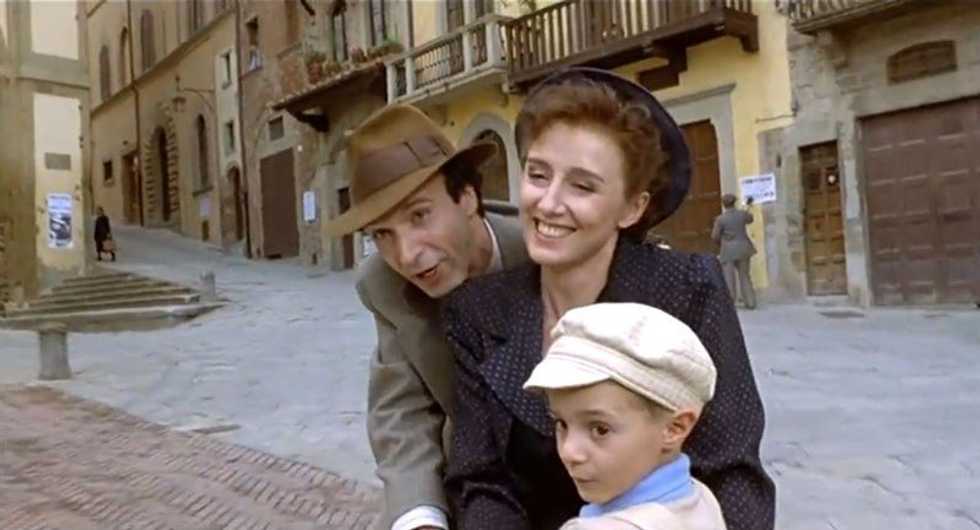
 This is the historical context which serves as the backdrop for Italian comedian Roberto Benigni’s 1997 classic film "La Vita è Bella" ("Life is Beautiful"). Written by Benigni and Vincenzo Cerami, the movie is a two-part tale centered around a gentle, cheerful Jewish-Italian waiter named Guido Orefice, played by Benigni himself.
The first half of the film, set in 1939, follows the amusing, humorous buffoonery of Guido who has just arrived at the town of Arezzo, Italy to work as a waiter in his uncle’s luxurious hotel. After several clumsy encounters with a pretty schoolteacher named Dora (Nicoletta Braschi), he sets his romantic sights on her. Guido eventually charms her and wins over her affections, helping her escape from her stiff, upper-class fiancé by whisking her away on a horse in one of the film’s most memorable scenes. Filmed with an abundance of light and soft color, the first part of the movie lends an aura of fantasy and humor to the story.
 The second half of the movie takes place about half a decade later. The couple’s marriage is implied through the appearance of a child, an endearing, adorable boy named Giosué (Giorgio Cantarini). The political climate has changed: the Nazis have occupied Arezzo and Jews are beginning to face harassment. This culminates in Guido and Giosué’s internment in a concentration camp (Dora soon joins them, forcing the Nazi soldiers to let her board the train with her family). Once there, Guido convinces his son that they are all playing a game which pits prisoner against a prisoner in pursuit of the grand prize, a brand new tank. In the end, Guido is assassinated, but his family -- and his creative deception -- survive him. Throughout this final portion of the film, cinematographer Tonino Delli Colli’s use of dark, drab colors along the black and white continuum conveys the desperation and brutality to which Guido and his family have been subjugated.
The resulting film is an expertly crafted piece which juxtaposes comedy with the tragedy of the Holocaust to shed light on humanity’s capacity to harness great hope and optimism in the face of tremendous adversity.
Guido stands out as the character who best exemplifies this remarkable ability to approach hardship with rose-colored glasses. From the beginning of the film until his death at the end, he remains largely cheery and exuberant - rarely is he seen in a moment of desperation. Guido’s relentless optimism can be attributed to both his adherence to the Schopenhauer Method and his fiercely innocent perspective on life. Taken together, these idiosyncrasies allow Guido to translate his fantasies into his reality, thus enabling him to maintain a consistently hopeful outlook.
Early into the film, Guido’s friend, Ferruccio, introduces him to the Schopenhauer Method, proposed in the 19th century by the German philosopher Arthur Schopenhauer in his most famous work, "The World as Will and Representation." Schopenhauer suggests that the will is a universal, not individual, force: the rational mind has no power over this omnipresent will, which is also the source of all suffering. Life, according to the philosopher, is aimless and tedious; the will yields misery and, if possible, should be annulled.

Yet Guido, ever the idealist, misinterprets this idea to mean that the force of will alone can spawn actions and shape a person’s surroundings. Indeed, any time Guido invokes the Schopenhauer Method, the technique does appear to work (albeit through a series of coincidences). At the Offenbach opera, Guido uses it to make Dora look at him. In the concentration camp, he uses it to will the Nazi guards’ dog away from Giosué’s hiding spot so that the latter is not discovered. Guido’s use of this technique to effect positive change in his life and fight Fascism, as in the second example, infuses Benigni’s film with irony, since many critics claim that Schopenhauer’s ideas served as inspiration for the Fascist regime.
Guido’s nearly childlike obsession with the Schopenhauer Method fits in neatly with his endearing naivete and innocence. His misinterpretation of the technique, which he views as a magic trick rather than a mindset, reflects an attitude characterized by the belief that extraordinary occurrences are possible. This outlook frequently renders him incapable of grasping, or acknowledging, the cruelty around him. When his uncle Eliseo’s horse is spray-painted with the words “Achtung, Jewish horse,” the elder warns Guido about impending hostility. The latter, however, laughs it off, viewing the incident as an isolated prank rather than a broader omen.
When he and his family are shipped off to the concentration camp, Guido reframes their dire situation into a game in order to shield his son from the brutality of human nature. Here, Guido demonstrates an increased awareness of, or willingness to acknowledge, humanity’s capacity for cruelty. Yet, by devising the game, he chooses to preserve and defend not only the innocence of his child, but his own.

When Giosué sees his father performing forced labor -- stumbling upstairs with the heavy anvils which he and his fellow prisoners are made to carry - Guido explains that they are simply building the tank which will be awarded to the winner. When Giosué relays to his father rumors about the soldiers making buttons and soap out of Jews, the elder laughs at the sheer absurdity of the idea, assuring him that it’s just the crafty children attempting to convince him to forfeit the game. In this way, Guido imposes his optimistic -- although intentionally constructed -- outlook on his son. Although Guido, Giosué, and the prisoners are all made to suffer the same misdeeds at the hands of the Fascists, the differences in their perspectives paint their experience in the camp.
Guido’s innocent worldview and belief in the Schopenhauer Method combine to transform his fantasies into reality: he revels in creating fictitious worlds both for himself and others. He often does this by preparing series of coincidences which appear to have occurred by magic. Although he knows that these schemes rely entirely on manipulation, it is not the deception in which he takes pleasure; rather, he finds joy in creating an alternate world for his loved ones.

When he rescues Dora from her fiancé by riding up on a horse, he is indulging the fantasy of the knight rescuing the damsel in distress. In reality, he actually is saving her from her stifling surroundings, and their mode of transportation is an actual horse. Similarly, Guido reconstructs the concentration camp into a game in order to imbue his son with hope. By the end of the film, when the American tank arrives at the camp and pulls up before Giosué, this fictional game has become reality: Giosué has indeed won the game and survived.
Despite the rampant evil surrounding him, Guido refuses to allow man's failings to taint his optimistic worldview. Benigni uses Guido’s character to argue that innocence is something chosen; it is a particular outlook on life, not a pure, static trait which can be spoiled. This attitude, combined with his unique interpretation of the Schopenhauer Method, enables Guido to live his fantasies. In doing so, he is able to transform the dark, tragic cruelty around him into his optimistic, hopeful reality.

















