
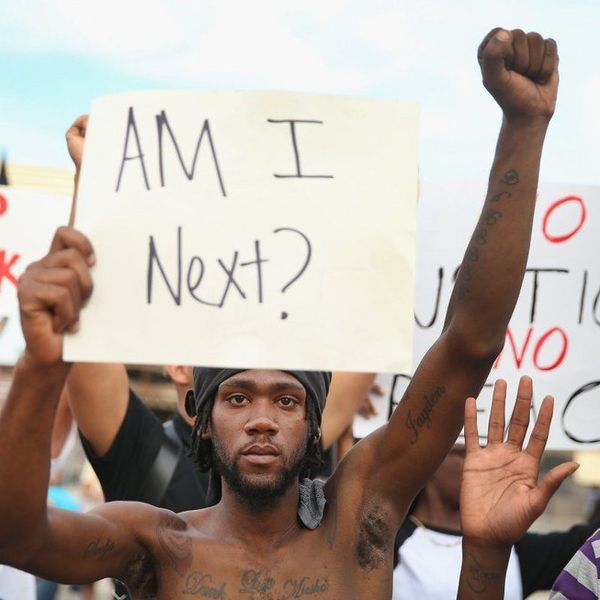

If you’ve ever spent more than 10 minutes on the internet, I’m sure you’ve come across someone asking the question: “Why are you making this about race?” Talking about race is messy and uncomfortable for many [white] people, but some outright refuse to acknowledge that it’s even worth discussing. With every police shooting, every death of a black man, woman, teenager or child that makes the news (and it’s worth pointing out there are so many that don’t ever reach the news), you are bound to see someone asking why it’s even a point of interest that they were black. Take a look at the cases of Freddie Gray, Sandra Bland, Eric Garner, Michael Brown, Sam Dubose. I would put money on the fact that I’m sure I heard someone ask, every time, why their deaths had anything at all to do with their race.
(For the record, other non-white groups are targeted by police as well, and also face criticism when their race is acknowledged as a factor. However, this articledeals mostly with the “why is race important?” question being asked regarding incidents involving black men or women.)
“This shooting wasn’t about race. This crime wasn’t about what they looked like. This death didn’t have anything to do with their skin color. Why does it always have to be about race?”
I’m going to assume that, most of the time, that question comes from a place of ignorance, which is okay. Privilege allows you to move through life unaware of a lot of things that are really going on in the world, and you have to work actively to keep from being blinded to them. So for all of those people who keep asking the race question, I’m going to do my best to help you out. I’ll try to explain to you why so many of the events that have transpired lately are being tied to race.
Before I start, I want to put in a disclaimer that I’m white. I do not, and will never, experience any sort of racial prejudice against me. Because, again, I’m white. I experience prejudice in other ways, but not in terms of my race, which, once more, is white. When discussing racial prejudice, it is always important to listen to voices of those actually experiencing it. The voices of people of color are the ones to prioritize when trying to discuss the complex issues of race.
However, since I would bet that most of those people are tired as heck of dealing with people asking the “Why is this about race?” question, I am going to try and put in my two cents.
For white people (like myself), it is very hard to imagine a world wherein our lives are constantly affected by our skin color. Actually, scratch that - it’s hard to imagine a world where our lives are constantly negatively affected by our skin color. Because everyday we benefit from the simple fact that we are white.
For people of color, the opposite is true. Race dictates how they are seen in the office, walking down the street, entering a store. Like it or not, we don’t live in a colorblind society. And we never will. You can’t just decide to “not see race;” weirdly enough, the world doesn’t work like that. American history has always been shaped by race. And when I say that, I mean it’s been shaped by white people trying to oppress non-white people. We don’t make things about race, the world we live in has already done that for us.
So, these tragic incidents where we see confrontations between white police officers and black people ending in injury and death- those events were shaped by race long before the public found out about them. No one truly sits at home and wonders how they can make different events more related to race; they come to us already tied to racial history and the current race relations in this country. They are prepackaged with racial elements slapped all over them. When a black 17-year-old boy is shot and killed for appearing “suspicious”, while a white killer of 8 is captured alive by police, you would have to be working pretty hard to not think race had anything to do with it.
So when you ask the “Why is this about race?” question, what it seems like you’re doing is brushing a whole lot of important context about race under the rug without a second thought. Race is not something we can ignore, and it’s not something we can separate from any of these incidents cleanly.
In fact, if you’re still asking that question, I’d like to counter with my own. Why are we always trying to make it not about race? Look at the Black Lives Matter movement, for example, which began in 2012 after the death of Trayvon Martin. Some people take offense to the singling out of one section of the population and suggest All Lives Matter as a more “encompassing” slogan. And you know what? Of course all lives matter. But that’s kind of a ridiculous thing to say, isn’t it? No one is going around shouting about how all lives don’t matter. Black Lives Matter is saying that what we need to highlight is the fact that black lives do matter, because what’s going on in this country right now is definitely making it seem like they don’t. And if you can’t handle that, if you can’t deal with someone prioritizing black lives for a single movement, then that’s probably something you need to think about.
Look, here’s the thing, fellow white people: we don’t really get to tell a person of color whether something is racist or not. Honestly. We have absolutely no place to tell someone that an incident had nothing to do with race. Nor do we have the right to question whether we should even bring race into a discussion. And the reality of that is because we have no clue what it’s like to live as a non-white person. We have the luxury of not worrying about race all the time; people of color do not. We do not know what it’s like to be racially oppressed. We will never fear death because of a traffic violation, or simply the clothes we are wearing. We live in a world where the system benefits us. And if we can ever hope to change that system, we need to recognize this.
I encourage everyone to check out the Black Lives Matter website for more information about the movement. Additionally, I found I, Racist by John Metta to be very informative, and would recommend it to other white people who hope to gain a better understanding of what exactly we must do.

















