


In the early years of the Cold War, no realm of American society was exempt from the hysteria engendered by the so-called Red Scare. Fear of communism and its supposed infiltration was near ubiquitous. Interestingly, though perhaps unsurprisingly, Hollywood became the favored battleground of Joseph McCarthy and his fellow demagogues. The infamous Hollywood blacklist sought to destroy the careers of any actors, screenwriters, directors, etc. suspected of communist activity. Due process was inapplicable. All this was done, of course, in the guise of democracy.
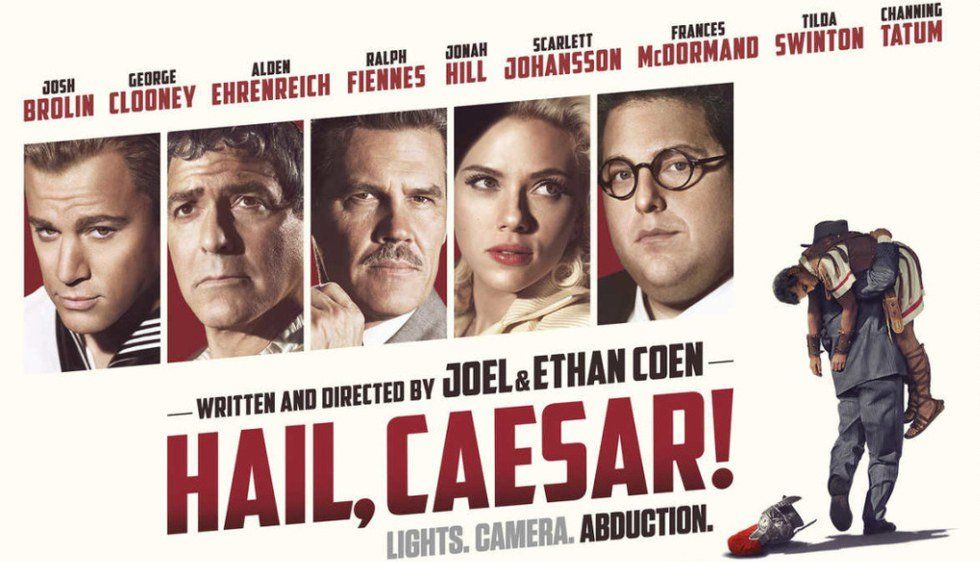
Set in Hollywood in 1951, Joel and Ethan Coen’s latest movie, “Hail, Caesar!,” is a smart and original satire on this rather tired subject, as well as on several others. Like many Coen films, “Hail, Caesar!” largely defies categorization. The plot is straightforward and irrelevant, merely providing occasion for (often times humorous) commentary on the ethos governing America in the mid-20th century. The number of characters is matched only by the number of themes. A lot is happening beneath the surface of this film, which evokes 1991’s “Barton Fink” for its subject matter and 1998’s “The Big Lebowski” for its comedic style.
The story’s protagonist, Eddie Mannix (Josh Brolin), heads Capitol Pictures, a major Hollywood production company. In addition to superintending the production of movies, Mannix serves as the de facto public relations manager for Capitol’s biggest stars, insulating them from the tabloids. He is also a practicing Catholic who attends confession regularly (his “sins” are banal things like lying to his wife about how many cigarettes he smokes).
Mannix is beset by a chaotic schedule that keeps him from his family. Things become a little more stressful when one of his most bankable actors, Baird Whitlock (George Clooney), is kidnapped from the set of the eponymous film (Capitol is producing a movie called “Hail, Caesar!”). Dramatic irony is employed: the viewer sees two extras drug Whitlock and carry him away; Mannix only knows that Whitlock is missing, and assumes he left to get drunk.
Before we find out where Whitlock was taken, it’s revealed that Mannix has been offered a lucrative position with Lockheed Corporation, who quietly boast about their contribution to the newly-designed hydrogen bomb. Mannix is ambivalent about the opportunity, although it’s not clear whether his ambivalence is due to a love for movies or a reluctance to work in the weapons industry.
Baird Whitlock, it turns out, was abducted and taken to an oceanfront property by a group of (inept and pathetic) communists, most of whom used to write screenplays for Hollywood films. Calling themselves “The Future,” they write Mannix a note demanding $100,000 in ransom. Mannix moves to fulfill the ransom without hesitation. Meanwhile, Whitlock begins to sympathize with the communist cause.
Central to “Hail, Caesar!” is the juxtaposition of Whitlock’s indoctrination and Lockheed’s courting of Mannix. Both men are pressured to play a more proactive role in the developing ideological conflict between east and west. Mannix is already an arch-capitalist, but he now has the chance to become a Cold War bureaucrat. Whitlock, his name a pun on his utter lack of wit, is being pulled in the other direction, into the fifth column.
The Coens’ penchant for slapstick and bathos is fully indulged here. At times, these tendencies have fallen flat (see the dreadful “Intolerable Cruelty” and the mediocre “Burn After Reading”), but they work well enough in “Hail, Caesar!” The general coherence of the narrative and consistency of tone, seem to keep everything in check; even the aggressive—and totally expected—anticlimax is palatable.
Baird Whitlock’s final speech is a classic Coen letdown. On the cusp of some profound truth—perhaps a philosophical or spiritual epiphany—Whitlock loses the thread and the moment is ruined. The audience laughs; at least, I did. Indeed, there are plenty of occasions for laughter throughout, for instance, the meeting between Mannix and four religious authorities, who have been brought in to discuss whether “Hail, Caesar!” is blasphemous. Alden Ehrenreich gives a risible performance as the knuckleheaded Hobie Doyle, and Channing Tatum is fantastic as a sendup of Gene Kelly. Even Jonah Hill, in a bit part, made me laugh.
In short, “Hail, Caesar!” is everything you’d expect from a satirical/metafictional/parodic/historical Hollywood mystery comedy directed by the Coen brothers. There’s very little not to like.
















