
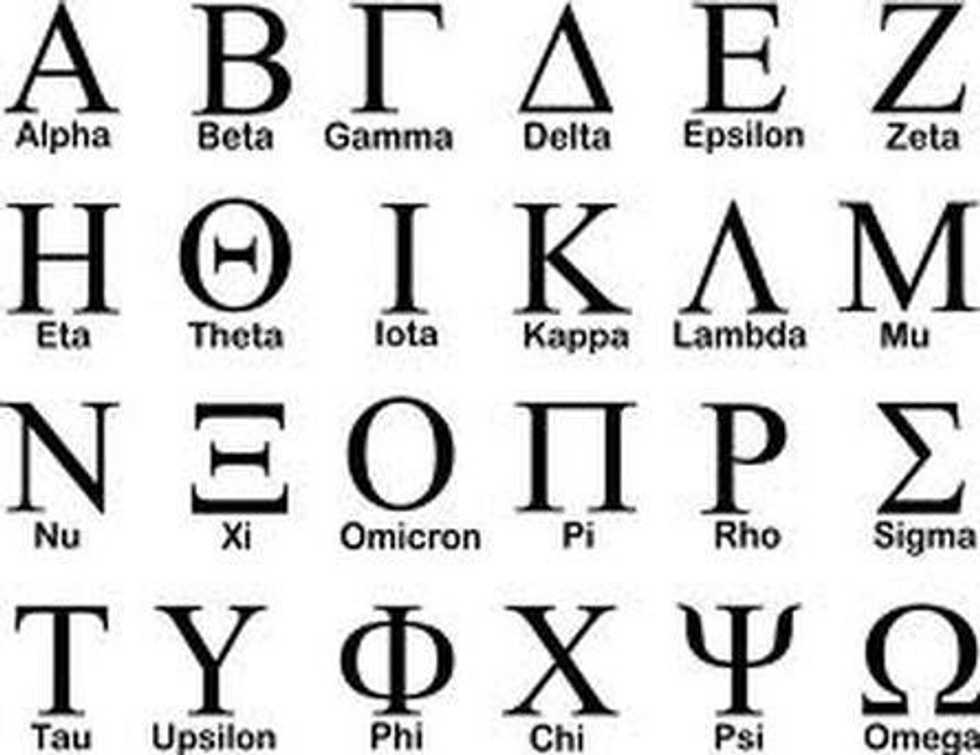
I may be treading on unholy ground writing an indictment on such a prolific part of modern collegiate culture—the fraternity and sorority system—but it's something I feel needs to be discussed. The issue that I will be exploring in this article is not an issue with Greek Life itself or with any individual organization therein, but the way that Greek men and women portray themselves through media.
I write this article as a member of a fraternity that is very dear to me, as well as a leader of a sports team and as the classical academic-type (some would call me a "nerd"). I see myself as a person who's exposed to a wide breadth of experiences available to a college student (at least at my university), and can comment impartially, as I have been heavily involved on both sides of the hypothetical Gates of Troy.
Any organization, especially one that is both controlled and populated by college students, has inherent problems; this is unavoidable. Every organization, Greek or otherwise, has growing pains, outside pressures, and internal conflicts. My belief is that Greek Life is not doing itself any favors by making the assumption that people look down on them in any way. Now, I must condition that statement with the added fact that there are some very ardent anti-Greeks (known as Persians). I was once one of these and I am very good friends with a few outspoken critics of Greek life.
It's hard to look at the front page of The Odyssey or a similar website or my Facebook news feed without seeing someone's article refuting myths or stereotypes about sorority girls or frat guys. So ultimately, this article is a plea to all members of Greek Life to end the inferiority complex that they project to the rest of the collegiate world. It's also an exposition on the issues caused by these tendencies.
I hope that this notion can encourage some serious discussions that can address the weaknesses of Greek Life in a different and hopefully effective way.
Systemic Weakness.
In an organization that is dependent on recruiting and attracting new members to survive and thrive, a strong public image must be established and maintained. It would be ridiculous to assume that a young man would pledge to a fraternity that appears weak. A major part of joining a frat or sorority is the social currency that comes with being a member. You are joining a select and very special group when you join a Greek organization and a very important part of that is understanding its benefits.
By continually debunking and discussing the fallacies associated with Greek life, you perpetuate them. Much like with anything else, most logical people assume that any long-standing stereotype must be rooted in some type of truth. When people defend Greek life, the project the weaknesses of their organizations for all to see and scrutinize—it's only a matter of time before unpopular and truly detrimental opinions become what many consider to be common knowledge.
The continued weathering of public opinion will, before long, begin to turn opinions very sour; parents, professors and mentors will begin cautioning students against going Greek in favor of them being more independent. When this happens, it's only a matter of time before recruiting dries up and organizations begin to whither away.
No Explanation Necessary.
I hear this phrase tossed around quite a bit when it comes to exclusive organizations: "From the outside you can't understand it, and from the inside you can't explain it." This sounds like a great piece of ideology to grasp, until you feel the urge to explain yourself to someone who doubts the merits of your organization and you are unable to because you cannot relay your message in terms that will make sense to the other person.
The mother all indictments is of course: "why would I want to pay for friends". The problem with the typical explanation goes into exactly what dues pay for. The problem with this response is that it doesn't really answer the question. Most people understand that organizations require money to be financially solvent, however it is still up to you whether this is a price you would be willing to pay for the experience of Greek Life. Maybe instead of attempting to justify your dues in the terms of someone else, it might be a better solution to simply tell them how worthwhile it was to join and that you would recommend it to anyone.
Also, it helps to understand that there are certain people who simply cannot be convinced that Greek Life is in any way beneficial. It's important to accept that it isn't for everyone and if it were for everyone, your experience wouldn't be nearly as special.
The Self-Perpetuating Cycle.
As a member of a Greek organization, you have been chosen from among many to become a member of a very influential and exclusive community. The fact that you are in one of these organizations means that, in theory, you are of a caliber higher than the average student at your institution. The criticisms of those who are not on the inside should not have much traction or or be given the acknowledgment that you would give someone who has experienced Greek Life. This concept works in the rest of life as well; there is no reason to listen seriously to anyone who is novice in a field of which you are an expert.
There will always be those who have something negative to say about your fraternity, sorority, team, or club. These people don't understand what the organization means to you and to the others in it, as they can only scratch the surface or view the image projected to them by the organization. This then relates back to the fact that the organization must show a strong image that is positive for all. This image is key, and with an inferiority complex, weakness is projected, perpetuating the cycle of excessive criticism and defense mechanisms.
In the current state of things, Greek Life is alive and well and will continue to thrive in the foreseeable future, regardless of its critics and shortcomings.
I believe that by reflecting upon both our own and our group's confidences and weaknesses, we can work to change or accept them instead of denying or providing justification for their existence. We can take up a personal challenge to make ourselves both more accountable and hardier against the judgement of others.
Again, I hope that this essay can inspire discussion and genuine introspection into what it means to be in a fraternity or sorority and your relationship with those who have chosen not to pursue that lifestyle. I also hope that people can become more cognizant of the messages that they are projecting from their organizations and more considerate of the unintended affects of those signals.