

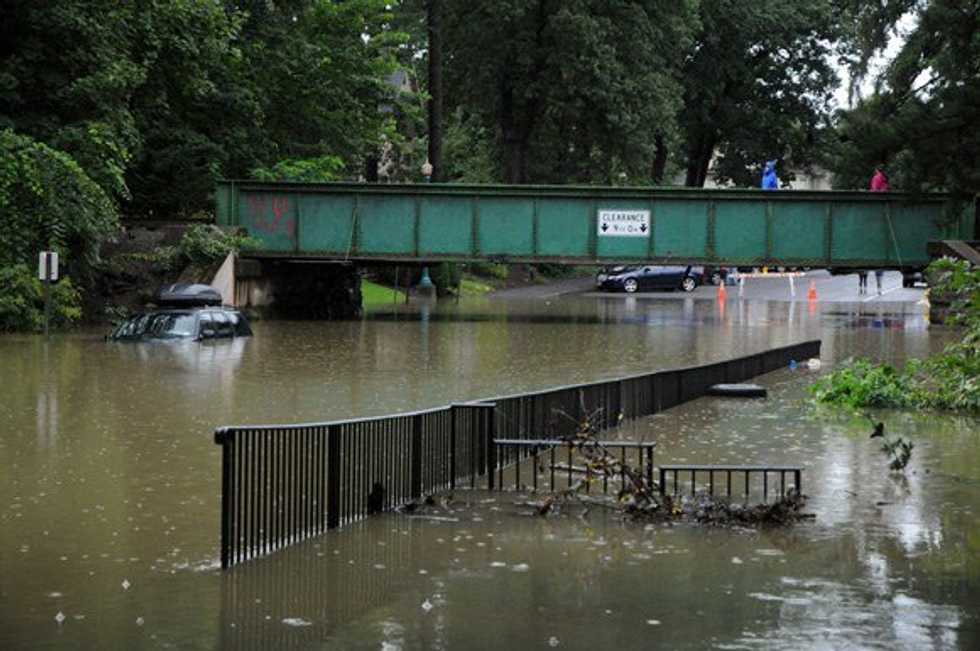
Nestled among the trees and farms of the Susquehanna River Valley, Lewisburg is a vibrant, charming town in central Pennsylvania. Quaint shops line the main road, while pedestrians are often out and about, basking in the fresh air and taking in the abundant sunshine. However, because of the location of Lewisburg between three watersheds, the risk of flooding from the Susquehanna River is high; according to the Susquehanna River Symposium held at Bucknell University, the river “has proven one of the most flood-prone watersheds in the nation” ("Susquehanna River Symposium." Bucknell.edu. Bucknell University. Web. 31 May 2016.). Lewisburg has been flooded approximately every fifteen to twenty years, primarily due to the West Branch of the Susquehanna River (Strawser, Justin. "Flood of Memories." The Daily Item. 16 Mar. 2016. Web. 31 May 2016.). This watershed is one of two main branches of the river, along with the North Branch, and has been the cause of thirteen significant flood events since the late nineteenth century.
In March 1936, melting ice and snow accompanied with heavy rain caused extreme flooding in Lewisburg. People were stranded in the upper levels of their homes for days, while many homes were destroyed. The Susquehanna River crested at approximately 33 feet, displacing thousands from their homes and causing $67 million worth of damage in the Susquehanna River region alone. This devastation became the catalyst for federal legislation concerning flooding, specifically The Flood Control Act of 1936. Passing swiftly through Congress and ultimately signed by President Roosevelt, this act financially supported the building of dams and levees throughout Pennsylvania.
In 1972, however, when Hurricane Agnes aggressively hit central Pennsylvania, the flood-control projects were not strong enough to withstand the influx of water. The Susquehanna crested at over 36 feet, resulting in $2.1 billion in property damages as well as 48 lives lost throughout the state (Kury, Franklin L. "40 Years after Agnes, Flood Management Remains an Issue." PennLive.com. PennLive Op-Ed, 20 June 2012. Web. 31 May 2016.). Houses along the Susquehanna River in Lewisburg are in the flood plain, and when the usually three feet deep river crested to 36 feet, over a foot of water flooded the first floor of homes.
Following this devastation, Lewisburg razed many structures and replaced them with Hufnagle Park, named in honor of the former Lewisburg chief of police who died there while trying to rescue someone from floodwaters in 1973. It is bordered by Bull Run, a creek that is rip-rapped to stabilize the bank against flood erosion (Jones, Janet. Learning from Lewisburg: A Walking Tour. Print.). Furthermore, laws were passed in 1978 requiring every town with a 100-year flood plain to regulate construction and require flood insurance. Although flood insurance is not required for those who do not live within the floodplain, Lewisburg highly suggests that every citizen obtain it due to the hazards that come from living adjacent to a river ("Lewisburg Borough Flood Information." Lewisburg Borough. Web. 02 June 2016.). In the words of the late Adam Bittinger, a Pennsylvania state representative, “I am convinced that it is far cheaper to prevent damage than to repair or replace; it is a whole lot less painful to be a bit limited sensibly in where and how we build than to dig through the muddy remains afterward trying to salvage a little bit of our lives or, worse, looking for the bodies of friends and loved ones” (Kury). His words remained with those living on the banks of the Susquehanna River, leading to the demolition of houses too close to the water; in downtown Lewisburg, these homes have been deemed Repetitive Loss Property by the Borough of Lewisburg (Lewisburg Borough Flood Information).
Since these laws were passed, the rate of flooding has decreased dramatically. New construction has been built with first floors consisting of only the garage and non-living space because flooding is almost guaranteed (Jones).
A primary aspect of Lewisburg is Bucknell University, which is the largest private liberal arts school in the nation. Housing 3,600 students, flooding to Lewisburg can be devastating to the university. The floodway, or the area of land that must be reserved because it is adjacent to a body of water, crosses through the back of campus, while some dorms on the downhill side of campus are within the 100 year flood plain (Ferrante, Julia. "Historic Flooding Event Prompts Rare Bucknell Closing." Bucknell.edu. Bucknell University, 8 Sept. 2011. Web. 31 May 2016.). In the most recent flood of 2011, the flood water submerged cars, reached the tops of overpasses, and led to the evacuation of 1,100 students living in flood-prone areas throughout campus. Water quickly surpassed the flood walls, surprising students at how quickly flooding can occur. This flood in 2011 was the result of Hurricane Irene and Tropical Storm Lee, which occurred just a week apart. They made the ground impermeable because it had already absorbed an excessive amount of moisture in a short amount of time, so it was too wet and the water had no where else to go. Creeks had already overflowed and the Susquehanna was rising, creating dangerous conditions.
Although Lewisburg has made progress in the affects of flooding, a neighboring town, Sunbury, has been much more successful in combating the frequent flooding. Located near the merging point of the West Branch and the North Branch, it is very susceptible to flooding, and after the Flood of 1936, the townspeople decided that something had to be done to prevent another catastrophe. As a result of the Flood of 1936, Sunbury was under up to 15 feet of water, 6,000 residents evacuated, and more than $4 million worth of damage (Strawser).
The town came together to construct a 2.4-mile-long concrete wall to keep water away from the town. At 7 feet high, it has since protected Sunbury; when Hurricane Agnes hit in 1972, the water, just barely, did not exceed the top of the wall. Today, along with the wall, there are 2.6 miles of levees and six pumping stations, constructed to pump the excess water out using an advanced system that continuously monitors the water (Strawser).
Although the frequency of floods throughout the Susquehanna River Valley has decreased, laws need to be made more stringent. People do not understand that power of flooding until it is too late, and the changing landscapes require adaption of the laws. Although Bucknell is working to negate the negative effect that humans have had on the landscape by restoring a stream on campus to help reduce downstream flooding and, in turn, restore the flora and fauna of the area ("Restoring Miller Run at Bucknell University | Turf Trends." TurfTrends.com. Bucknell University, 22 Oct. 2015. Web. 31 May 2016.), flooding is still an issue. Chris Duffy, a professor of civil and environmental engineering at Pennsylvania State University, alluded that many homes not in the 100-year flood plain may be now because of the increase in development. There are less permeable regions because of the influx of homes and businesses, so the water cannot be absorbed into the ground as much as in the past. Therefore, some buildings that are not classified as being in a 100-year flood plain may be now because of run off, which home and business owners should be made aware of (Begos, Kevin. "On Ancient Susquehanna, Flooding's a Frequent Fact." Huffington Post. Associated Press, 9 Sept. 2011. Web. 31 May 2016.).
Thus, despite the picturesque skyline visible throughout the town, Lewisburg and surrounding areas are at risk for flooding because of their location on the banks of the Susquehanna River. Multiple floods throughout the past hundred years have influenced laws and guidelines for living in flood plains, but the hazards are still eminent. Thousands of people are displaced every few years, and homes are finally being torn down to prevent further damage. However, Lewisburg will continue to be the historic, charming town in central Pennsylvania that it has always been, slowly strengthening its ability to combat the flooding and allow for further growth as not only a town, but a home to permanent residents and students alike.