

I have some good news and some bad news for you.
The good news is that you’re unique and wonderful and special.
The bad news is, so is everyone else.
And the problem with both of those statements is that they are both at once true and false. They’re sort of like those two doors in the movie "Labyrinth," which features iconic lines like that weird, creepy “I will be your slave” thing and David Bowie’s angrily-huffed “tra-la-la?” which just comes right out of nowhere (the MO of the entirety of the '80s).
But I digress. In the movie, there are two doors that can speak, and one says it always tells the truth and the other says that it always lies. But therein lies the riddle: how could one door truthfully say it always lies if it is always lying? You see that craziness? Imagine my young mind trying to pick that one up.
Anyway, if we take that incident and butcher Schrodinger to apply him to our situation (this one’s for the cat), we could see both doors as being both true and false at once, living in a stasis of both/neither until we figure out the answer. In the case of the conundrum posed at the beginning of this article, we see both the overly-optimistic statement regarding everyone’s individuality (oxymoronic much?), while also examining the blandly-pessimistic regard of everyone being unique, so therefore nobody is.
I figured out not too long ago that I’m personally unhappy shoving things into black and white areas, as rigid guidelines lead to contortionism, and I don’t know about you, but I’m not very flexible. I’m probably about as flexible as a wet rock, which is notably no different from a dry one in terms of flexibility. So to see these statements in the stasis of occupying the grey area of neither/both is a lot more comfortable for me. It’s also, incidentally, more true to real life.
Most people will find others they have at least one connection with. You like Bon Jovi, and I like Bon Jovi. Nice. We’ve made some weird sort of connection, which can bring us together in a semi-awkward situation. We’ve got something basic to fall back on.
And in other situations, we will find people we have absolutely no connection to. Why the hell do you think "Coraline" is a shit film? Get out of my house. I will call the police. I will sic my new dog on you (her name is Scarlett, and she’s a 5 or 6-year-old purebred boxer. She is a big droopy baby and I love her). In those awkward circumstances, we’d be more likely to drill holes in each other's fingernails than anything else.
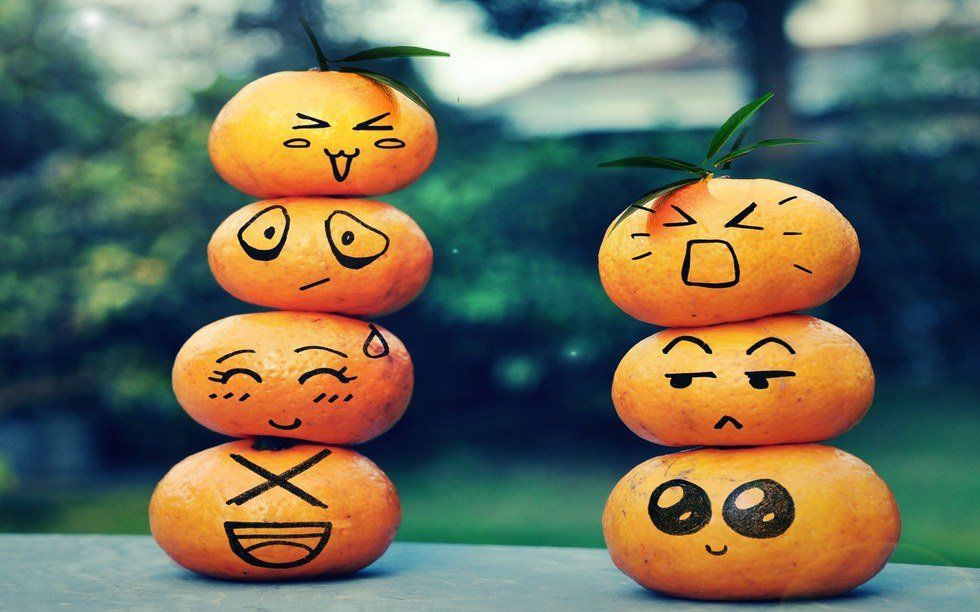
But in mutual enmity there is also a connection: emotion. Emotions are strong things, even when they’re mild. If we’re feeling content, we make vastly different decision than if we’re feeling actually happy. Same with anger and spite, or sadness and depression, or even those emotions that make up dichotomies, like insecurity and confidence.
We all feel these things. These emotions all march their little parades through our heads whenever they feel like it. But the problem with assuming that everyone is the same is that we are definitely not. Even down to our basest desires, people feel things a lot differently than others. Empathy is such an important feeling because of this: true empathy lies in distinct recognition of a similar feeling, or at least being able to stretch ourselves out enough to feel it too, and that’s powerful and strong. We need empathetic people, or at least forgiving ones, in our lives because we’re all going to act like an arse to someone we know and love and don’t want to act like an arse to. Emotions are not always going to be comprehensive things, and rarely are in the first place.
Not to mention the fact that people are constantly changing: we are liquid trapped in glass bottles, sloshing around as we move and experience new things. Imagine if every new experience was a drop of food coloring, and each reaction was a movement—or lack thereof—of our bottles. We would change, and we would be expected to change. That’s the beauty of being human: we absorb so much, especially the things that happen to us, and often turn that into something new, or use it to transform something else around us, or even just use it to stay motivated or to learn.
What I’m trying to get at is that people around you are rarely going to be the same person tomorrow that they are today, and that’s a good thing. That’s OK. If we didn’t grow as people, then we’d doubtless be sitting on the couch watching something mindless like Spongebob all day. People seem to think that when you stop physically growing, you also stop mentally and emotionally growing, but you don’t. Your brain is tireless in its work, and it uses what goes on in your life to change and adapt. No matter how many times you’re stung by a bee, it’s going to hurt. No matter how many experiences your brain absorbs, it’s still going to react to new ones.
People change. Emotions are not “one size fits all,” but are complex indicators of those internal changes, or even just spur-of-the-moment reactions to stimuli. And we may not always understand one another, but we should dedicate more time to learning how. People are all immensely different, because of how we all continue to change, continue to use the strange gift of sentience to let ourselves be altered or to alter ourselves of our own volition.
I guess my bottom line here is that we all react differently to things, but we shouldn’t begrudge one another that. We can’t.
Don’t be afraid to step back if you don’t understand. Don’t be afraid to ask what’s going on. Don’t be afraid to leave it alone. Don’t be afraid to step up and help.
Don’t begrudge others for changing, because we all do. And don’t begrudge yourself for it either, because you change, too. You’re not alone, and yet you’re always alone. Isn’t life funny like that?













