Imagine a world where no group of people ever experiences discrimination or hate based on race, gender, class, sexuality or any other trait. Wouldn’t it be nice if everything that everyone said fostered respect and appreciation? We could all come together and celebrate our differences, and life could be so much happier.
Unfortunately, that isn’t how the world works. There are hateful and angry people living among those of us who know everyone to be humans regardless of our differences. Everyone, no matter their opinions, is given free speech. Disagreements and disrespect will happen, offensive things will be said, and that’s unlikely to disappear anytime soon. This is why “safe spaces” aren’t helpful. They may seem to be an oasis in a vast, cruel world, but they do much more harm than good.
“Safe space is a term for an area or forum where either a marginalised group are not supposed to face standard mainstream stereotypes and marginalisation, or in which a shared political or social viewpoint is required to participate in the space” (Google).
Before addressing the problems with safe spaces, I want to point out that I can definitely see some limited benefit from them. If someone experiences discrimination and hate speech on a regular basis, safe spaces can be a way to escape such hostility. People know they can have a break from hearing these hurtful words and have some room to breathe. As an individual who lucks out when it comes to many traits like race and class, I do not know what it is like to have experienced some of the things that marginalized individuals have. Although I may experience some sexism, others hear offensive words or phrases directed at them daily. So I understand that it may be easier for me to advocate against safe spaces. But considering that safe spaces do not solve these hateful attitudes, I stand by my opinion.
Also, by arguing against safe spaces, I’m in no way defending the discriminatory and intolerant opinions of others. It’s true that free speech means that we can say whatever we want with little exception, but that doesn’t mean we shouldn’t filter and consider our words before putting them out into the world. Safe spaces are simply the other extreme, filtering too much, and it also causes a lot of problems.
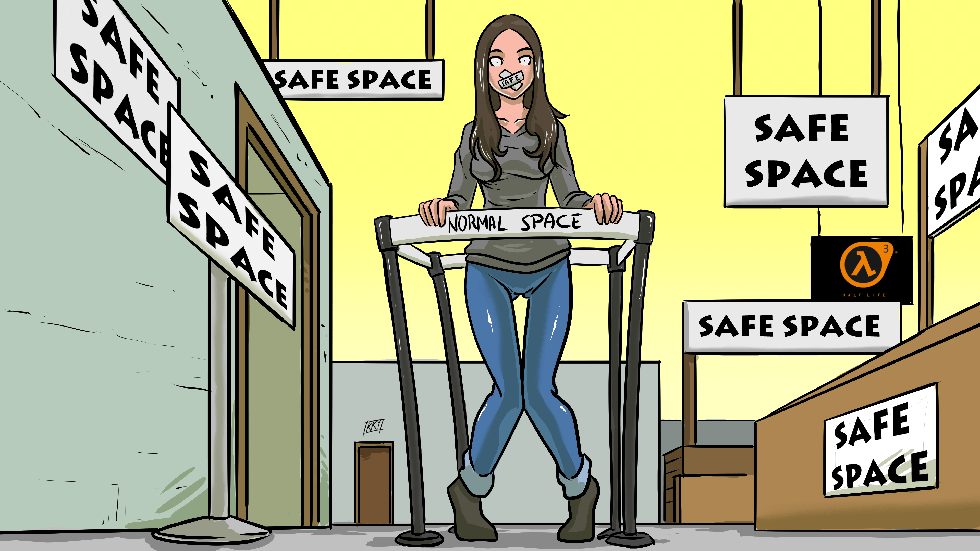
Safe spaces are a band-aid solution. As the definition states, all the people in the space have the same views and marginalized groups don’t face any stereotypes or otherwise discriminatory statements. In theory, anyway. They try to temporarily fix or relieve what is a deeply-rooted and complicated issue. By removing hateful language completely and stifling people who would otherwise say it, excluding them from the space, this just makes for more conflict and tension. Telling people they can’t say something, or that they need to leave if they do, doesn’t lead to anything positive or productive. It simply creates defensiveness. Technically, they can say it, according to free speech, and this approach doesn’t give any reason as to why what was said is hurtful.
Although it’s less likely today, some individuals just don’t know why their words are a poor choice. It’s certainly natural and understandable, though, that the person on the receiving end feels offended or upset, and ignorance on the offender’s part doesn’t mean the victim’s feelings are invalid. But instead of attacking back and telling them they don’t have the right to say it, why not challenge their view? Attempting to educate can go over much better than telling them to shut up or go away. Maybe they’ll gain a new perspective and consider their words more carefully next time. Of course, letting them in on why they should not say certain words or phrases in respect to a certain group does not always work. There are a lot of times when the person knows exactly what he or she is saying, and the intention is to ostracize and hurt the victim. Even in this case, however, safe spaces are still not the answer.
The world is not a perfect, loving place all the time. All of us have hardships we must face. That isn’t to say anyone’s struggle is less difficult or less valid than someone else’s, but that safe spaces try to force the environment into perfection. They are unrealistic and come from a great amount of idealism. They can often be used to avoid offensive or hurtful material, and this hurts both the victims, because they do not learn how to handle it, and the ones guilty of it because their views remain undisputed.
Safe spaces delay the inevitable of encountering hateful individuals. They may feel peaceful and necessary for those that face unfortunate marginalization, but the truth is that they cannot make the world a better place. Instead of turning away from discrimination and intolerance by relying on safe spaces to cope, we may find it much more helpful in the long run to align ourselves with people who make us feel supported and together challenge those who do not.