
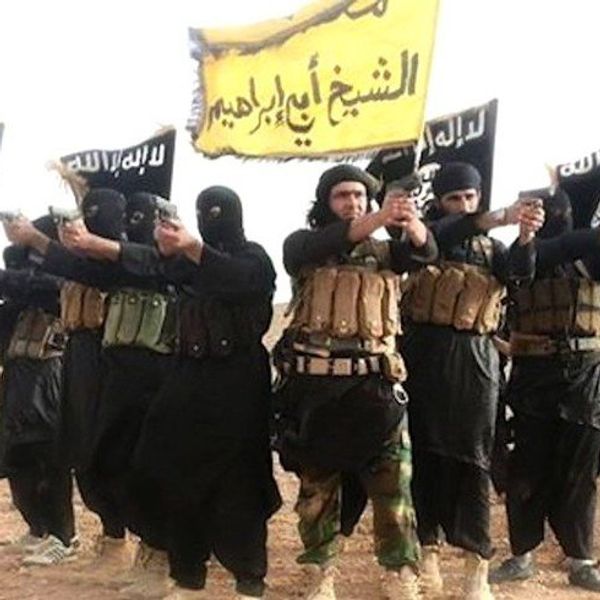
Ramadan has been a bloody month. All over the world, we have seen attacks by Islamists. In the final days of Ramadan, ISIS has been suspected of carrying out attacks in Iraq, Saudi Arabia, and Turkey with a bombing in Baghdad leaving almost 300 dead.
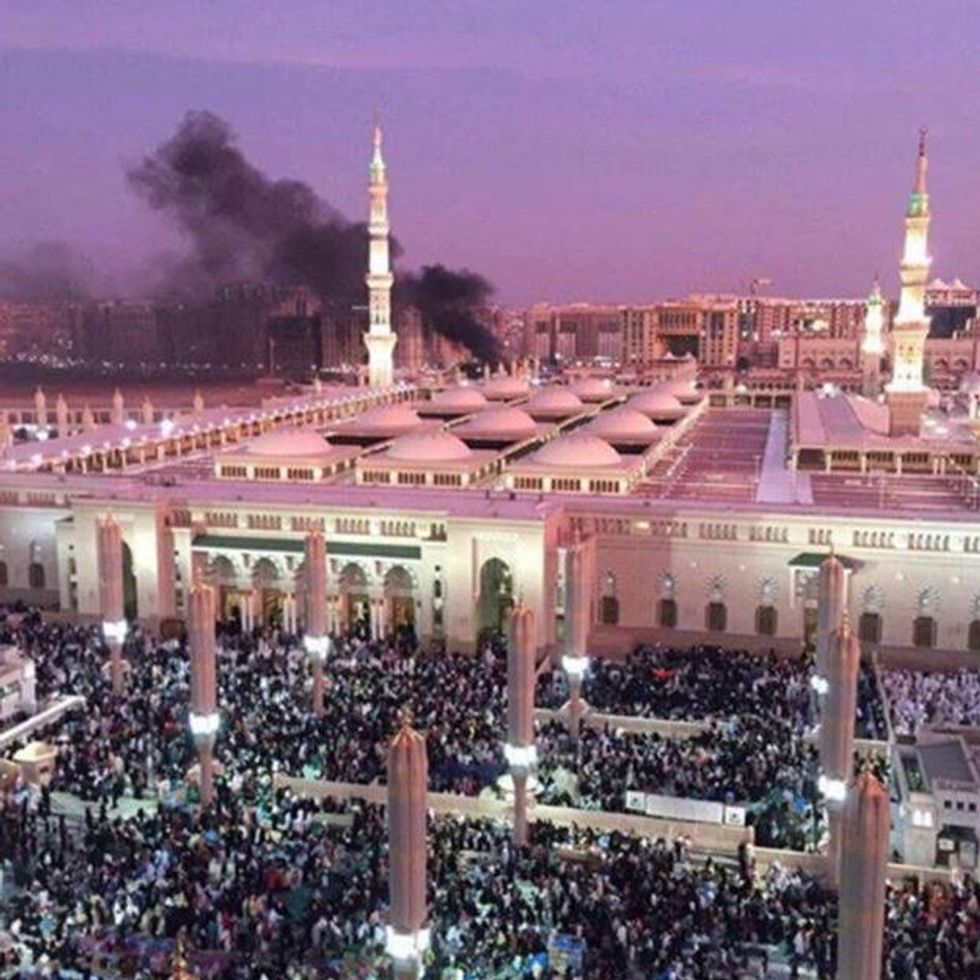
These attacks have been in primarily Muslim countries, with one suicide bomber attacking Al-Masjid an-Nabawi, the second holiest Mosque in Islam.
Because of this, many have used the attacks to push their usual agenda that ISIS has nothing to do with Islam, that they are just another "hate group." In response to the Saudi Attacks, the Egyptian Foreign Ministry said that the fact that the attacker would target one of Islam's holiest sites during the sacred month of Ramadan, in which the Qur'an states that fighting is forbidden, shows that terrorism "knows no religion or belief or any meaning of humanity". Many have taken to twitter expressing similar sentiments.
But an investigation into Islamism, the ideology of ISIS, as well as certain Qur'anic verses and mainstream hadiths, show that ISIS' recent actions only make sense in the context of a particular reading of Islam.
First, perhaps it would be pertinent to read the part of the Qur'an that deals with warfare during Ramadan. The passage is as follows:
"Fight in the way of Allah those who fight you but do not transgress. Indeed, Allah does not like transgressors. And kill them wherever you overtake them and expel them from wherever they have expelled you. And fitna is worse than killing....Fight them until there is no more fitna and until worship is [acknowledged to be] for Allah. But if they cease, then there is to be no aggression except against the oppressors. [Fighting in] the sacred month [Ramadan] is for [aggression committed in] the sacred month, and for [all] violations is legal retribution. Whoever has assaulted you, then assault him in the same way that he has assaulted you. And fear Allah and know that Allah is with those who fear Him" (Qur'an 2:190-194).
Notice how I kept the Arabic word "Fitna" as untranslated. That's because it's a tricky word to translate. Some English versions of the Qur'an translate it as "persecution," while others translate it as "subversion", or "civil strife". The Muslims refer to the First and Second Fitnas as Civil Wars early in Islam's history that lead to the current Sunni/Shiite divide.
Whatever the exact definition of "fitna," it is universally agreed that it isn't good for the Muslim community (the ummah). And it must be combated, even at the cost of killing.
To ISIS, as well as Islamists in general, the Islamic World is currently in a state of severe "fitna." The oppression Muslims are facing comes not only from the West, but from Muslim governments themselves, whose association with secular nationalism and the importation of Western culture has only served to further divide and oppress Muslims. This association with Western ideals is termed by Islamists as Jahiliyya, literally meaning "ignorance."
And when did this fitna begin, according to the Islamists? While all do not universally agree on a precise date, the most extreme Islamists believe that this period of humiliation began with the end of the Ottoman Empire in the 1920s. It was during this time that the Ottoman Sultan considered the caliph of all Sunni Muslims, was sent into exile, and any remnant of a unified Islamic society was swept away, replaced instead by the modern boundaries of the Middle East, mostly imposed by Europeans as a result of the Sykes-Picot agreement.
These Islamists wish to reestablish the caliphate and erase the national boundaries that have separated the ummah for decades. This is why Osama Bin Laden, in a video message recorded in 2001, alluded to the end of the Ottoman Empire the most humiliating event in Muslim history. It is why ISIS, when posting a video of them literally bulldozing the border between Iraq and Syria, entitled it, "The End of Sykes-Picot."
The man who abolished the caliphate was Mustafa Kemal Ataturk, a Turkish politician who abhorred the idea of the caliphate and wished for Turkey to become a Western secular democracy with a separation of mosque and state, going against everything the Islamists stand for.
And what was the name of the airport in Istanbul that was bombed?
Ataturk International Airport.
While many in the media speculated as to why ISIS chose such a target, it is reasonable to believe that an attack on an airport named after Ataturk symbolizes Islamist hatred for the man who wished to transform Turkey from the center of Sunni Islam to what many consider a model of secularization and Westernization in the Middle East.
Next, we get to the attack in Baghdad. The reasoning behind this attack was simple: ISIS, a Sunni Islamist group, believed that the Shiite Muslims of Iraq are guilty of Kafir (unbelief). In ISIS's mind, Shiites are apostates of Islam, who, in the view of numerous Muslim hadiths and Islamic scholars, are deserving of death (examples: Al-Bukhari 52:260, 84:57, 84:58)
Finally, we get to Saudi Arabia. At first, many were confused by these attacks. Doesn't Saudi Arabia subscribe to Wahhabism, a sect of Islam that is practically identical to the type of Islam that ISIS holds to? Why would ISIS wish to attack them?
Well, the first attack was in a Shiite village, which we have established earlier is considered Kafir by ISIS. The second attack was near an American consulate, which matches up with their hatred of the West. The third attack was at Al-Nabawi mosque.
Except it wasn't meant for the mosque. It was meant for the security headquarters outside the mosque. And that changes everything.
As stated before, ISIS (and Islamists in general), consider nationalism to be a form of paganism, and consider anyone who does not bow to their transnational caliphate as heretical and an enemy of God. They consider the Saudis' rule over the Holy Lands of Islam to be illegitimate. In ISIS's mind, they are not attacking the sacred sites of Islam, they are protecting them and wresting control away from oppressive governments. They view the wealthy and decadent lifestyle of the Saudi royal family the same way Muslims view the pagan Quraysh of pre-Islamic Mecca, wealthy merchants who cynically take advantage of religious pilgrimages for material gain.
The Qur'an states that wars of aggression and the harming of innocents are prohibited during Ramadan. But in the eyes of ISIS, none of their intended targets were innocent. Whether engaging in the Kafir of Shiite Islam, the Jahiliyyah of the Turkish government, or the fitna of the Saudi Royal Family, ISIS views their intended targets as not only guilty, but active aggressors against the restoration of the caliphate and the implementation of international sharia.
And this makes ISIS' intentions very Islamic indeed.