
I feel compelled to begin by making it known that I am not shocked about the outcome of the Stanford swimmer rape case. Appalled? Certainly. Disgusted? Yes. Ashamed? You bet. But am I shocked? Absolutely not.
On Thursday, June 2, 2016, a Palo Alto, California courtroom was rocked by the decision of Judge Aaron Persky in response to the crime committed by Brock Turner. Turner, 20, is a former Stanford University swimmer who was found guilty on three counts of sexual assault.
In January of 2015, his freshman year, he raped an unconscious woman behind a dumpster, leaving her with awful trauma. He attempted to flee the scene, but was thankfully captured by two older students who called the authorities and made a report. In March 2016, a jury convicted Turner with sexual penetration with a foreign object of an intoxicated person and sexual penetration with a foreign object of an unconscious person, as well as assault with the intent to commit rape. All three charges are felonies. The survivor, 23, who has understandably chosen to remain confidential, delivered a powerful account about how the assault has affected her life while highlighting rape culture. This statement was made the same day Judge Persky handed Turner his (laughable) sentence of just six months in jail with probation, along with the requirement to register as a sex offender.
To quote Persky: “A prison sentence would have a severe impact on him.” How nice of Judge Persky to fear for poor, innocent Brock. Why do I say innocent? The fact of the matter is that no, Turner did not just walk, yet the sentence he received assures minimal punishment. I wish to inquire this: What about the severe impact of the sexual assault on the victim; is her life not forever changed? Was it not enough that she suffered at the hands of her abuser, but has to undergo more because of our so called “justice” system?
Apparently, none of that matters to Persky, who claimed “I think he will not be a danger to others.” Let me get this straight—we are talking about a man who violently assaulted someone right? She suffered terrible trauma, both physically and psychologically, yet he is not deemed a threat?
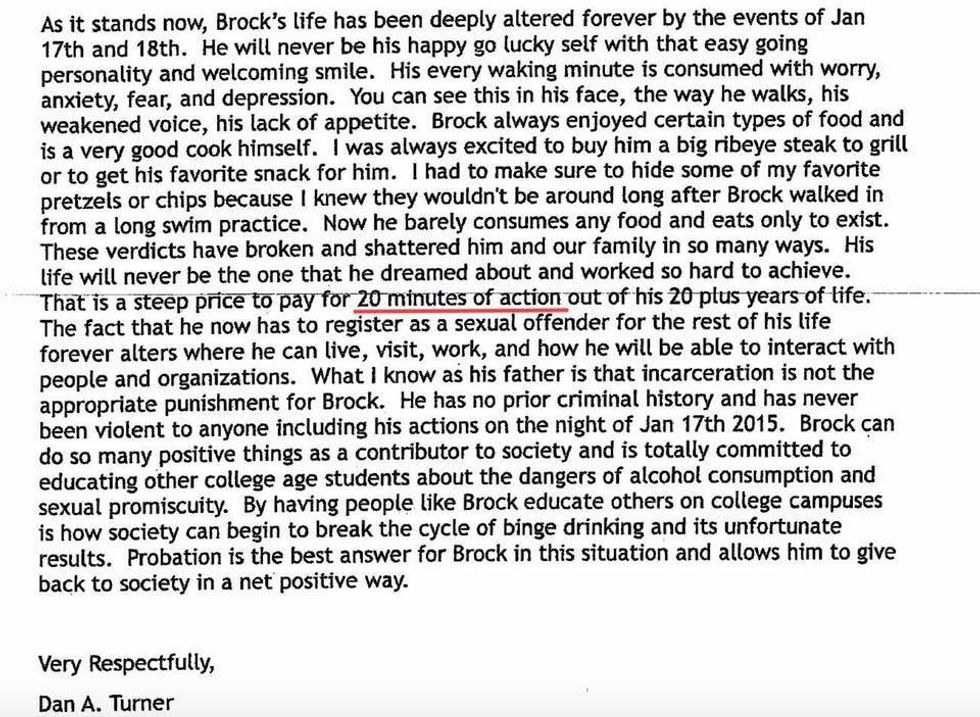
Brock’s father, Dan Turner, seems to share that belief. He is more distraught over the fact that his son no longer has the appetite for a steak than knowing Brock is a rapist. He even referred to the rape his son committed as “20 minutes of action." Like father, like son:
Statistics show that one in five women and one in 16 men experience sexual assault in college, yet the majority of victims don’t report it. This could be due to a variety of reasons, including fear, shame and our culture of victim blaming—just to name a few. Now, in the case of campus sexual assaults carried out by college athletes, the statistic is one-third, a number that is significantly greater than their fellow students.
Most athletes who commit sexual assault are the players who assert their power and dominance through vigorous athletics. The driving forces behind rape are power and violence, which explains why these players are more likely to commit acts of sexual assault. The issue of entitlement also comes into play. As aforementioned, the climate of honor and permissiveness constructed for college athletes promotes pompous attitudes, bestowing the feeling of entitlement. This unique mix of circumstances is, quite frankly, dangerous for student athletes who abuse their power. “The Hunting Ground” is a superb documentary about sexual assault on college campuses, and it can be found on Netflix. While it does not primarily focus on sexual assaults committed by college athletes, it offers a paramount perspective on the topic.
Brock Turner is a rapist. No amount of swimming titles or achievements can erase that. As the media continues to portray a fallen hero, we must not be fooled into having sympathy for him. Integrity is based on our ability to live ethically in our solo moments; when we are alone with our actions.
For Turner, that meant he was allowed to rape a woman behind a dumpster while she was unconscious. His status as an athlete should have no bearing in the case of sexual assault, yet it has. It has deprived a human being of the justice she deserves. It has prevented a criminal from receiving a suitable punishment for his crimes. This is just one of the many similar cases of sexual assault committed by college athletes, but we cannot sweep this one under the rug. This should be the point where we finally campaign for justice, for all those we continue to silence.