

A film only needs three simple components to pass the Bechdel Test. Two women, who are both named, have a conversation with each other about something other than men. Sounds pretty straightforward, right? Surprisingly, I'll bet you've seen quite a few movies that don't pass the test.
So, what is the Bechdel Test? Cartoonist Alice Bechdel, the test's namesake, outlined the requirements in her 1985 strip titled "The Rule." Since then, the test has been used as a rule of thumb to determine how well women are represented in popular films.
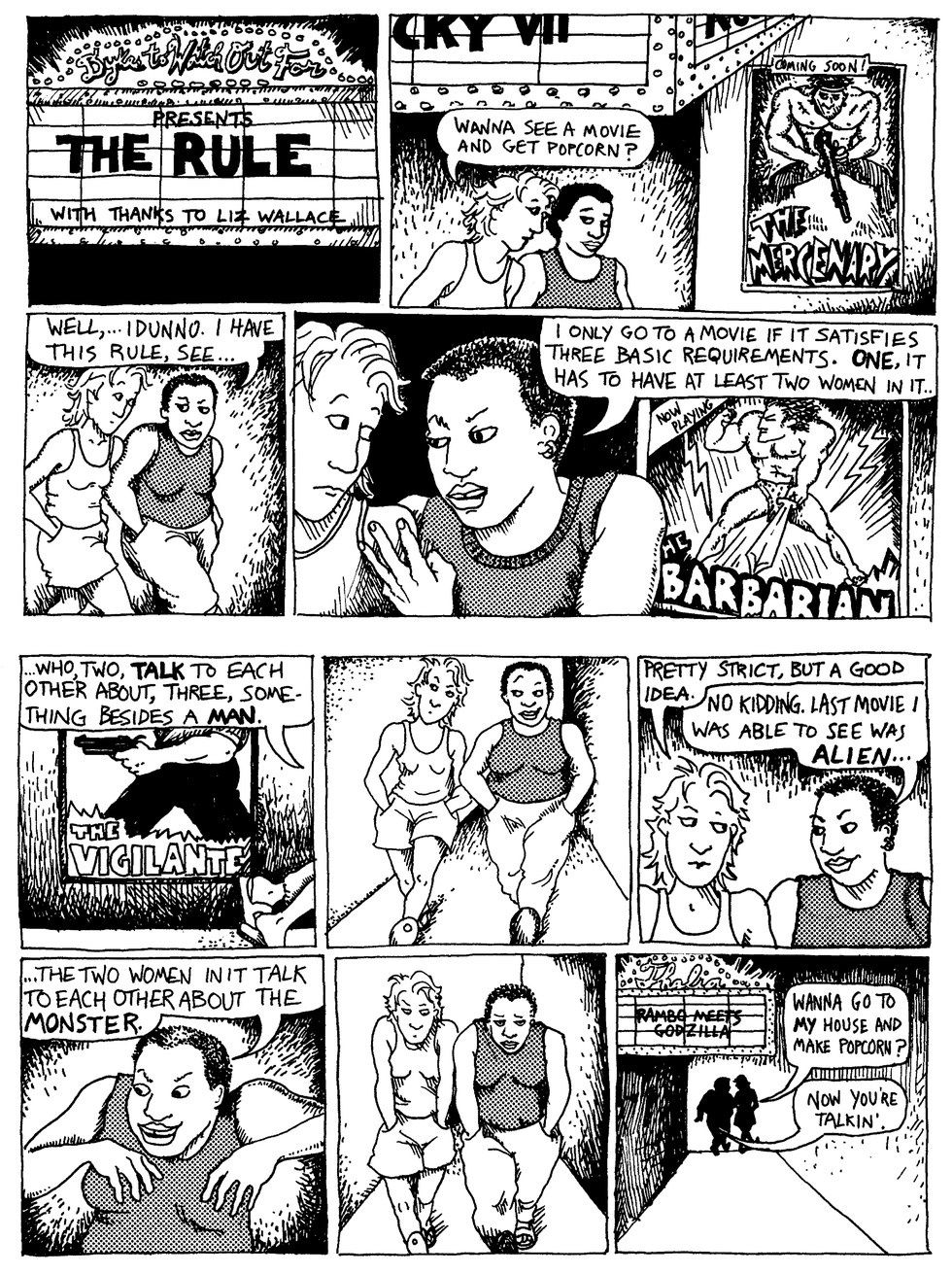
The test is deceivingly difficult as many movies feature women who haven't been named and have conversations with men but not fellow women. And then there is the little snafu of the topic of conversation. Once you stop to think about it, a lot of the conversing between women in films has to do with the male stars.
Now, it is important to note most movies nowadays do pass the test. "Mad Max: Fury Road" passes with flying colors and "Magic Mike XXL" squeaks by, too. Tarantino's newest film "The Hateful Eight" passes, along with "Fifty Shades of Grey" and the "Minions" movie. The bechdeltest.com continues the list of the passing films, and in recent years, they far outweigh the failures.
But passing still isn't so simple. You might be surprised to learn only half of the Oscar-nominated films of 2016 passed the test, as the Wall Street Journal's Lucy Feldman discovered. "The Big Short," "Bridge of Spies," "The Martian" and "The Revenant" don't meet the requirements, and "Spotlight" only passes by a hair. The Coen brother's newest film, "Hail, Ceasar!" fails, as well. Some famous, recent action movies don't pull through either, such as "Ant-Man," "Fantastic Four" and "Mission Impossible - Rouge Nation." John Green's movie adaption of "Paper Towns" doesn't make the cut, either, along with both "21 Jump Street" and the sequel, "22 Jump Street."
But so what, right? How does this test really prove a movie has or has not represented females well enough? Well firstly, it's just a rule of thumb. That being said, it does make some solid points. Often, women in films are featured only to complement the men and are, therefore, not rewarded with names or storylines of their own. Their conversations revolve around the male main characters and are often not accompanied by other women.
Nevertheless, the test has its flaws. Many critics have spoken out against the test, and it is, admittedly, not universal. And for a test that seems so simple, we've all enjoyed films that fail it. However, the test illuminates the matter of representation in mainstream films and raises questions about women specifically. Representation is a tricky and complex issue; the Bechdel test simplifies it in a way where most people can understand and identify with. It is easy, and it is memorable, and in a world where women make up half of the population, it's not going anywhere.

















