In 2012, a band by the name of Bon Iver walked onto the stage at the Grammys to accept the award for Best New Artist. I remember watching with my sister and asking, “Who the heck is Bon ‘eye-ver’?” She responded, with just the right condescending tone, “Its pronounced Bon ‘eee-v-air’. He sings that song ‘Skinny Love’.”
Since that day, I have developed an aggressive obsession with the indie-folk band. Right up there next to Justin Timberlake and Coldplay, Bon Iver has quickly developed into one of my favorite and most reliable bands to listen to, always having just the right sound at just the right time.
Using the band’s name as a pseudonym for his own, mastermind Justin Vernon has delivered two of the best folk albums in recent memory in just the last few years. For Emma, Forever Ago was the record that launched him into super-stardom, and the following album Bon Iver, Bon Iver secured his place among the most loved indie artists of our generation. He then put the band on hold as he pursued a multitude of side projects.
Since 2012, fans have been waiting patiently for Vernon to return to the sound that made him immortal. And so we have 22, A MILLION, the band’s third full-length record which was released September 30th, 2016. This is one of the most anticipated albums of the year, if not the most, but does it live up to the hype?
The first song on the album, “22 (OVER SooN)”, was one of the first singles released, and is one of the best tracks on the album. It is haunting with a simple yet vast soundscape. It's very reminiscent of his early work, offering Vernon’s trademark falsetto dancing over spare electronic sounds. “10 deathbreast” follows, and this is where the sound of the record starts to take a drastic shift. The vocals are highly auto-tuned across distorted drums, paired with bright electronic sounds. It's a short song, but packs a punch.
“715 - CREEKS” is next, and is one of my favorite songs on the record. Vernon opens with spare, auto-tuned vocals and adds practically no instrumentation for the entire song. Its most powerful moment comes when Vernon’s vocals shatter the record towards the end of the song, as he sings, “Love, a second glance it is not something that we'll need / Honey, understand that I have been left here in the reeds, But all I'm trying to do is get my feet out from the crease”. Another one of the previously released singles, “33 “GOD”’, follows, transforming from a bare-bones piano ballad into a full fledged folk-tronic jam.
The end of Side A comes with “29 #Strafford APTS”, and it's one of the albums strangest moments. Distorted vocals float across an acoustic guitar, before employing some electronic ‘twangs’ and even more vocal distortion. It's a good track, but it's not an easy one to love.
So now we must flip the record over to Side B - and here is where things start to get weird. The first 5 songs all felt like potential singles; like a normal album typically would. But the second half of the album is a trip through Vernon’s mind. Get ready.
“666” is a spare track that quickly evolves into another folk-tronic showing. Again, this isn’t a bad track, but it's difficult to love - and even more difficult to interpret. This bleeds perfectly into “21 MOON WATER”, which begins as an ambient trip through your own memories. Talking about what lies ahead and what lies behind, Vernon forces you to look inside of yourself. The track goes crazy about halfway through, turning into a mess of random sounds and horns. You may think your record player is broken, but what you hear is intentional, and it is beautiful.
This then spins right into “8 (circle)” which feels much like a continuation of the previous sound. The ambient sounds remain, but with a more coherent horn section. It feels a lot like “Holocene” at times, evoking even more emotion than I thought was possible. A change of direction comes with “___45___” as Vernon offers flat, almost moaning vocals over electronic horns and piano. It quickly becomes a cacophony of bright sounds until his vocals return - now harmonized - singing, “I been caught in a fire, I stayed down the other night / I been caught in fire, I stayed down”. Towards the end, what sounds like a banjo enters the scene, pulling you deep, deep into the forest of Bon Iver’s mind and soul.
Finally, we get “00000 Million”, a highly personal track that echoes beautifully over a simple piano. He sings about his life thus far, and where fame has brought him, "Must've been forces, that took me on them wild courses / Who knows how many poses, that I've been in". Finally, as the album draws to an end, and as he comes face-to-face with his own demons, Vernon vanishes hauntingly from the record, almost whispering when admitting, “When the days have no numbers / Well it harms, it harms me, it harms, I'll let it in”.
Alright - so that was a lot to digest. And when you listen to the album, you’ll understand why. It is strange and entirely different than his typical sound, combined with ridiculously avant-garde lyrics and sometimes indistinguishable vocals. It is a highly polarizing album; some people will love it, and some will hate it. Personally, I fall into the former.
A YouTuber by the name of The Needle Drop reviewed the album and criticized the odd sound, mishmash of vocals and instruments, and gave the album a weak 5/10 rating. I respected his argument - especially when it comes to the song titles. But another YouTuber, known as The Nerd Writer - someone who analyzes pop culture, film, and music - turned his sights to Bon Iver for a particularly interesting video. He points out that what Vernon does best is evoke memories in his listeners, and in turn, these memories become a mood.
That is a good explanation for 22, A MILLION. A lot of the sounds on the record are hard to get used to, and the album will almost certainly make you feel uncomfortable at times. But what the tracks may lack in audible clarity, they make up for in sheer emotion. And yes, a lot of his lyrics are wild and a bit of a stretch, which some might say is an excuse for songwriting. But I see the departure from the norm as a step in Bon Iver’s career and sound; I don’t want him to lose the iconic folk sound forever, but I certainly appreciate his experimentation on this album.
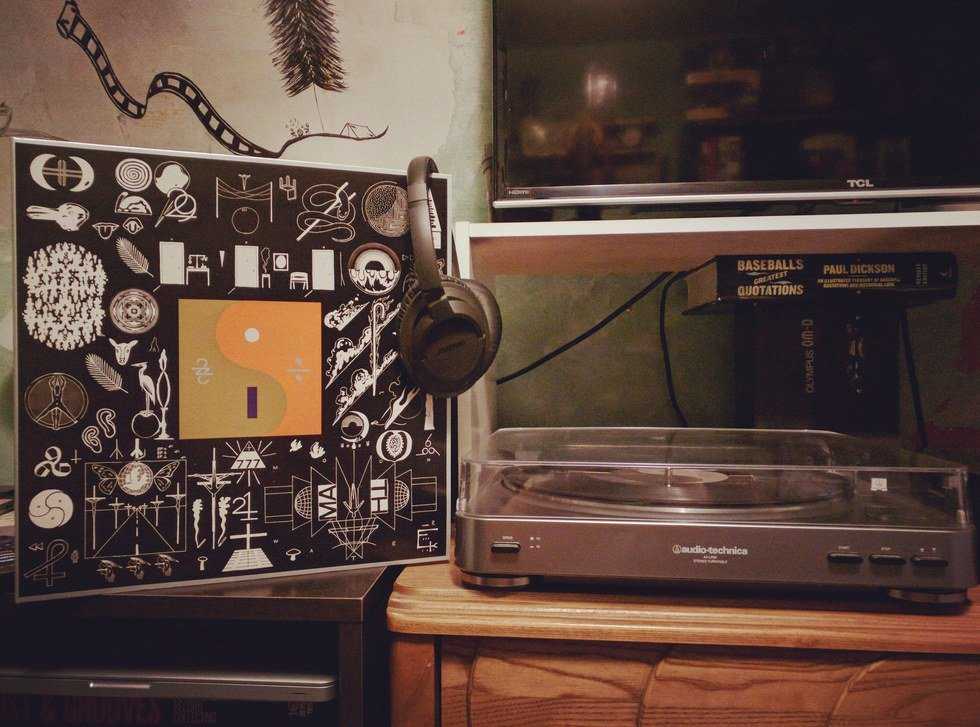
I first heard this record fully-through on vinyl, and after listening on Spotify as well, I recommend the physical edition. It's a short album, but is jam-packed with sound and energy. The first half of the album sounds great on vinyl, but when you flip it to Side B is where the analog medium really shines. The last 5 songs bleed together, with their mix of sounds and vocals, taking you on a journey through Vernon’s imagination and creation. It is 25 minutes of uninterrupted bliss.
This is a highly interpretive album, and it certainly will not please everyone. But if you are a fan of Bon Iver and are ready to not only expand your musical tastes but also your mind, you simply cannot pass this album up, and I place it somewhere between his first two records. I’ll be listening to this record for a very long time; I’ll be analyzing it even longer. And that is the beauty of Bon Iver’s music - it stays with you, it lingers. Much like a memory of your first love or your first heartbreak, these are the songs that simply stain your soul, floating back into your conscience with just the right sound at just the right time.